|
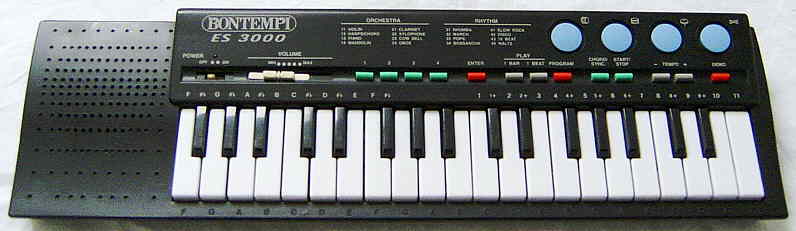
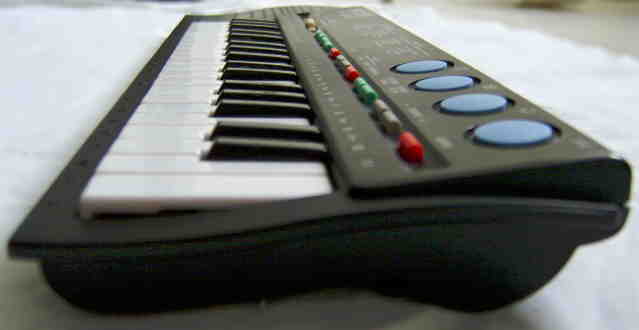
digital squarewave keyboard with drumpads & cheesy accompaniment |
 |
 |
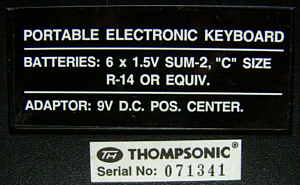
This instrument was also released as MC-2100 (by Medeli?) and Thompsonic TS-21 (seen on eBay).
(Note: This keyboard may sound nice, but don't buy one of these so far your only intention is to get a keyboard with faithfully imitated natural instrument sounds. Remember, this is a squarewave instrument and though many of its sounds sound not even remotely like what is written on its buttons, though bought with wrong expectation it may disappoint you.)
Due to strong similarities with Elite MC2200 I only describe here the difference.
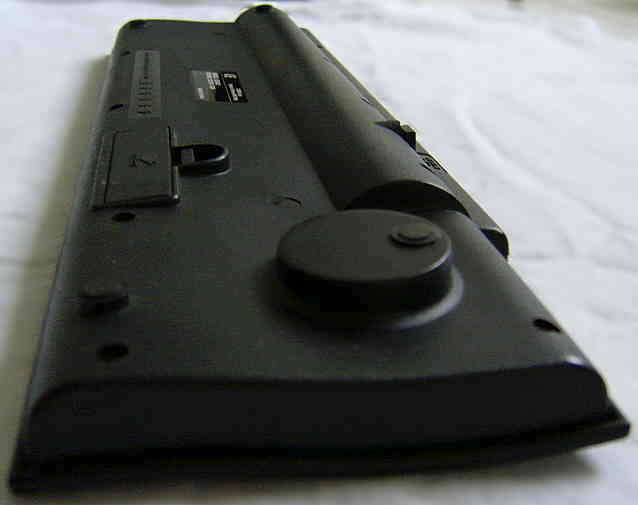 |
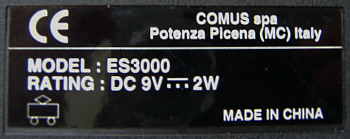 |
2 higher note keys addable.
Unlike MC2200, all main voice preset sounds work properly and don't refuse polyphonic play - even the fast play polyphony flaw is gone here because this keyboard does not mute the earliest note but ignores later notes when more than 2 keys are pressed. But long decay envelopes sound much shorter (1s instead of 2.5s e.g. in 'cowbell' or held 'piano' notes) due to changed components in the analogue RC circuit; short envelopes are not affected but even seem to be here a tiny bit longer.
The monophonic rhythms make no use of the 'cymbal' sound and thus consist (like with the MC2200) of only 3 low- res percussion samples with audible start and end click, which gives them a fat trashy timbre and is well suited to synchronize brain waves for meditative musics. The cymbal can be only played by its drumpad. Unlike MC2200 there is a real rhythm "start/stop" button, so it can start them without beginning in accompaniment mode.
The chord sequencer is a bit awkward to use and was hard to figure out without a manual. To program it, select the desired rhythm and press "program", which begins the synchro start mode of the single finger accompaniment ("power" LED flashes => rhythm starts after any accompaniment section key press). Now repeat in a loop until all chords are entered:
The demo "Brother John" is arranged exactly like that song of MC2200,
but plays a little bit (less than 1 tempo step) slower.
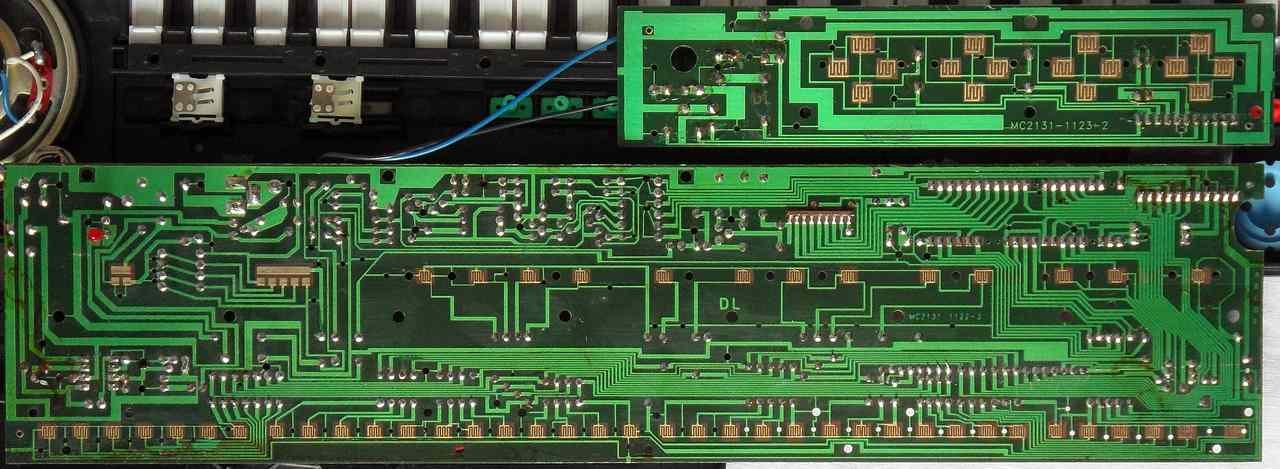
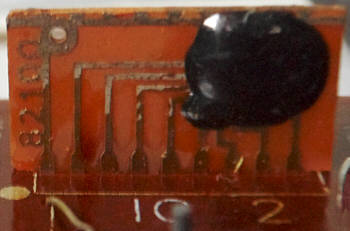
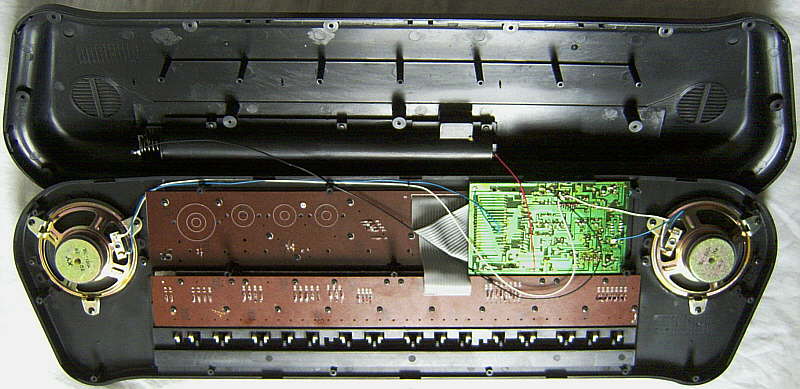
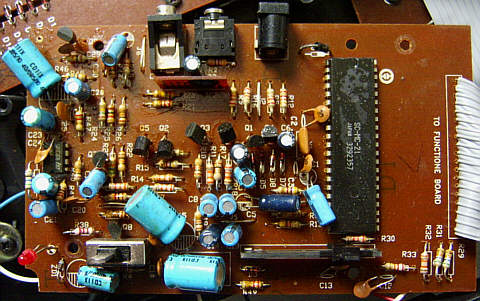
circuit bending detailsThe Bontempi ES 3000 is based on the single-chip CPU "SC-MC-21", which controls the percussion IC "82100".
The hardware is very similar like Elite MC2200 (CPU "SC-MC-22") and mainly differs in the CPU software. So the envelope control is fully identical (see here), except that in SC-MC-21 hi octave preset sounds don't turn monophonic. The reason for the shorter decay are different components in the analogue RC network that controls the VCA. improve volume control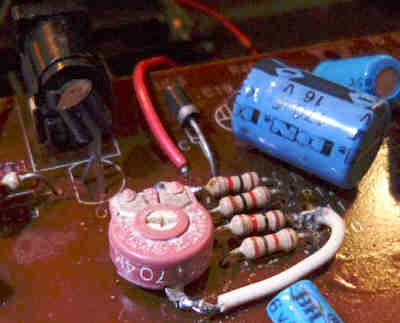 The
volume control slide switch simulates a potentiometer by a chain of 4 resistors
(each 1k, located near the power supply jack). Unfortunately their values
are a poor choice, so it yells terribly loud. To turn it down, connect
a trimmer (I used 10k) from the right end of R11 (2nd resistor) to GND
(e.g. left pin of upper resistor) and adjust it until the lowest volume
setting is pleasant to use. (You may instead replace it with a real potentiometer
if you like.) The
volume control slide switch simulates a potentiometer by a chain of 4 resistors
(each 1k, located near the power supply jack). Unfortunately their values
are a poor choice, so it yells terribly loud. To turn it down, connect
a trimmer (I used 10k) from the right end of R11 (2nd resistor) to GND
(e.g. left pin of upper resistor) and adjust it until the lowest volume
setting is pleasant to use. (You may instead replace it with a real potentiometer
if you like.)
remove amp distortion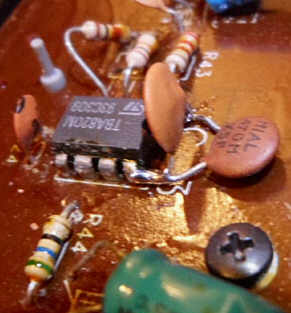 My
ES 3000 sounded very harsh and scratchy; particularly at low volume envelopes
got crunchy and percussion way too thin and hissy. An oscilloscope revealed
that the feeble power amp IC (a tiny TBA820M) was oscillating, sending
much HF dirt to the speaker. To fix this, simply wire a capacitor from
its pin 1 to pin 8. I found a ceramic 390pF parallel with 470pF sounding
best, but a anything about 1nF should work. Bigger capacitors seem to worsen
the timbre again; apparently it has to be tuned to cancel the oscillation
wave exactly to not affect the sound. My
ES 3000 sounded very harsh and scratchy; particularly at low volume envelopes
got crunchy and percussion way too thin and hissy. An oscilloscope revealed
that the feeble power amp IC (a tiny TBA820M) was oscillating, sending
much HF dirt to the speaker. To fix this, simply wire a capacitor from
its pin 1 to pin 8. I found a ceramic 390pF parallel with 470pF sounding
best, but a anything about 1nF should work. Bigger capacitors seem to worsen
the timbre again; apparently it has to be tuned to cancel the oscillation
wave exactly to not affect the sound.
keyboard matrixCompared with Elite MC2200 (CPU "SC-MC-22"), the keyboard matrix for this shorter keyboard has a row less. The benefit of this may be that the absence of 7 highest note keys or the omitted keyboard matrix out pin 35 has freed enough computing time to play also hi octave preset sounds duophonic. Interesting is that all keys with same notes are in the same places like in SC-MC-22. Like SC-MC-2, the keyboard matrix inputs need unusually low resistance (below 1k) to respond.
The input lines are active-low, i.e. react on GND. Any functions can
be triggered by a non- locking switch in series to a diode from one "in"
to one "out" pin.
Place 33->34 does nothing (no button click) but blocks the panel buttons. Places 28->34, 29->34, 30->38 do nothing at all (no fixed diode). So the only eastereggs are 2 higher note keys. |
Regarding the CPU type label, also a instrument named "MC-21" may exist,
which appears to be the genuine name of this hardware class. A very similar
but more versatile 49 midsize keys instrument (with many rhythms and demo
melodies) was released as Elite MC2200;
unfortunately it suffers of annoying polyphony bugs.
A keyboard with case like ES 3000 but
very different hardware was released as Thompsonic TS-123,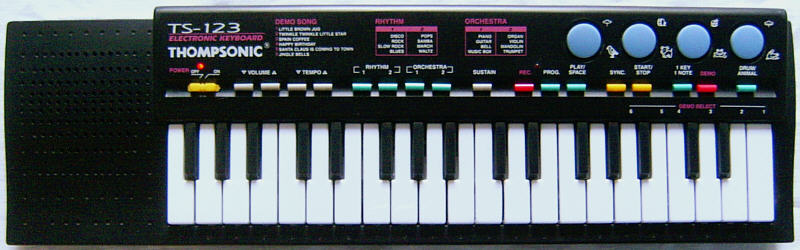 which is basically a My Music Center
variant with changed controls (8 preset sounds & rhythms cycled through
by each 2 buttons, 6 demos, sustain button, volume +/- buttons, record
& playback sequencer, drumpads switchable to animal voices). It was
also shown as MC-23 on the Medeli
website of 2001.
which is basically a My Music Center
variant with changed controls (8 preset sounds & rhythms cycled through
by each 2 buttons, 6 demos, sustain button, volume +/- buttons, record
& playback sequencer, drumpads switchable to animal voices). It was
also shown as MC-23 on the Medeli
website of 2001. |
 |
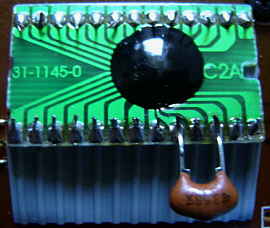 The
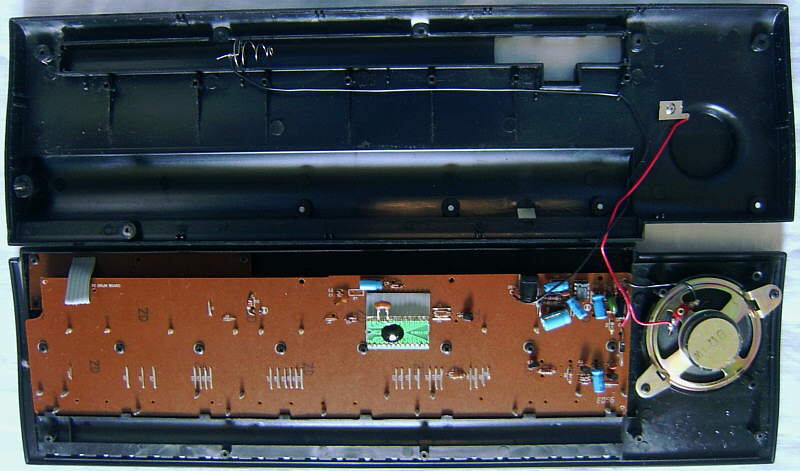
Thompsonic TS-123 CPU is "31-1145-0, C2A" (26 pin DIL-shaped COB). The
Thompsonic TS-123 CPU is "31-1145-0, C2A" (26 pin DIL-shaped COB). |
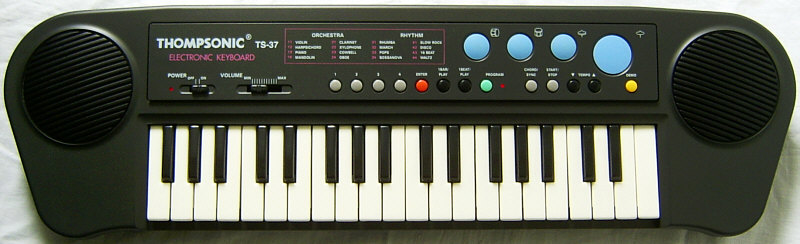
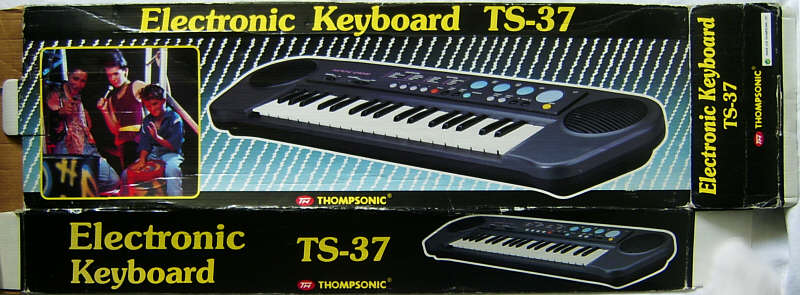
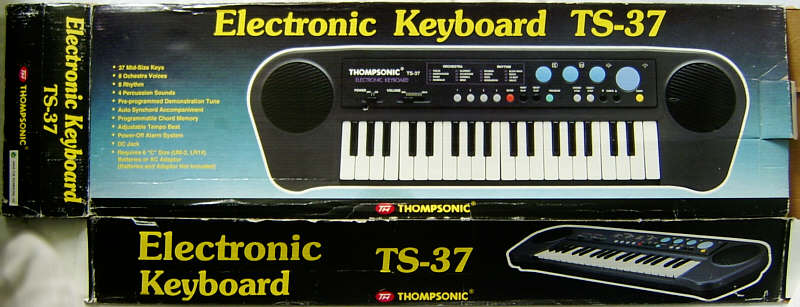
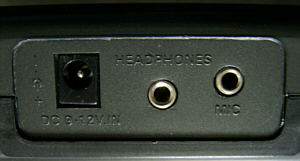
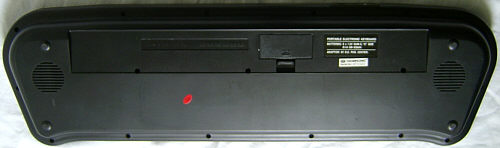
Through its 2 bigger internal speakers the percussion samples sound quite fat and end with a strange bassy pop noise. Unlike ES 3000 it has an additional headphone and microphone jack.
 |
 |
 |
 |
 |
 |
 |
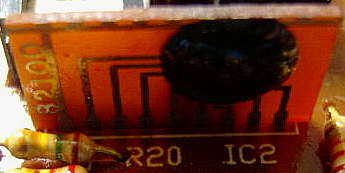 Percussion samples are on a separate COB IC.
 |
| removal of these screws voids warranty... | ||
 |
 |
|
|
|