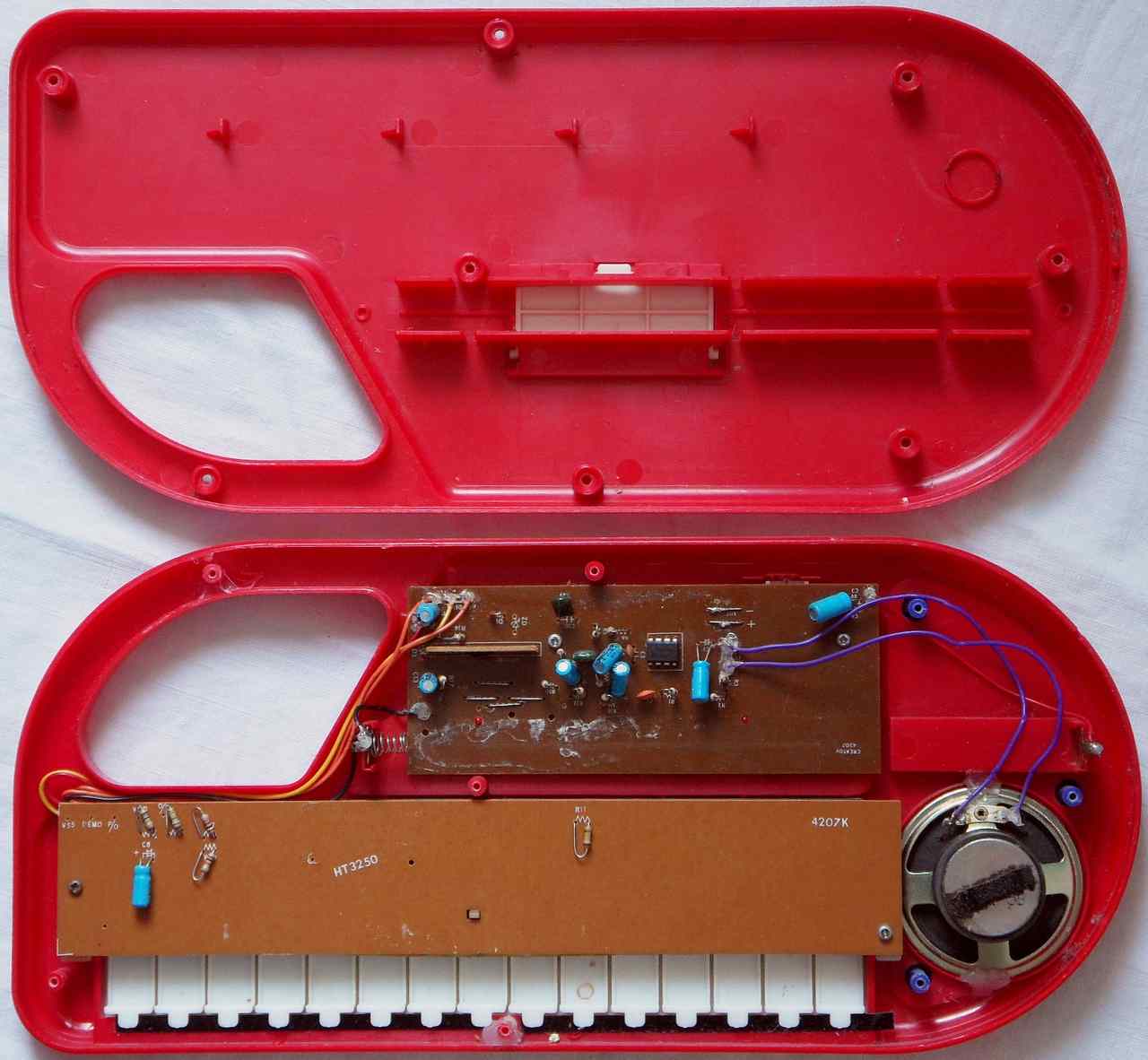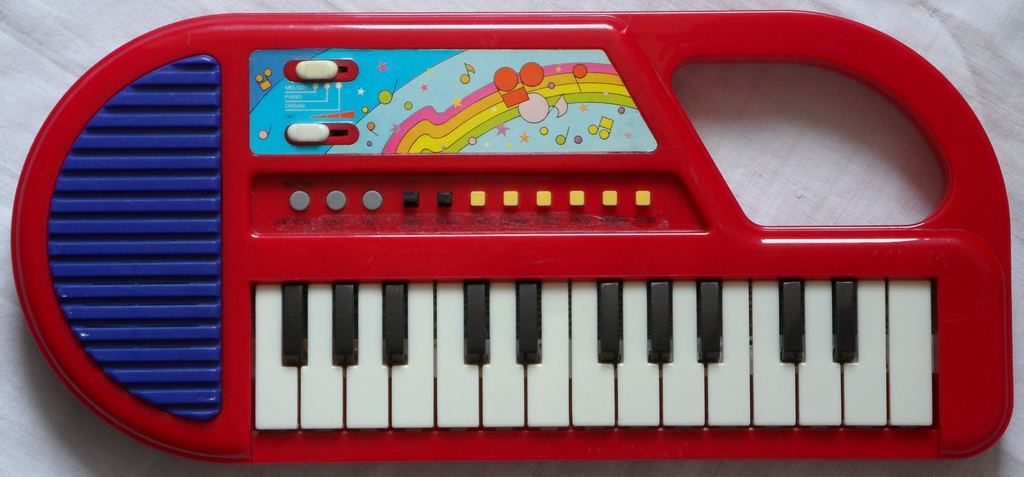
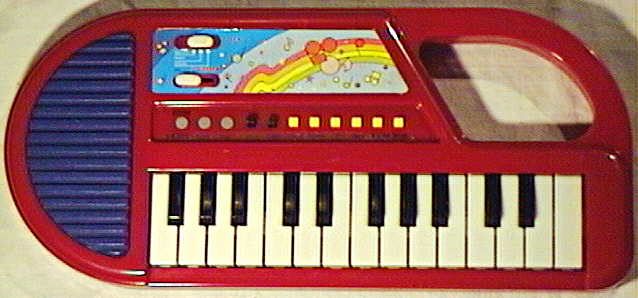
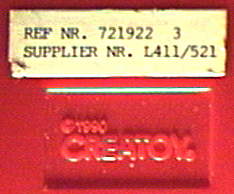
This red toy keyboard from 1990 (embossed case date) has a handle and blue, semicircular speaker, but there is no name on it. It plays 8 fantastic, grainy POKEY-style rhythms. Main voice is plain squarewave, but well playable.
In Germany it was also released as GoodPlay - Melodie-Orgel (seen on eBay).
 |
 |
 |
Most interesting is that with empty batteries at full volume rhythm and main voice start to distort and modulate each other. Particularly in 'piano' mode the envelope capacitor produces a strange tekkno growl.
The rhythms are made from only 2 blip percussion sounds. The 'boom'
(sort of conga) is a distorted analogue squarewave (sounds like the heartbeat
signal in the medical unit of the first "Star Trek" TV series),
while the 'cha' (sort of snare?) is made from shift register feedback noise
and goes "deng!" like banging on a metal spring or piece of sheet metal.
Both are impulsive and have their own nicely unique style. This may be
a predecessor of the
Hing Hon EK-001
percussion engine.
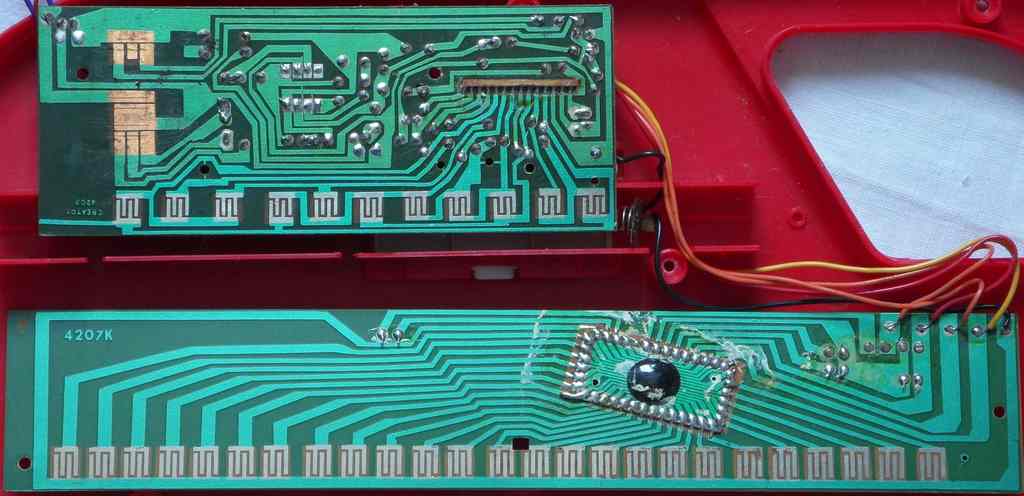
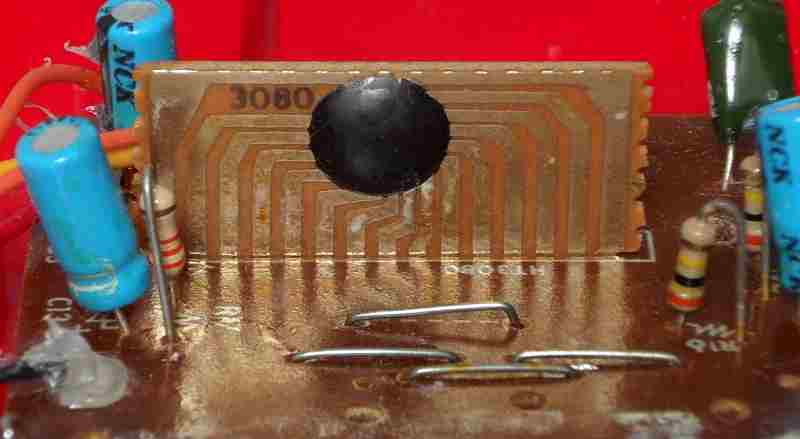
hardware detailsThe Creatoy 4207 keyboard is build around the main voice CPU HT3250 (unlabelled 40 pin COB) and rhythm CPU "3080" (15 pin COB, HT3080), those do not communicate with each other. Downloaded datasheets reveal that both were made by Holtek.
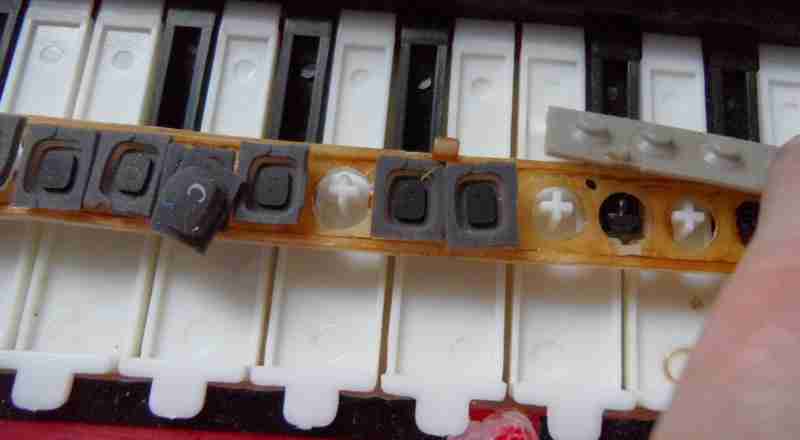
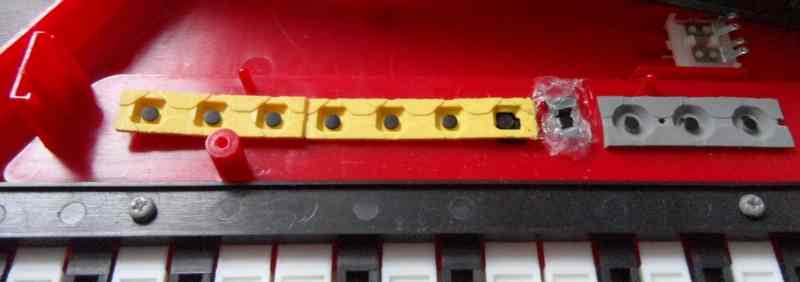
When I found the instrument on a flea market, 2 rhythm buttons of silicone were torn off and some silicone contacts of the keyboard didn't conduct anymore. Though I bought for about 2 EUR a "pocket databank" calculator with many silicone rubber keys to transplant the contacts from its mat to the defective keyboard. =>It is now playable again.
rhythm keyboard matrixThis keyboard matrix of the rhythm CPU is based on the "Holtek HT3080"datasheet example schematics.
The input lines are active-low, i.e. react on GND. Any functions can be triggered by a non- locking switch in series to a diode from one "in" to one "out" pin. important: Because pinouts differ among IC variants, I also have marked the keyboard matrix pins by their "C" ("columns" = out pins) and "R" ("rows" = in pins) numbers. These are IC pin names, not capacitors and resistors! pinout HT3080, HT3081, 3080The CMOS LSI "Holtek HT3080" (24 pin DIL or COB with 23 die pads) is a rhythm generator with unique sounding blip percussion that was used in toy keyboards like Creatoy 4207. The "HT3081" is a variant with different rhythm set.It contains 8 preset rhythms with 16 step tempo control. The rhythms are made from only 2 blip percussion sounds with capacitor envelope. The 'boom' is a plain squarewave drum, and 'cha' is made from shift register feedback noise (sounds "deng!"). Both can sound simultaneously. Rhythm patterns have 12 or 16 steps. The keyboard matrix has 4 outputs and 3 inputs. Additionally the chip supports a 3*3 led matrix out for light effects (each led from a 'C' to an 'R' pin with optional serial resistor), those likely can be used for other things. This pinout is based on the datasheet of Holtek HT3080/HT3081 "8 Demo Rhythm Generator" of 1996-06-25. caution: The pinout of the COB module "3080" (15 pins) in the
actual Creatoy keyboard differs and was rather concluded by me from
photos than actually measured (since it has no unused pins), so it may
be wrong.
The rhythm set of HT3080 is {march, beguine, swing, 4-beat, disco, tango, waltz, rhumba}; that of HT3081 is {march, rock, rhumba, swing, tango, 16-beat, ballad, waltz}. pinout HT3250, HT3250BThe CMOS LSI "Holtek HT3250" (40 pin DIL or COB) is a simple monophonic squarewave toy keyboard CPU with 15 demos. The "HT3250B" is a variant with vibrato and step play.It supports only 25 keys and 2 preset sounds {piano, organ} (selected by locking switch) made from plain squarewave with capacitor envelope. By lack of a keyboard matrix it permits nicely fast play and supports independent attack and decay control and so is not as useless as it looks like. This pinout (with component values) is based on the datasheet of Holtek
HT3250 "25 Key Piano/Organ with 15 Melodies" of 1996-06-28. The Creatoy
keyboard COB has its 40 pins in the same order.
|
In "melody" mode the white keys start each a short monophonic demo in 'piano' sound without rhythm. Because the rhythm CPU does not communicate with the main CPU, rhythm can be manually started, but will run out of sync and ignore what the demos do. I identified them through the Holtek HT3250 datasheet.
The demos are:
| removal of these screws voids warranty... | ||
 |
 |
|
|
|