| Elta KE-3 | analogue squarewave keyboard with accompaniment but no rhythm |
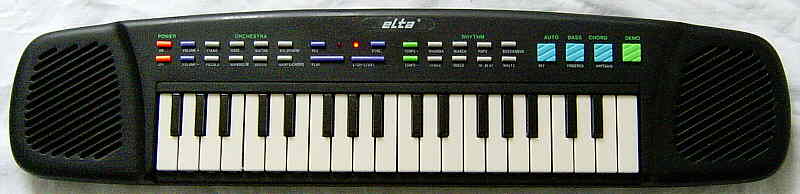
This small beginners/ toy keyboard is something really bizarre, because it has 8 nice accompaniments with even arpeggio, but no rhythm(!). Its warm squarewave sound and technology resemble very much the Angeltone DM-380/ Fujitone 3-A. (see there) although it has less features. It has also 8 nice demo melodies. Unfortunately at least in unmodified state a keyboard matrix flaw prevents to play certain notes simultaneously despite it is 2 note polyphonic, and volume is too loud and can not be set reasonable low.
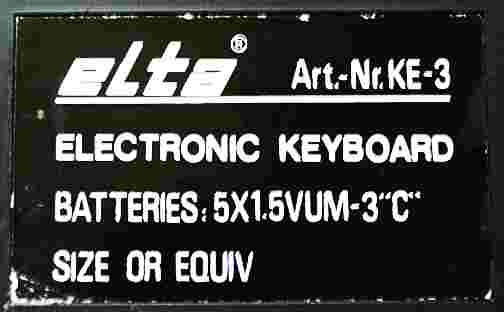
On the box is still a tag showing that the German initial retail price was 89DM (about 40€), and the keyboard picture on the box has a crossed out brand label "ANGELTONE", which apparently was the genuine manufacturer of this small tablehooter. It was also released as Fujiyama 230 (by "Japan Design"?, seen on eBay).
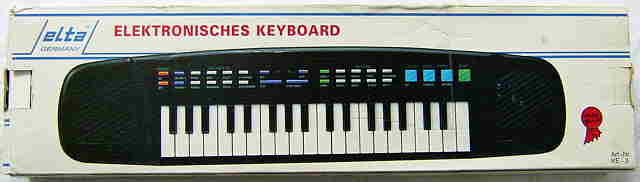 |

crossed-out Angeltone logo on the box photo |
missing keyboard matrix diodes added.
Generally the Elta KE-3 sounds much like the Angeltone
DM-380/ Fujitone 3-A;
the only main differences are the digital volume and power buttons (with
auto power- off), the 64 step resolution tempo control (most steps are
in the slow range) and the simple sequencer (monophonic record/ playback
with fixed key accompaniment, no edit). It also features many nice sounding
squarewave demo melodies, those play in an endless sequence but the start
melody can be selected by pressing its corresponding piano key together
with the "demo" button.
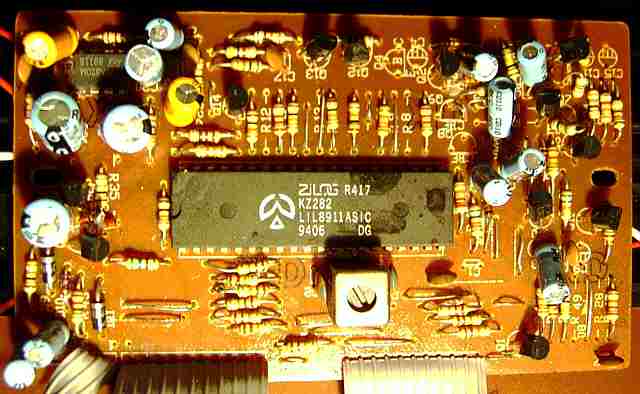
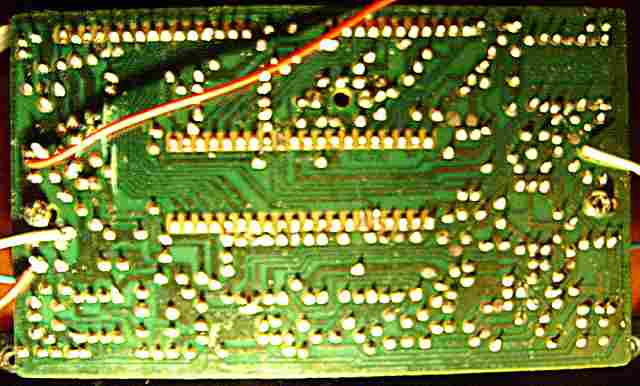
circuit bending detailsThe hardware of the Elta KE-3 is based on the "Zilog KZ282" CPU (40 pin DIL). It is basically a very simplified successor of the HBATEC keyboard. To reduce part count, the analogue percussion was completely omitted, so it only plays squarewave accompaniment. Despite this, the small PCB still contains a lot of discrete components (analogue envelope controls, auto power- off etc.). Extremely bizarre is that this PCB (labelled "S2312, 9012 2002" and "TC370 91 2 5") has white component placement marks printed on its top, but a lot of components are soldered in totally different places those contradict the marks (e.g. a transistor is where a capacitor should go and vice versa etc.). I never saw such a messed up PCB elsewhere in a consumer product; I can only imagine that this thing was either a prototype or a new CPU was released that had a changed pinout and thus the poor factory pieceworkers were urged to solder the discrete components differently to adapt the given PCB to it (it must be badly confusing to assemble such PCBs). E.g. there was a shorted solder joint that looked like a fault, but when cut open, the envelope of the 2nd main voice (or the arpeggio) plays too short, thus it was likely intended to be shorted and I had to solder it back.
keyboard matrix
The input lines are active-low, i.e. react on GND. Any functions can
be triggered by a non- locking switch in series to a diode from an "in"
to an "out" pin. The matrix was sorted by ascending key notes ( = ribbon
cables in Angeltone DM-200).
eastereggs:
A design flaw in the Elta KE-3 keyboard matrix prevents to play any 2 note combinations those share the same key matrix row. To fix this, solder a diode into each matrix input line of the keyboard PCB (ribbon cable). reduce volume The instrument plays always quite loud and even at the lowest setting
it is still loud enough to annoy neighbours tonight (although at least
the speakers sound nicely warm and don't distort). To reduce the volume,
solder a 10 Ohm resistor into the loudspeaker line.
pinout KZ282The "Zilog KZ282, R417, LIL8911ASIC" (40 pin DIL) is a squarewave home keyboard CPU with 2 note polyphonic main voice and accompaniment. It strongly resembles the KZ283 of the HBATEC keyboard, but has 40 pins to support a conventional keyboard matrix. The 2 main voice channels have analogue capacitor envelopes controlled through each a short envelope trigger pulse /ME and a duration signal /MH that indicates how long the key is held. The 4 step digital volume control uses a 2 bit output. Pin 20 outputs something that looks like the clock divided by 2. Pin 22 combined with the keyboard matrix outs can control LEDs and 3 (unused) percussion triggers.Pinout comparison with the Zilog Z86C30 datasheet strongly hint
that this is a Zilog Z86C40 MCU (236 bytes RAM, 4KB ROM, 16MHz). Even the
in-only and out-only port pins match. The port pin order is a mess, don't
ask me why. This pinout is based on my own hardware observation combined
with above MCU. Line names were chosen by me to describe their functions
(partly inspired by Casio naming conventions).
|
All demos use a monophonic main voice with only the standard accompaniment and arpeggio, but they switch them in nice ways. Names were partly identified by the Angeltone DM-200 manual, which however lists them in different order and also some names seem to be different (possibly Chinese names of well known melodies).
The demo melodies are:

This is another keyboard based on the same hardware class like Elta KE-3. Unlike the latter, it has matrix diodes and thus no polyphony flaw. But it lacks the power-off button (only auto power- off) and plays a different arpeggio.
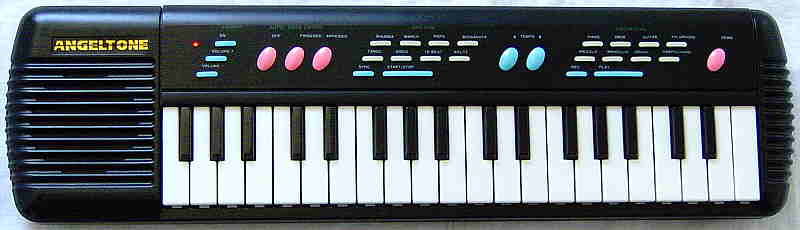
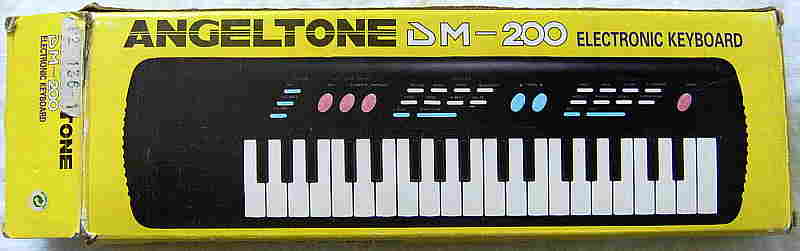 |
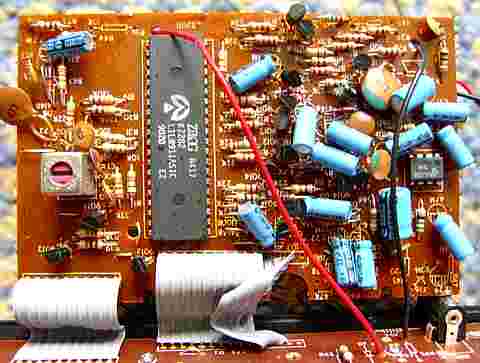 |
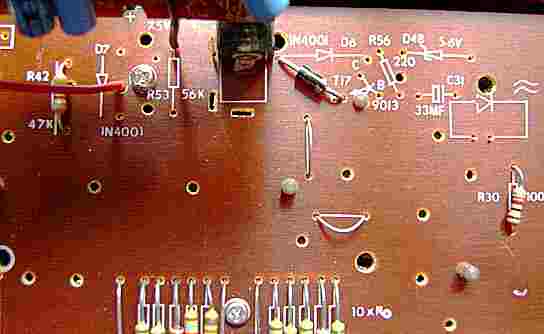 panel PCB has empty solder holes
 |
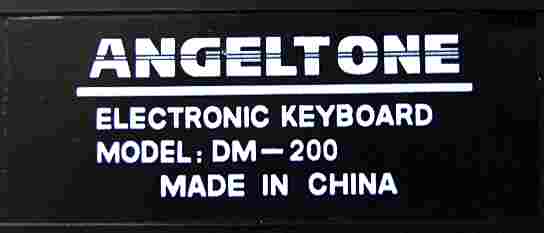 |
 The
golden "ANGELTONE" logo sticker on the case is made of hologram foil. The
main PCB (labelled "S2011") is less messed up and not hacked together;
there are only a few omitted discrete components printed on it. The manual
is a mess of Engrish misspellings, and its German translation is even worse.
The speaker of my (used) specimen was bent and distorted horribly; after
manually aligning the diaphragm it now sounds fairly ok. This instrument
was also released as ESD TK-25 (told by eBay vendor).
The
golden "ANGELTONE" logo sticker on the case is made of hologram foil. The
main PCB (labelled "S2011") is less messed up and not hacked together;
there are only a few omitted discrete components printed on it. The manual
is a mess of Engrish misspellings, and its German translation is even worse.
The speaker of my (used) specimen was bent and distorted horribly; after
manually aligning the diaphragm it now sounds fairly ok. This instrument
was also released as ESD TK-25 (told by eBay vendor).
Likely a fullsize variant with Fujitone
3-A case without drumpads and 'rec' & 'play' instead of custom
drummer 'play/space' & 'program' buttons was released by Hua
Li (only 2 Chinese characters) as DM-250. (Box shows brand "discover
MTC" and "MusiTech Collection" with an MC-3
case (dummy?) MusiTech MT-4000, seen on internet.) I expect this
to have a KZ282 CPU due to the sequencer
buttons. Due to omitted drumpads likely also this one lacks percussion
hardware.
| removal of these screws voids warranty... | ||
 |
 |
|
|
|