 |
lo-fi FM keyboard with strange tekkno sounds & MIDI out |
|
 |
 |
 |
 |
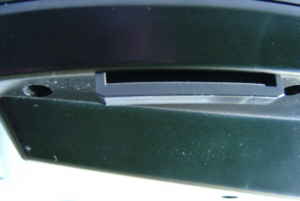
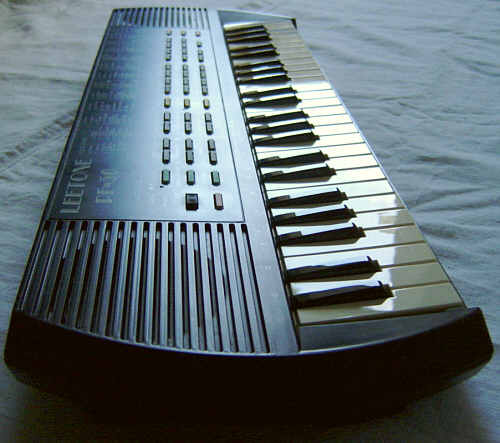
2 strap eyes permit keytar use. |
 |
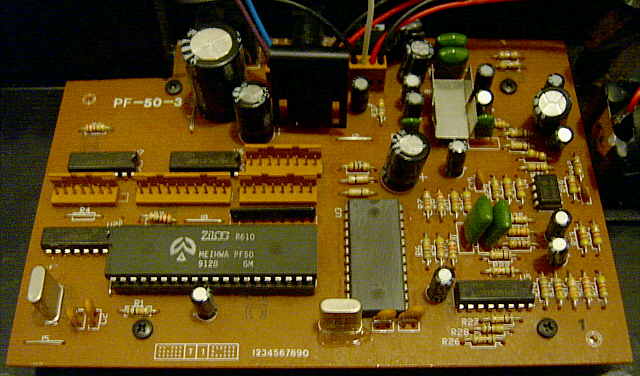 |
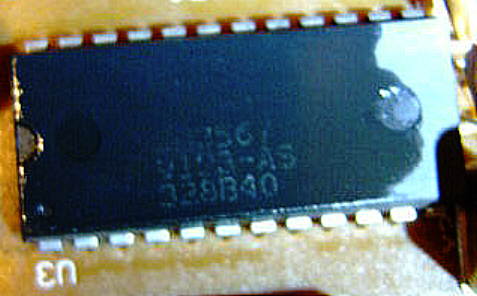 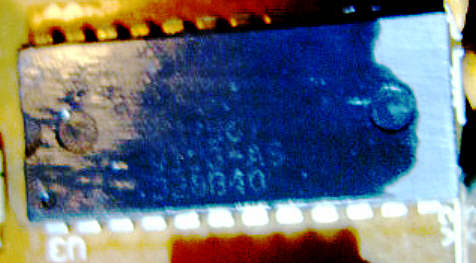 The sound IC print was sanded off.
 |
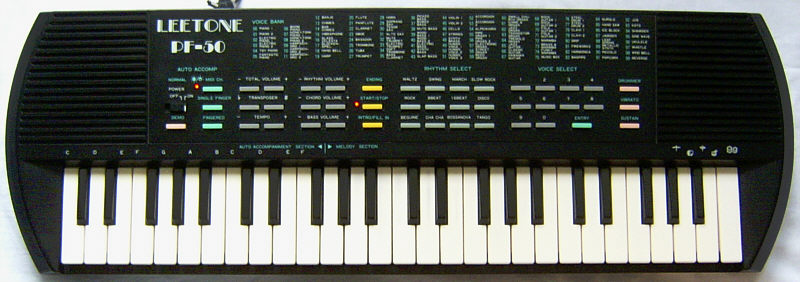
The 100 sound bank includes many of the favourite Fujitone 6A synth sounds (see there) like "hand bell", "fireworks", "leaf spring", "hand saw", "metallic synth", "human voice" 1..3 etc., but the natural instrument sounds are different and also some synth sounds differ, because the PF-50 has neither complex envelope tricks (mandolin ring, siren effects) nor 4 operator sounds. Great is also that (like most FM keyboards) the timbres are time- dynamically playable, i.e. the timbre of notes changes depends on how long a key is pressed, which provides a relatively expressive playability despite the keyboard is not velocity sensitive. The natural instrument imitations are barely natural and some are ridiculously off. Decaying volume envelopes end too sudden to sound natural. Many timbres also sound too fat (bassy) and dull. Fortunately at least it doesn't overuse tremolo (unlike Superb Sound EK-905). In the following I will only mention sounds those are special or strongly differ from what the name suggests. "piano" 1..2 are the usual FM e-pianos with dull bass range. "electric piano" 1 is a rhodes timbre with mild 4Hz vibrato, while 2 is more nasal with fast 8Hz vibrato. The "toy piano" has noisy clanging attack and grainy sonorous bass range. "fantastic piano" has nothing to do with a piano, but is a very duration sensitive synth noise (rather a sound chip crash). When the key is held down for long notes, the sound starts with a very scratchy semi- metallic cold noise, followed by a slowly decaying dull sine wave or e-piano tone. Very short played notes sound like a vibraphone (without vibrato), but when you hold the key a tiny bit longer, the timbre gradually changes into harsher metallic noises (hitting a tin bucket) or even a sort of digital snare drum or synth buzz noise because the sound decays with the timbre that it had during key release. The effect needs skill to control, but especially with active sustain you can play nicely bizarre droning synth patterns. "boom piano" is a nicely warm and sonorous synth bass or lead voice with grainy timbre sweeps, that reminds to Casio CZ-230S sounds. The "honky-tonk piano" 1 is a semi- metallic synth piano with strong 4Hz wahwah tremolo; 2 is brighter with less tremolo and resembles a clavinet. "banjo" sounds too fat and more like a clavinet or balalaika. "chimes" is a long decaying tubular bells sound; "bar chimes" is brighter. "glass celesta" resembles a bright vibraphone with fast vibrato and tremolo. "glockenspiel" sounds too dull and bassy. "hand bell" is a louder fading metallic tone with zipper noise; however here it sounds less granular than on Fujitone 6A (perhaps by too much DAC aliasing distortion?). "wind bell" is similar, but duller and longer with better audible granularity. "harp" plays too dull and low - same with "trombone". Also "trumpet" could be brighter and has a 6Hz tremolo. "horn" is a french horn. "soprano sax" has a too strong 6Hz tremolo. "mute trumpet" is another french horn. "electric trumpet" sounds like a home organ trumpet sound with 6Hz tremolo. "picked bass" sounds fat and hollow. The "bowed bass" sounds harsh and hollow; it may be a steel cello, but resembles more an oboe with slow attack. "wood bass" 1 is a very hollow and semi- brassy synth bass with timbre fade and grainy zipper noise texture; 2 lacks the timbre fade. "electric bass" is a funk synth bass timbre; high notes sound brassy. "synth bass" resembles a fat slap bass, but decays very slowly (almost like an organ). "slap bass" is thinner with zipper noise texture. "violin" 1..2 have 6Hz tremolo, but "cello" has too much of that. "strings" dto. and sounds unrealistic by the lack of chorus. The "synth brass" fades (too?) bright (sounds cold) and dull again.
"human voice" 1..3 are synth voices those barely sound like expected. 1 sounds bright and thin with long notes, and has more chorus tremolo with short notes; 2 has always chorus tremolo. 3 is always thin and resembles a "vox humana" pipe organ rank. The "alpenhorn" is a similar cucumber like "fantastic piano"; it sounds not at all like expected, but is a very grainy, metallic fading "dwellngaaaa..." synth sound, which timbre strongly changes with key press duration. "pipe organ" 1 resembles a wooden pipe organ rank or flute; 2 is more massive. "electronic organ" is a plain and a little dull tooting Hammond timbre. "street organ" is harsh with slow attack and at high notes rather resembles a bowed glass. "small church organ" is a nasal with sonorous bass range and weak 6Hz tremolo - perhaps a Las Vegas wedding chapel electronic organ, but no pipe organ. "chime & organ" layers a harsh, semi- metallic synthetic "deng!" noise to low notes of the same organ without tremolo. "jazz organ" is a plain and slightly hollow Hammond organ tone. "transistor organ" has 6Hz tremolo. "tremolo organ" is a harsh and hollow metallic organ timbre with percussive attack and 6Hz tremolo. The "jazz guitar" has a cold and hissy distorting attack with zipper noise (very unrealistic). "classic guitar" sounds like yet another FM piano with hollow bass range. "hawaiian guitar" is the same with 4Hz tremolo and fades a little brighter. "rock guitar" is bright and sounds nicely like a sitar at high notes; 2 sounds more like a harsh clavinet - bass range has a little farty attack. "folk guitar 1" is almost like "classic guitar"; 2 is brighter and less unrealistic (steel strings). "funky marimba" has a more clicking attack and decays slower than the normal "marimba". "steel drum 1" fades brighter and duller again with held notes; 2 sounds more like clanging on ceramic vessels. "clavi" 1 resembles an acoustic guitar; 2 is the same in thinner. "drip" is a bubbling synth brass that goes: "browmmm". "bagpipe" sounds harsh and quite realistic. "gurgle" is a synth noise going: "boahwahwahwa". "hand saw" is thin and metallic, but high notes almost disappear in aliasing noise. "ice block" is a dull metallic hammer hit noise followed by a much quieter and duller decay. "jamisen" is a metallic drone and resembles "handsaw" (low notes sound much longer). "leaf spring" is another thin metallic synth sound that drowns in aliasing noise. "metallic synth" is a fat and metallic synth brass with zipper noise texture. "popcorn" is a synth sound that goes "boang". "jug" is a decaying dull sound with not really percussive attack. "koto" could be also a banjo. "shamisen" is similar with more clicking attack. "ukulele" sounds way too fat and resembles rather a dull xylophone or harp. "whistle" is a flute with 6Hz tremolo. "reverse" is a semi- voice- like hum that fades louder and than continues at low constant volume. The vibrato button adds a square 6Hz vibrato to all preset sounds; with some of them (e.g. "oboe") it even makes thin timbres somehow fatter, almost like a rotary speaker effect. The sustain button adds sustain; the intensity of both effects depend on the preset sound.
The percussion has the typical electronic FM timbre known from the OPL3 "MIDI synth" of early PC soundcards. The accompaniment patterns are quite standard but have each an intro, fill-in and ending. Unfortunately it accepts only standard chord even in fingered mode, and there is no manual chord mode. (Chord keys start rhythm, when in fingered or single finger mode.) There are separate digital volume controls for rhythm, chord and bass channel, but these massively reduce the bit resolution when set low, which turns percussion into bizarre distorted tekkno noises (resembling Yamaha PSS-30), and you can not mute a channel completely. The OBS rhythm select buttons also used to quickly switch between running rhythms.
The demo melody is a polyphonic and nicely arranged loop of the Carmen opera theme, which has some style similarities with the HBATEC keyboard demo. Bizarre is that you can not only play keyboard, but even select plenty of mismatching functions during demo, which badly messes up the music. E.g. you can select the "waltz" rhythm, which plays in wrong tempo, or you can replace the highest notes with percussion by pressing "drummer".
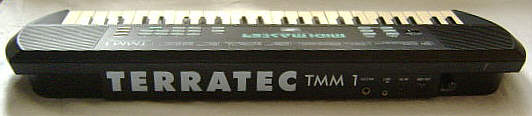
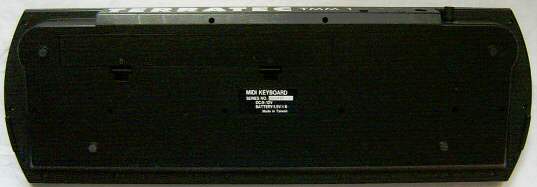
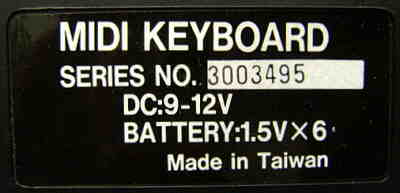
This Taiwanese thing from 1993 is the mute twin of the Leetone PF-50. Despite internal speakers it contains no sound generator and thus can only play sounds from a PC through a line-in jack. As a pure midi input keyboard it appears nowadays fairly useless, since it has neither velocity sensitive keys nor pitch/ modulation wheel and also lacks key split.
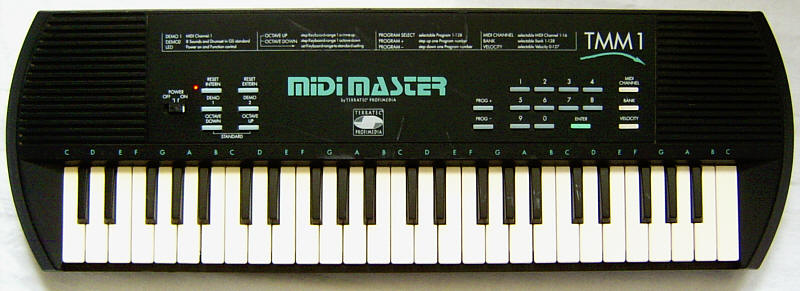
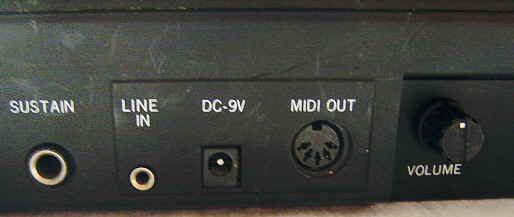
The only visual feedback of the TMM1 is the red power LED, which flashes to indicate that a number has to be typed in with the key pad. There is also a sustain jack. The brand label says "Terratec® Profimedia". Also a white version was made, which was also released as Trust Home Entertainment - Music Maker. Both seem to be much more common than the real Leetone PF-50.
 |
 |
 |
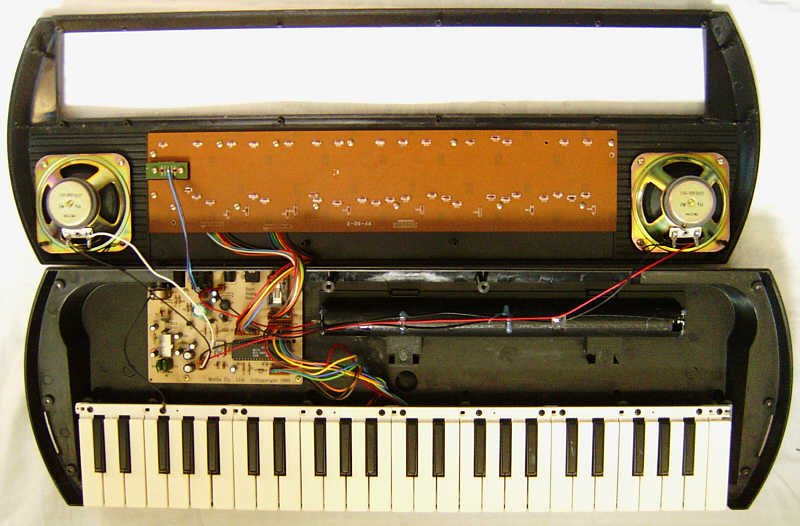 |
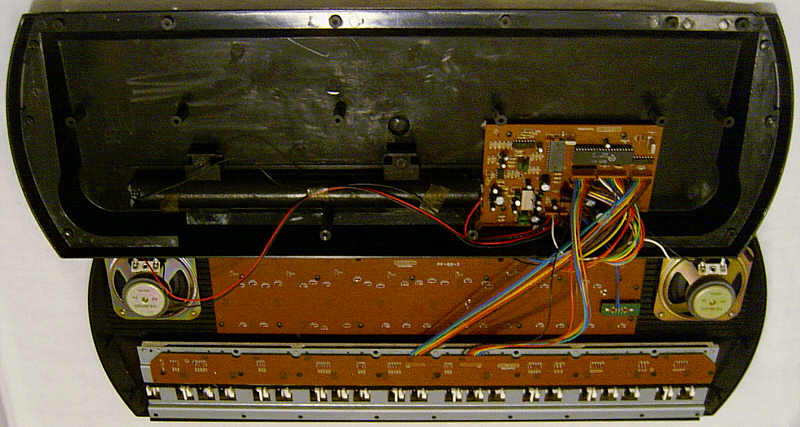
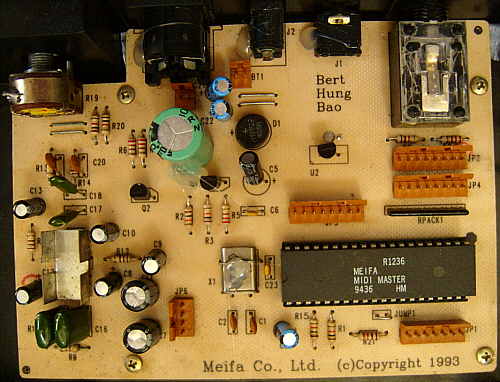 no sound IC
 |
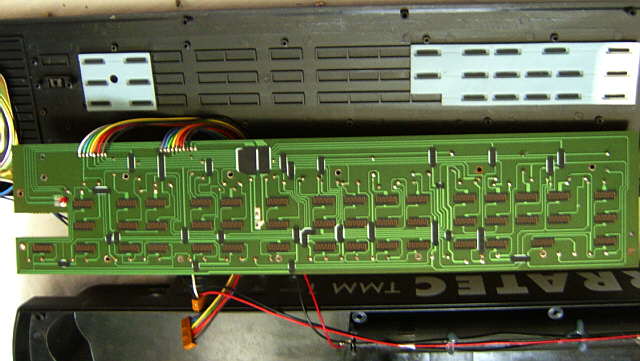 The panel still has unused contacts from Leetone PF-50.
 |
 |
The TMM1 has 2 demo buttons. One plays a charleston/ ragtime piano monoto
on MIDI channel 1. The other plays a short fusion loop with 8 tracks; at
least with my Casio GZ-50M (external GM sound generator) it jerks
at a certain point; possibly it chokes of too many simultaneous MIDI data.
| removal of these screws voids warranty... | ||
 |
 |
|
|
|