
|
MC-103 | FM keyboard with simple synth & programmable rhythm |
This fullsize keyboard has plain 2 operator FM sound with simple synthesizer, versatile accompaniment and programmable rhythm. Although simple, the intuitive control panel permits plenty of interesting live play tricks and the sound is quite warm.
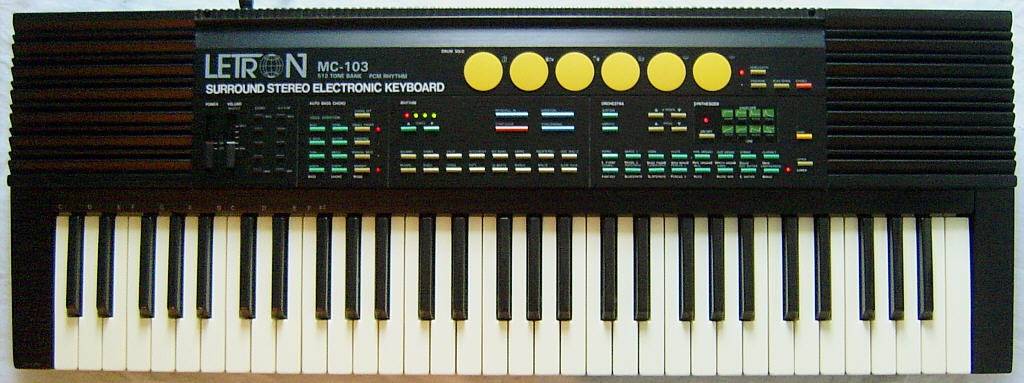
Despite the control panel lies "PCM RHYTHM", the percussion is only made from 6 typical electronic sounding FM drums. The drumpads can be switched off to increase polyphony. There are 16 preset rhythms, those have intro, fill-in and ending, and each 2 accompaniment variations; bass and chord voice can be switched among 4 preset sounds. The accompaniments are nicely arranged, although they sound fairly establishment and contain nothing really unusual. At least they accept also disharmonic key combinations and not only those few ones considered "chords" by the establishment, and the nowadays rare "chord memory" feature permits interesting live play tricks. The 32 semi- OBS preset sounds are 2 operator FM timbres those sound quite warm, smooth and noble, although not necessarily realistic. They remind more to classic expensive home organ or e-piano timbres. There is a very simple synthesizer feature that can switch the envelope and timbre among each 4 presets to form in total 512 preset sound variations, those include nice synth pad and bass sounds and also some grainy tekkno stuff.

 |
 |
 |
 |
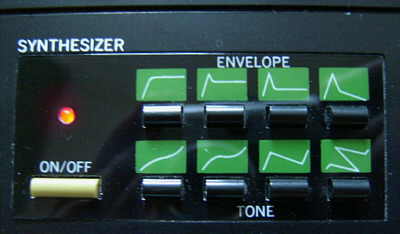 The rightmost TONE "waveform" (reversed 'Z') is physically impossible.
 |
 |
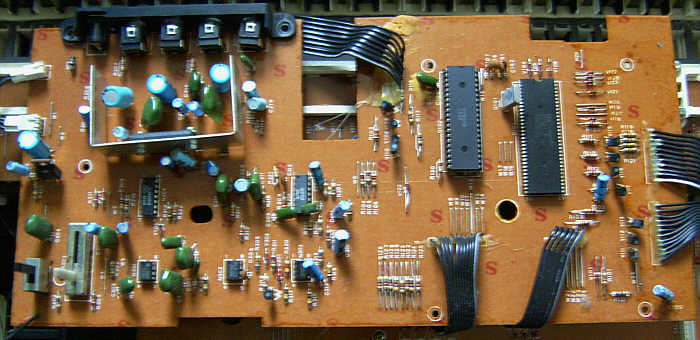 |
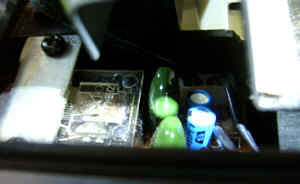 A relay switches the audio signal.
 |
 |
 |
The preset sounds of this instrument have the typical 2 operator FM timbres and most are not programmed really realistic but resemble more classic home organ or e-piano timbres since most have very simple envelopes. But they don't sound unpleasant but have quite warm and noble sounding timbres (less rough than my Yamaha PortaSound FM keyboards) with nice bass range. Beside acoustic instrument imitations there are also some typical timbre sweep synth sounds, although nothing really spectacular. The "piano" is a typical FM timbre with hollow bass range. "flute" is a metal flute with dull bass range. "horn" sounds like a french horn; "wah brass" is similar but quickly fades duller during its slow attack. "pipe organ" 1 and 2 are both metal pipe organ ranks with short sustain, while "jazz organ" is a plain Hammond imitation with clicking attack. "synth organ" is more like a harsh reed organ or harmonica; "pop synth" is an even brighter one. The "funksynth" is a typical FM synth brass that slowly fades quieter; "cosmic" is a similar but more saxophone- like timbre. "fantasy" is a bowed string with slow attack and mild 2Hz tremolo that slowly fades silent and has long sustain. "slap synth" resembles a distorted lead guitar that slowly decays silent. "percus 1" is fast decaying picked string (a bit like a koto or damped e-bass); 2 sounds like a harp. "koto" decays longer with hollow semi- metallic timbre. The "banjo" sounds a little thin. The vibrato button adds a fast 6Hz vibrato to them, which with some sounds slowly fades in. Also the sustain duration of the "sustain" button varies among preset sounds.
With the 8 "synthesizer" buttons the "envelope" and "tone" parameter of each preset sounds can be switched among each 4 OBS preset variants. "tone" seems to control the FM modulation intensity (from dull to brighter, with some sounds partly distorted) while "envelope" changes the attack phase (from slow to percussive). What they exactly do depends on the preset sound. One of the "envelope" and "tone" buttons always corresponds to the original preset sound; with the "synthesizer" on/off button you can quickly switch back and forward to find out which one; in total there are only 512 sound variants (32 preset sounds * 4 envelopes * 4 timbres , gladly advertised as "512 TONE BANK" on the control panel). Due to its separate FM sound chip, also this instrument can be likely easily modified into a more versatile FM synthesizer, like I did with the Fujitone 6A (and thanks to the programmable rhythm it may be even more interesting to change the percussion this way). Like with Letron MC-3, the OBS preset sound buttons can be also used as a realtime sound control, since they also change the timbre of held notes and re- trigger their envelope. Even the "envelope" and "tone" buttons behave the same way, while the synthesizer on/ off button does not change held notes, which permits plenty of nice live play tricks. Great is also that (like most FM keyboards) the timbres are time- dynamically playable, i.e. the timbre of notes changes depends on how long a key is pressed, which provides a relatively expressive playability despite the keyboard is not velocity sensitive.
The percussion has the typical electronic FM timbre known from the OPL3 "MIDI synth" of early PC soundcards. Great is that this instrument has a programmable drum pattern ("custom drummer"), which has up to 32 steps (depending on the selected rhythm) and functions like with Letron MC-3. Unfortunately it is not realtime programmable (like with the similar Elta KE-10) and annoying is that (unlike MC-3) you can not exchange the accompaniment later without manually re-entering the entire pattern.
The accompaniments are nicely arranged, although they sound brave and rather establishment and contain nothing really unusual. But there are each 4 preset sound variations for bass and chord and a "variation" button, with that you can switch back and forward to a second (usually more complex) accompaniment pattern. There is also a manual bass mode, and with rhythm off the usual manual chord mode. The individual intro, fill-in and ending patterns (the latter 2 with accompaniment) are a nice detail, although also establishment. Fortunately the fingered accompaniment accepts also disharmonic key combinations and not only a few establishment chords. A nowadays rare great feature from the home organ era is the chord memory button, which in disabled state plays the accompaniment only so long any chord section keys are held, while the rhythm keeps running. When chord memory is off and rhythm is started in synchro mode (with "sync/ ending" button), it plays even the rhythm only so long chord section keys are held, i.e. it stops the rhythm by key release and restarts it every time a chord section key is pressed, which permits nice stuttering jungle grooves etc. But unlike early 1980th keyboards this trick does not work in manual bass mode, nor you can make the chord memory hold manual chord with rhythm off.
The 2 demos are nicely arranged. The first seems to be a tango (although with "swing" rhythm). The 2nd song "Joseph Kosma's Autumn Leave" corresponds to the 1st demo on Thompsonic TS-33; also the arrangement style of the demos is similar. You can directly select the 2nd demo by holding the 2nd white key while pressing the demo button.
Apparently an MC-103 version with detachable speakers (case shaped like
MC9000) was the CCE
EK-100X. A 49 keys variant of the MC-103 was released by Levis
(type "E 10A NEW" according to the manual?, I asked the eBay
vendor), however its manual lists its demos "Autumn Leaves" and "Danube
Waves Waltz"; the latter makes no sense so far it correctly describes the
same hardware class. A direct predecessor of the MC-103 was the Elta
KE-10 (almost same case shape and sounds), and the accompaniment
has strong similarities with the midsize GPM
MC-5000. Likely another direct predecessor was the Thompsonic
TS-33 (especially its fullsize variants MC9000 and Fujitone
6B) because its entire operating concept is almost identical despite
it had no FM sound. Another somewhat similar squarewave instrument like
the MC-103 was the VTech Rhythmic 10.
Apparently MC-103 hardware was also used in a different Elta KE-10
version (with slightly changed control panel layout, claimed by an eBay
vendor).
| removal of these screws voids warranty... | ||
 |
 |
|
|
|