|
|
polyphonic
squarewave mini-keyboard with audiogames |
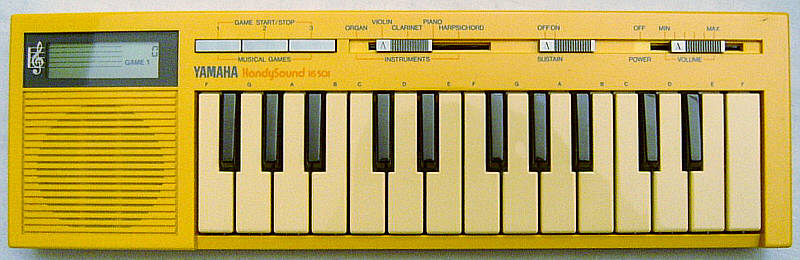
This keyboard of 1982 (manual copyright date) is almost identical with
Yamaha HS-500, but has a yellow
case and different audiogames those show musical notes instead of alphabet
letters on the LCD. Also the "violin" and "harpsichord" preset sounds are
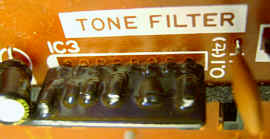
duller due to an additional filter hybrid.

different main features:
-
different 3 OBS audiogames
-
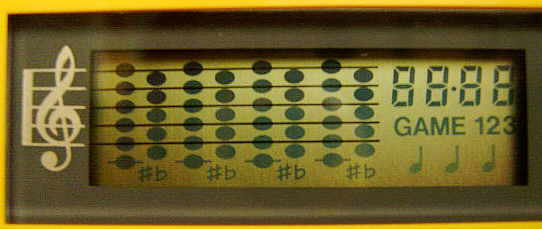
LCD display indicate musical notes (black dots) instead of alphabet letters
-
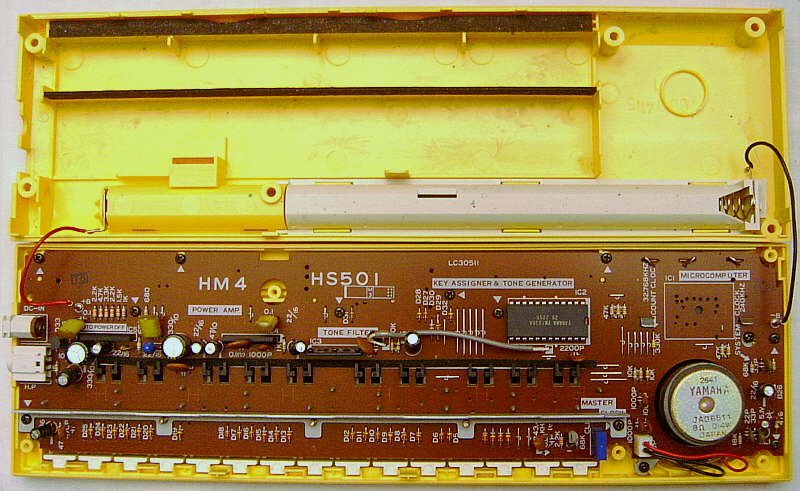
multi-chip hardware:
-
sound CPU= "Yamaha YM1036A, 28 2055" (24 pin DIL, crystal clocked @ 240kHz
"system clock"?)
-
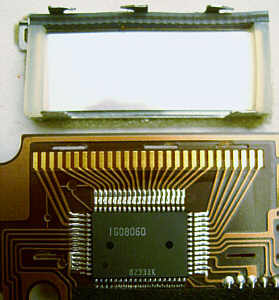
game CPU= "IG08060, 8233XK" (64 pin SMD, crystal clocked @ 32.768kHz "count
clock"?)
-
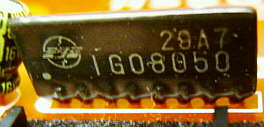
filter hybrid= "IG08050, 29A7" (8 pin SIL)
eastereggs:
-
test mode: Hold down "game 1" button during power-on to start the LCD test
mode. This modes repeatedly lights up all segments from left to right;
the keyboard works like normal during this. (Yamaha
HS-500 does this differently.)
notes:
The PCB strongly resembles Yamaha HS-500,
but game CPU and sound IC (only clock rate?) are different. When keys are
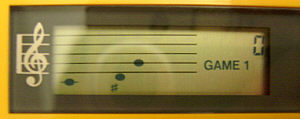
held, the LCD shows up to 4 of the corresponding musical notes as full
notes (black dots) on their note lines. Notes lower than the low "C" are
not displayed. Sharp notes are indicated by an additional "#" below it.
Strange is that starting game 2 switches this symbol to "b"; starting game
1 or 3 switches back to "#". The 3 audiogames are here selected by OBS
buttons and unlike HS-500 apparently have neither selectable modes
nor levels. Also the jingles differ from HS-500. All audiogames use only
the white keys. Games can be cancelled by pressing their button again.
(I downloaded the manual from Yamaha.)
-
game 1: "Keyboard Says..."
This game works similar like Senso or Simon. The instrument
plays a monophonic note sequence (also shown on LCD) and the player has
to repeat it on the keyboard. When he plays it perfectly, he gets 100 points,
else less according to the number of mistakes. Correcting a wrong note
immediately scores 95 points. So long you score >80 points per round, the
game continues until the count of notes reaches 16. First it is only 1
note, but after every try a further note is added, making the sequence
longer and longer. The game ends when the player makes too many mistakes.
For up to 4 notes any mistake ends the game; for 5 to 9 notes 1 mistake
and above 9 notes 2 or 3 mistakes are allowed (so long the score is >80
points per round). From 9 notes on the note range widens between C and
C and a fanfare sounds after game end. The maximum possible score is 1600.
The instrument plays an ascending or descending scale while it displays
the corresponding note; when the scale reaches its end, it reverses. This
way it goes up and down and up again while it turns faster at every turning
point. The player has to hit a corresponding key before it turns too fast
or a timeout (when it has moved 64 times). Each level consists of 4 notes.
You have to stop as many notes as possible at the same height; the game
continues only when you line up 3 or 4 matching notes (named "three cards"
or "four cards" in the manual). The 4th note in a round moves faster when
you lined up 3 correctly. Lining up 4 notes scores 500. Lining up 3 scores
300 points. Lining up 2 pairs of notes scores 200 and 1 pair scores 100.
Each level is faster than the previous one. The maximum possible score
is 10000. A final score above 1000 sounds a fanfare.
-
game 3: "Keyboard Invader"
A repeating signal will sound at the pitch of a certain note (displayed
to the left on the LCD). To the right, your "cannon" appears as another
note. The player has to hit the correct key corresponding to the enemy
"invader" note to shoot it. (The "cannon" will instantly move to the height
of the note of the pressed key and another note flies out of it to the
left as a missile). Shooting an invader scores 50 points. When the player
waits too long, the invader note will fire a missile to the right; when
the cannon gets hit, the player looses a life. Thus the player has to hit
another key to avoid the invader's missile. (Initially the player has 3
lives, those are indicated by note icons to the lower right of the display.)
When player's and invader's missile collide, the one who shot first wins.
By not looking at the staff display until you score up to 1000 points,
you can train your hearing. Between 2000 and 5000 points it is possible
to win bonus live. After 2000 and 5000 points the game turns more difficult.
After 2000 points the note range increases between C and C. Reaching a
score >1000 sounds a fanfare. The maximum possible score is 10000.
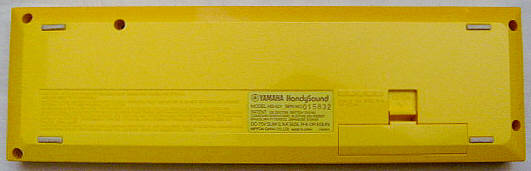
| removal
of these screws voids warranty... |
|
|
 |

|
|
| |
back
|
|