|
full polyphonic squarewave tablehooter with analogue rhythm |  |
|
This ultra-rare midsize tablehooter is a full polyphonic squarewave organ with analogue rhythm, but it has not even envelopes nor accompaniment - only a keysplit for a duller "bass" voice (also full polyphonic) in the left keyboard halve and a primitive sequencer.
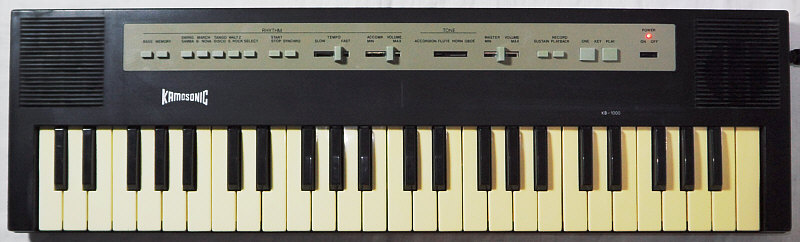
The entire user interface behaves like one of those wooden mid of 1970th beginners keyboards despite this was obviously built in 1980th. The "sustain" button makes the monophonic note of the last released key toot forever like a stuck key (i.e. no decay!); the "memory" button does the same with the bass voice, so they are rather a key hold mode (like pedal sustain in early Casios) than what their name suggests. Unusual is also the very archaic primitive sequencer, that can not even play by itself, but can only be stepped through with 2 "one key play" buttons (but this even 2 note polyphonic).
This keyboard was also released in beige as RJP 888 (seen on eBay). Apparently this instrument was a direct predecessor of the great Ramasio 892. Due to strong similarities I only describe the differences to the latter.
 |
 |
 |
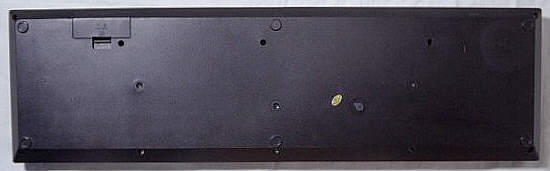
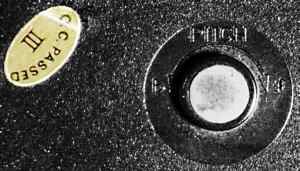
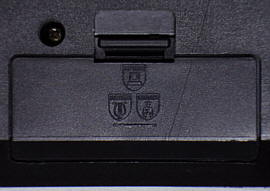 strange shield icons on the battery lid.
 |
|
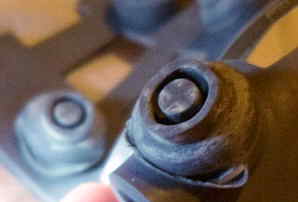
caution: Like with Ramasio 892, the key rubber contacts are not silicone. Mine were crushed and sticking to itself. I guess they are of butyl rubber, which tends to be as vulnerable as latex, thus be careful not to bring oil (except silicone) or any other fatty substances in contact with them, which would likely dissolve the rubber. It may be also a good idea to store this instrument in an airtight PE or PP plastic bag to protect the rubber from airborne ozone and phthalate.
The sound IC is the same like in Ramasio 892. The entire thing sounds not realistic, but very much like a cheap and cheesy analogue 1970th home organ with slightly creaky timbre. The main and bass voices are squarewave with no envelope at all and thus start and end with audible key click. The 'accordion' and 'horn' use multipulse-like timbres. They all have a mild 6Hz vibrato and somewhat resemble Casio VL-1. The preset sound slide switch seems to be analogue and mixes lower octave drawbar footages from the sound generator. The bass keys seem to respond a little slower than the main voice, which hints to more software in between.
Also the analogue percussion are very home-organ-like. The tempo differs much among rhythms. Most can be set very slow, but not overly fast.
To use the sequencer, press "record playback" and play some notes (up
to 64). To replay them, press "record playback" again and press the "one
key play" buttons in the correct tempo. To restart the pattern, press "record
playback" twice (without playing notes in between, which would overwrite
it). Unlike all modern sequencers, you can not playback the pattern fully
automatic, but like in very early Casio prototype patents, you can
playback 2 note polyphonic by holding a note with one "one key play" button
and continue stepping through the sequence with the other. The sequencer
record mode always switches the left keys into bass mode. Switching bass
off exits record mode, despite the bass track can not be recorded anyway,
i.e. you can not record low notes of the left keyboard section at all (possibly
by too few ram bits per note). But during replay ("one key play" buttons),
you can still manually play full polyphonic main and bass voice or switch
bass off to use the full length.
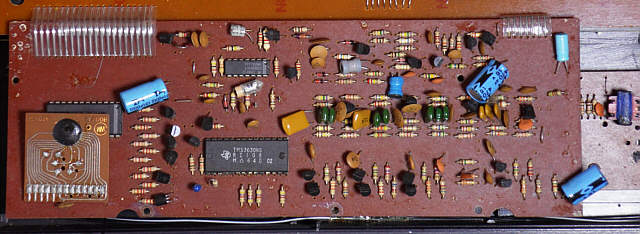
hardware detailsThe Kamosonic KB-1000 is based on the COB CPU "156D26 I[?]102D0B" that controls a TOS sound IC= "Texas Instruments TMS3630NS". There is also a 4 to 16 demux IC= "National Semiconductor CD4514BCN".
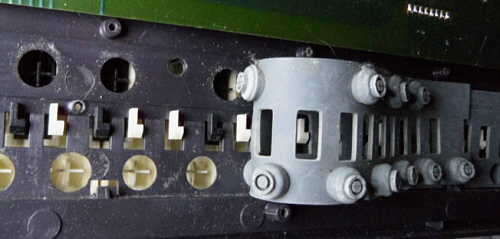
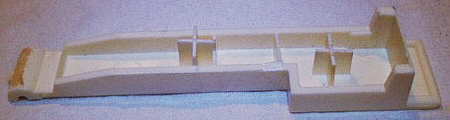
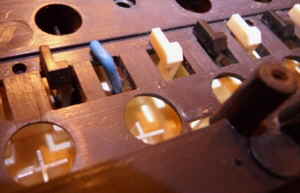
Like with Ramasio 892, the key rubber contacts are not silicone; they were partly greyish discoloured and one rubber cap was even torn. Many were sticking to itself at the folded edges (from misplaced installation?). I guess they are of butyl rubber, which tends to be as vulnerable as latex, thus be careful not to bring oil (except silicone) or any other fatty substances in contact with them, which would likely dissolve the rubber. It may be also a good idea to store this instrument in an airtight PE or PP plastic bag to protect the rubber from airborne ozone and phthalate. I also repaired a broken plastic hook under a key.
|
A simpler midsize keyboard by the same manufacturer was RJP 887
(40 keys, only 1 sound, no rhythm, simple sequencer (24 notes), 10 built-in
melodies, black case with cyan checked ornament pattern and buttons | seen
on eBay). Traktor told me that it is monophonic with discrete
vibrato circuit.
| removal of these screws voids warranty... | ||
 |
 |
|
|
|