
|
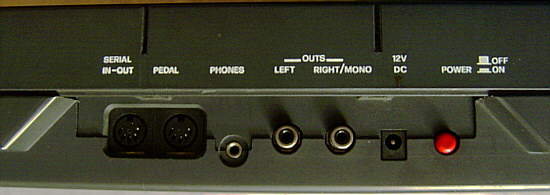
This keyboard from 1988 (sound IC date?) was apparently a more expensive predecessor or professional version of the Antonelli 2495. It has the same semi- analogue sound engine with analogue percussion and versatile accompaniment, but additionally it is stereo, has individual buttons for OBS controls and a duet/trio mode which permits interesting live play tricks.
This instrument was also released as Wersi X1000, with slightly different case design (handle in front of keys) as Siel MK 610 and with case like Madison OK 500 as Madison OK 300 (all seen on eBay) and Giannini GK 6110. Possibly also Suzuki PK-61 (told by e-mail) and Keytek K-60 (different button layout with 1 less, seen on eBay) were variants of it. Other versions may be named YD-610 and YDMK-610 (mentioned in Chinese book "Electronic Keyboard Principle & Maintenance").
caution: A common disease of Antonelli keyboards is that the plasticizer of PVC mains cables melts itself into the case plastic, which looks like scratches by a hot soldering iron and locally turns the plastic surface and paint into tar- like goo. Also my 2614 has some minor melt marks, thus watch out to avoid direct contact between plastic case and any sticky or smeary feeling PVC cables. (Better generally avoid contact with soft PVC; also certain keyboard dust covers and -bags were made of the plasticized material.) The smeary goo residues on the case can be partly removed with vegetable oil, but be careful to wash off also the oil residues with water and dish washing detergent, since long oil contact may damage this vulnerable plastic also.
Due to strong similarities with the Antonelli 2495, I only explain here the differences.
 |
 |
 The
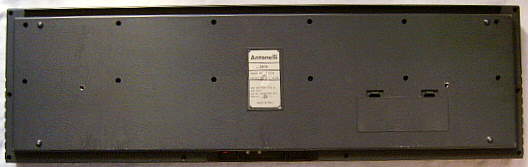
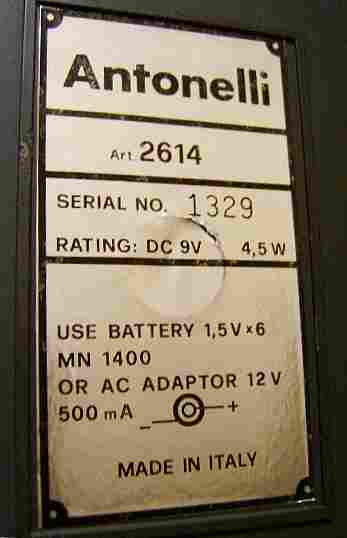
4 digit serial number 1329 hints that only quite small quantities of this
instrument were built. The
4 digit serial number 1329 hints that only quite small quantities of this
instrument were built. |
 |
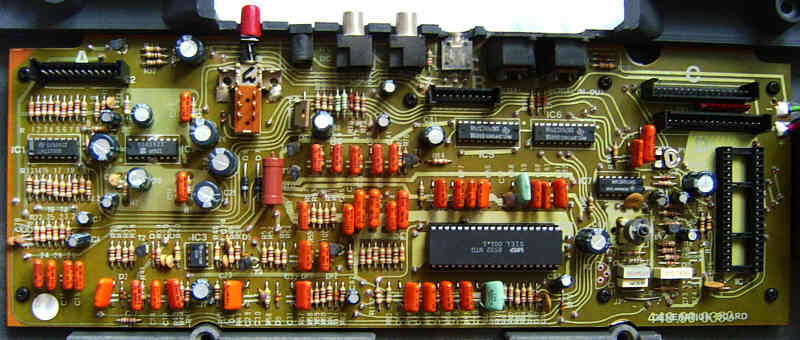 |
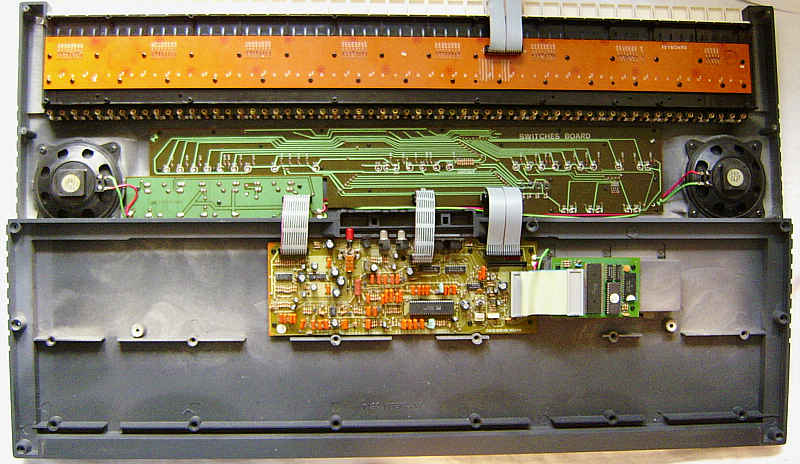
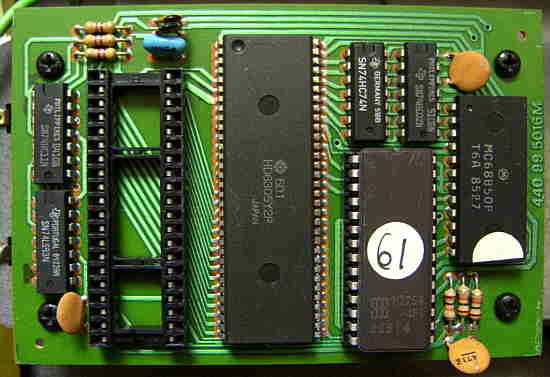 prototype daughterboard instead of IC4
 |
In a Chinese language book "Electronic Keyboard Principle & Maintenance" (ISBN 7-03-003804-5, thanks Traktor for the tip) I found some hardware info about the variant MK-610. Apparently it was supposed to have (instead of the prototype board) an 8 bit CPU "SC93344" with 4160 byte rom and 176 byte RAM. Something else (waveform definition?) has 32 byte ram. The RS232 mode has 2400 baud. (I can't read Chinese, so the rest is hard to figure out.) But Traktor showed me photos, that an actual MK-610 (serial number 3912 stamped near PCB) contained the same daughter board (CPU= "Hitachi HD6350P, 5J1, Japan"), so the planned single chip microcontroller possibly never went into production.
The preset sounds strongly resemble the Antonelli 2495, but the vibrato intensity of some sounds seems to be lower. The additional "vibes" sound has a dull semi- metallic vibraphone timbre with 4Hz vibrato and a little buzzy bass range. The "harpsi" has a harsh timbre with percussive attack (like intended). Like with Letron MC-3, the preset sound buttons also switch the timbre of held notes and decaying volume envelopes are only retriggered when you switch to a sustaining preset sounds, which can be used for life play tricks. Unfortunately the sunk buttons are a little hard to reach for rapid trills. Switching timbres makes a quiet popping noise.
Also rhythm and accompaniment features correspond to the 2495, except that the bass channel has an additional volume slider. The semi- OBS preset rhythm buttons switch the pattern only at pattern end, which prevents using them as additional fill-ins. With active key split (= manual chord) or accompaniment you can play an additional duet mode (labelled "counter melodies"), which plays a 2nd voice when you play monophonic notes in the right keyboard section. The button toggled through 2 modes and off. With enabled chord memory (works also without rhythm) and muted accompaniment voice you have the hands free to play only the duet mode. Unusual is that the duet mode refused to play its 2nd voice when the note in the right keyboard section corresponds to the same or a semitone higher note held in the left keyboard section. Pressing the "counter melodies" button also affects held notes, which can be used for live play tricks. Unfortunately it stops the by chord memory held notes. The 2 modes are very similar, except that they add for a few left/ right note combinations a different 2nd voice note, which apparently somehow was intended to play chords in different keys, because you can also play fingered or single finger chords in the left section, which turns monophonic main voice notes into a matching trio. Unlike the 2495, you apparently can not set the key split point manually, thus the left section is always 2 octaves wide. However the "split" button cycles between {on, oct/up, off}, thus you can shift the left section an octave higher (except with single finger chords), which also changes held notes (but stops chord memory notes) and sounds great for live play tricks. Especially combined with arpeggio and wicked rhythm settings you get plenty of strange tekkno patterns out of it.
The chord sequencer behaves much like in 2495 and is similarly awkward to use. The "mode" button cycles between "record" and "play" (LEDs lit). To record chords, press it once ("record" is lit and the rightmost 5 keys are mute, including the rightmost key labelled "sequencer write"). Play the single finger chords one by one, and while holding each chord, press and release the "sequencer write" key to store it. Each press of "sequencer write" adds one bar of chord (i.e. press it multiple times to store longer chords). Press "mode" again ("play" is lit now) to finish. To play it, press "mode" until "play" is lit and then start a rhythm. The chord sequence will now repeat in a loop. You can still try to play manual single finger chords during this, but they are cancelled by the next chord of the automatic sequence. With the "patterns" button you can cycle between 2 additional single finger chord sequences (LEDs "1", "2"), those seem to be fixed ROM presets (their LEDs always go out when sequencer "record" or "play" mode is selected).
Unusual is that the demo song of the Antonelli 2614 sounds identical with 2495; other companies changed it with every new hardware class. A more advanced 2614 variant (split/ layer sounds, analogue VCF, real MIDI jacks, programmable rhythm etc.) with different sound ICs was released as Madison OK 500.
A possibly direct successor of the 2614 was the Keytek K-70 (seen on eBay) and Suzuki Keyman PK-61ex (told by e-mail | with sample percussion and keyboard drumkit mode on highest octave).
Wanted: I am searching for the historical
PC connection software (DOS drivers?) that came with or was sold for the
Antonelli
2614 keyboard. Does anybody has this software (original or copy) or
the special cable or at least some info about these?
| removal of these screws voids warranty... | ||
 |
 |
|
|
|