|
|
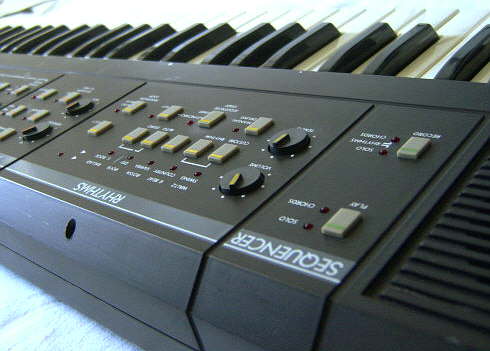
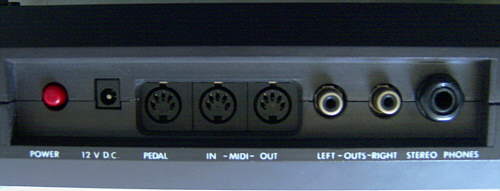
This keyboard seems to be a more advanced predecessor of Antonelli 2614. It has warm semi- analogue sound with analogue percussion and nicely versatile accompaniment (suitable for tekkno). It has programmable rhythm, simple sequencer and can do key split and layer preset sounds, those are routed through a Curtis filter chip CEM3350. There is also a stereo chorus effect, detune and duet/ trio mode. Annoying is that the user interface is somewhat contra- intuitive and not self- explaining; you have to press multiple buttons together to access some of the basic functions. It also has standard MIDI jacks.
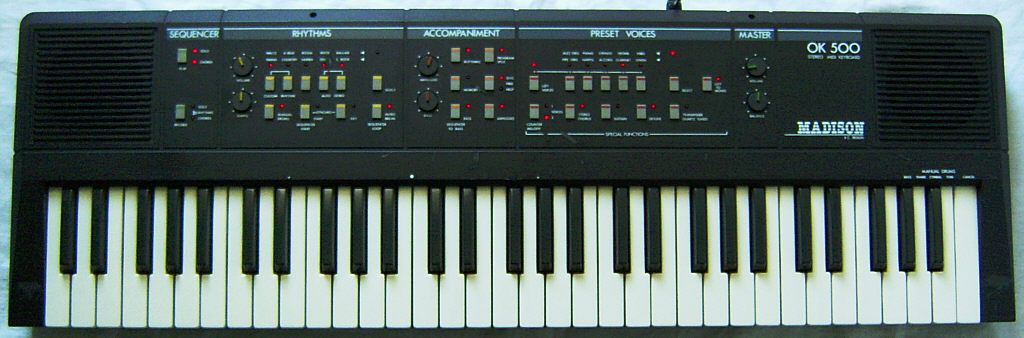
Although it has fewer sounds and features, the versatile concept of the OK 500 can be best compared with a JVC KB-700. The rightmost 5 keys can be switched into drumpad mode for rhythm programming. The timbres of the 10 preset sounds resemble Antonelli 2614, however the monophonic analogue VCF adds a filter sweep to some of them, which can be modulated by trilling preset sound buttons for great live play tricks resembling Roland TB-303. There is a "left" and "right" voice those each can use any of the 10 preset sounds. The left voice can be assigned to the chord voice or layered with the main voice when no chord is used. The "detune" button tunes the left voice a little higher, which in layer mode produces a detuned chorus effect (like a honky-tonk piano).
caution: A common disease of Antonelli keyboards is that the plasticizer of PVC mains cables melts itself into the case plastic, which looks like scratches by a hot soldering iron and locally turns the plastic surface and paint into tar- like goo. Also my Madison OK 500 has plenty of these melt marks, thus watch out to avoid direct contact between plastic case and any sticky or smeary feeling PVC cables. (Better generally avoid contact with soft PVC; also certain keyboard dust covers and -bags were made of the plasticized material.) The smeary goo residues on the case can be partly removed with vegetable oil, but be careful to wash off also the oil residues with water and dish washing detergent, since long oil contact may damage this vulnerable plastic also.
This instrument was likely also released as Siel MK 900 (same functions & ICs seen in service manual, PCB layout differs).
 |
 |
 |
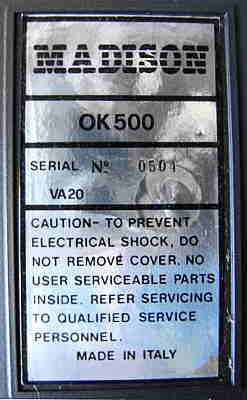 serial no.0540
= ultra-rare? |
The user interface and button writing of this instrument strongly differs from average home keyboards and is a little hard to figure out without a manual. (I don't have one.) Thus here is a brief introduction. Most important to know is that this instrument uses 2 independent main voices called "left" and "right" (those volume ratio is controlled with the balance knob). Mainly these correspond to the chord and main voice of normal keyboards, but here both are treated equally, which complicates the sound selection. At first view it looks like 5 ordinary semi- OBS preset sound buttons with a "select" button to switch between 2 banks of each 5 preset sounds, and fortunately there are plenty of red LEDs indicating which functions are selected; unfortunately with voices you only see one of them at a time (and a lit "select" LED here indicates the upper row, which is the other way around than most other keyboards). Thus most important to watch is whether the LED of the "left voices" button is currently on or off; when it is lit, you can see and select only the "left" voice; when it is off, you can see and select only the "right" voice instead. (Press that button to toggle between both voices.) Even worse; by pressing the currently lit preset sound button again, you can mute the current voice; when both are muted, the keyboard will stay mute until you select a preset sound again. When you select a left and a right voice (after power on, no left voice is selected), both will be layered. By pressing the "program split" button you can toggle this to key split mode (LED lit), i.e. the "left" voice will now be assigned to the left keyboard section and the "right" one on the right. There white dots above 3 of the keys to indicate selectable split points. Hold down the key left next to such a dot while activating "program split" (i.e. unlit LED lights up) to set that split point. (You hear that pressed key, which disturbs live performance.) In layer mode, the "left to mono" button (LED lit) turns the "left" voice monophonic (added to the highest played note), which also thins out its sustain and can be used for a monophonic lead voice. In key split mode this button does something else; it layers additionally a monophonic version of the "left" voice to the highest played note of the right keyboard section. The "stereo chorus" button adds a mild chorus effect that makes the sound wider. The "detune" button increases the pitch of the "left" voice a bit, which in combination of both voices produces a detuned chorus effect (e.g. layering "piano" with itself produces a honky- tonk piano sound, and also "strings" turns much more natural this way). The "transposer" button transposes the keyboard within 1 octave by pressing it while holding a key other than C; this assigns that note to the C key (=>LED lit). Press it while holding C to get back to default tuning (LED off).
The preset sounds are made by the Polyphonic Sound Generator IC "SGS M112B1", which in its datasheet is described as a drawbar organ on a chip. It has 7 drawbars of 32 step resolution, those each can use or bypass the ADSR volume envelope in various ways, and the IC even permits some external analogue controls. The timbres sound like made from multipulse squarewave; in fact they are made from up to 7 layered plain squarewaves per sound IC (each using or bypassing the ADSR envelope). The output is routed through a monophonic lowpass filter ("left" and "right" voice have an own one) with resonance and decay envelope, that is implemented with the famous "Curtis CEM3350" Dual Voltage Controlled State Variable Filter.
The timbres are warmer than with Antonelli 2495 and 2614 (which likely employed digital waveforms) and there is no vibrato (neither as part of preset sounds nor as a button). The "pipe org." is the classic multipulse squarewave pipe organ timbre with sonorous bass range; this one sounds a little dull. The "harpsi" sounds a little dull and brassy in the bass range and decays very slowly with held notes. The "accordion" is fairly dull and resembles rather a big wooden reed organ. The "clarinet" fades duller during attack by a filter sweep (retrogressed by each new note) and decays a bit before it holds the note; bass range is hollow. The "synth." is a thin tone that grows duller during its semi- percussive attack by a filter sweep with resonance and has a buzzy bass range (slightly resembling "frog" on Casio Consonant- Vowel keyboards like MT-60, but less dry and grainy). "jazz org." is a not really realistic Hammond imitation made from the same sonorous multipulse timbre like "pipe org.", but unlike the latter it rapidly grows much duller (like a dull reed organ) during its semi- percussive attack by a filter sweep. The filter envelope here is not retriggered so long notes are held, likely to simulate the "percussion" behaviour of the Hammond organ. Although the rapid timbre change rather reminds to certain Consonant Vowel timbres of early Casio keyboards (see CT-410V) than the sine wave based Hammond, it is still a nicely warm electronic organ sound. The "piano" is too dull and slightly brassy; the bass range rather resembles a bass tuba. "string" has slow attack and a bright timbre with likely a small dose of filter resonance; with no additional effects selected it sounds more like a single violin; the bass range is thin and buzzy. The "trombone" sounds a bit too dull and grows duller during attack by a filter sweep (retriggered only by playing lower notes); it rather resembles a tuba and high notes are too soft. "vibes" is intended to be a vibraphone, but it grows too dull during its percussive attack by a filter sweep (not retriggerred so long notes are held). Also this one is made from the sonorous multipulse timbre, but the bass range is too dull, and very unrealistic is that without sustain the note stops immediately after key release. And the sustain button adds a way too long sustain, that resembles more tubular bells, and the sustain timbre is brightened again by the filter sweep of every new note (unless you play in monophonic mode), like when these notes would be softly played again. While the sustain button adds to most sounds only 2s of sustain, to "piano" and "vibes" it adds way too long 6 seconds.
Like with Letron MC-3, the preset sound
buttons also switch the timbre of held notes, and decaying volume envelopes
here slowly fades brighter again when you switch to a sustaining preset
sounds. This also causes nice synth filter sweeps, which can be used for
live play tricks; together with sustain you can do a lot of Roland TB-303-
like sound effects this way. (I haven't tested the MIDI implementation
of the sound selection yet, but I could well imagine that this works also
with sequencer software.)
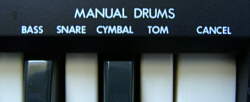 The
analogue percussion sounds like typical home organ drums. The "manual drums"
button turns the rightmost 5 keys into drumpad mode. Interesting is that
when "key" and not "start" is pressed, the rhythm plays only so long any
key in the left keyboard section is held down. It stops by releasing these
keys and always restarts the pattern by pressing an accompaniment key.
This way some weird breakbeat stuff can be played by trilling on the keys.
The tempo knob here permits no really extreme settings. The semi- OBS preset
rhythm buttons switch the pattern only at pattern end, which prevents using
them as additional fill-ins. The
analogue percussion sounds like typical home organ drums. The "manual drums"
button turns the rightmost 5 keys into drumpad mode. Interesting is that
when "key" and not "start" is pressed, the rhythm plays only so long any
key in the left keyboard section is held down. It stops by releasing these
keys and always restarts the pattern by pressing an accompaniment key.
This way some weird breakbeat stuff can be played by trilling on the keys.
The tempo knob here permits no really extreme settings. The semi- OBS preset
rhythm buttons switch the pattern only at pattern end, which prevents using
them as additional fill-ins. |
The accompaniment has a lot of features, those controls have partly odd names. To use any of its features, first the key split mode must be enabled with "program split" (LED lit). When "bass" is pressed, the lowest note played in the left section of the keyboard is layered with a monophonic bass (this works not only with accompaniment or chord mode, but also with the normal "left" voice). The bass is a soft and warm organ bass with sustain that sounds quite analogue. The key split also serves the purpose of a "fingered chord" mode; the only main difference is that you can use the full polyphony here. When "memory" is pressed, the current chord or key combination in the left section is held after releasing the keys until any new key is pressed. The single finger chord is selected with the "O.F.C., free, help" button, that cycles through 3 modes. Normally both LEDs are lit, i.e. the "left" voice behaves normal (fingered chord mode). Press it until only "O.F.C." lights up to get the single finger chord. When "help" is lit, you get a different single finger chord mode instead.
With active key split or accompaniment you can play an additional duet/ trio mode (labelled "counter melodies"), which plays a 2nd voice when you play monophonic notes in the right keyboard section. The button toggles through 2 modes ("1", "3") and off. With enabled chord memory (works also without rhythm) and muted left voice you have the hands free to play only the duet mode. Unusual is that the duet mode refused to play its 2nd voice when the note in the right keyboard section corresponds to the same or 1 or 2 semitones lower note held in the left keyboard section. (A slightly different glitch exists in Antonelli 2614). Pressing the "counter melodies" button also affects held notes (only the 1st time), which can be used for live play tricks. The 2 modes are very similar, except that they add for a few left/ right note combinations a different 2nd voice note, which apparently somehow was intended to play chords in different keys, because you can also play fingered or single finger chords in the left section, which turns monophonic main voice notes in mode "3" into a matching trio; in mode "1" it is only a duet.
To enable the automatic accompaniment, the button "rhythmic" has to be pressed and a rhythm started. When "rhythmic" is not pressed, the rhythm is simply combined with the normal manual chord (key split or single finger chord), thus this instrument does not urge you to use the automatic accompaniment but you can still play normal manual chord in the left keyboard section together with a rhythm. (Although this technically simple feature should be a matter of course and was available in most early home organs, it exists only in very few modern home keyboards.) You can even combine the arpeggio with manual chord play. The arpeggio plays a sort of dull picked string that resembles a harp but has slightly slow and distorted attack and sounds a little brassy. (Bass and arpeggio timbre stay always the same.) But in comparison to the cute and cheesy sounding Antonelli 2381 it sounds braver and more establishment- like. Each accompaniment is formed by a characteristic monophonic bass line and a rather generic arpeggio (both can be switched off), but it does not recognize chords in any way nor does it strum or otherwise melodically re-arrange the held notes from the accompaniment section into a complex pattern, but simply chops these notes rhythmically by the selected rhythm. Despite the patterns are quite boring (the Antonelli 2381 had more complex arpeggios and 2 variations per rhythm), you can nicely play around in realtime with the "left" voice (trilling preset sound buttons etc.) of the running accompaniment, and you can play instead of chords any weird disharmonic note clusters those get gated by the accompaniment into a wildly grunting sound. Generally it can do a lot of interesting tekkno things despite it was not designed for this.
There is also a sequencer for solo, rhythm and chord. The "record" button cycles through 3 modes: "chords", "solo" and "rhythm" (indicated by 2 LEDs). To program a rhythm, first select a preset rhythm with matching pattern length and accompaniment as a template. Press "record" 3 times (both LEDs lit) and press "start". You will now hear hear a ticking metronome (dull woodblock). With the rightmost 5 keys you can now add base, snare, cymbal and tom while the pattern repeats in a loop. Like with Yamaha's custom drummer feature, you can delete one of the instruments from the pattern by holding the "cancel" key together with it. (This mode can be also abused as a tekkno drum computer.) When you are finished, press "start" again. To select the programmed rhythm, press instead of a preset rhythm button "waltz" + "8 beat" together. You can now start it like any other rhythm. (It always uses the accompaniment of its template pattern.)
To record a chord pattern, press the "record" button once ("chord" is lit). Press "start". The rhythm will now start and the instrument switches to single finger chord with "memory" enabled. You can now play your single finger chords in the left keyboard section. (The main voice in the right section is not recorded.) Press "start" to finish, or press "intro break" to make a loop of it. To play the chord pattern, press "play" once ("chord" is lit) and press "start" to start it. You can manually play the "right" voice to it.
To record a monophonic solo pattern, press the "record" button twice ("solo" is lit). If you want to record it as the bass pattern, enable "bass" (LED lit); else it will use the "right" voice. Press "start". The rhythm will now start. You can now play your solo pattern in the right keyboard section. (It will be layered with bass when you record the bass voice only. The voice in the left section is not recorded.) Press "start" to finish, , or press "intro break" to make a loop of it. To play the solo pattern, press "play" twice ("solo" is lit) and press "start" to start it. When it is no bass track, it will use the currently selected "right" voice.
To play solo and chord together, press "play" 3 times (both LEDs lit), then press "start". Unfortunately you can not edit the sequencer contents, and you can set the loop mode or bass mode only during recording, which limits the use of the sequencer.
To play the demo, press "disco" + "s. rock", then press start. This
switches most features on and plays in a jazz organ timbre a short loop
of "When the Saints Go Marching In". In opposite to Antonelli 2614
here it has a short intro pattern. (Unusual is that you have to find 3
buttons to start the demo; most modern keyboards use one of the biggest
buttons for it.)
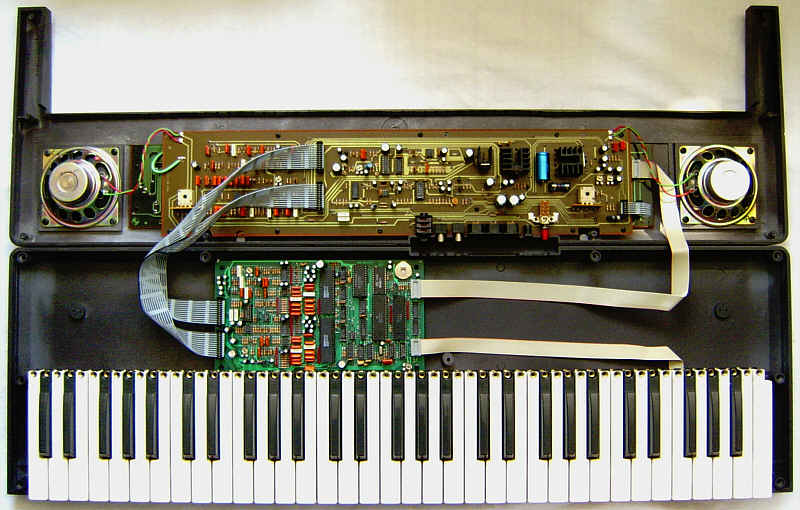
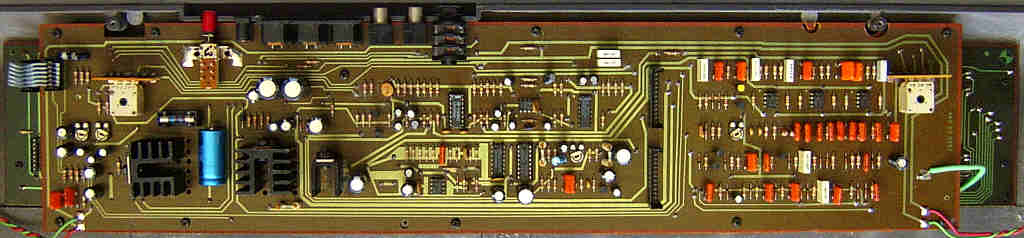
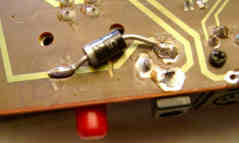
hardware detailsThe Madison OK 500 contains 2 main PCBs with many analogue and digital components. It is based on CPU Motorola MC6803P with external 8KB ROM+2KB SRAM, 2 sound ICs SGS M112B1 and the famous dual VCF "Curtis CEM3350" Dual Voltage Controlled State Variable Filter.Additionally there are some I/O ICs and a button cell to save memory contents (which may corrode traces when it decides to leak). The ROM IC is unfortunately a PROM ("Texas Instruments TMS25P64NL", software number "ZA64296 S101") and so may decompose over time (but I managed to dump its contents). The hardware strongly resembles Antonelli 2495 and 2614, but has real standard MIDI jacks, no strange daughter board and lacks the battery compartment. It also had no protection diode, and because it tends to hum when powered on at lower input voltages than 12V DC, I installed here a Schottky diode to avoid further voltage drop. (I haven't analyzed the hardware further yet.)
pinout M112B1The Polyphonic Sound Generator "SGS M112B1" (40 pin DIL) is a sound IC that was used in many (particularly Italian) semi-analogue keyboards and organs of 1980th. The datasheet describes it as a drawbar organ on a chip, but in fact it constitutes one of the last and most sophisticated squarewave sound ICs ever made, with massive thick timbres. That is to say, it mixes 7 "drawbars" of 32 step volume resolution, those each can either use or bypass the ADSR volume envelope in various ways (the bypassing ones have a hold level). The 8 note polyphonic tone generator supports 5 footages for a 6 octave keyboard (using 96 internal frequencies). So unlike many other sound ICs, the M112B1 is fed with note and octave numbers instead of cryptic internal frequency values. One or more polyphony channels can bypass the envelope. Sound channel 1 has its own non-enveloped output. The whole thing was obviously designed with drawbar organs in mind, so it even permits external analogue controls for hold or release phase, like used by an organ pedal. So e.g. the term "percussion" is used in Organese lingo, i.e. percussive attack phase and not a drumkit simulation or anything like that (it has no noise waveforms). But unlike a classic Hammond organ the timbres sound like multipulse squarewaves on steroids, because the drawbars are 7 plain squarewaves (50% duty cycle, each octave can be separately muffled by external filters) layered together. The drawbar circuit can mix only 4 of the 5 available footages {L, M1, M2, H1, H2} at a given time. As far I understand, ADSR parameters can not be defined individually, but there are only 8 preset envelope shapes, those however can be modified further by external analogue ciruitry.The sound IC is controlled by an external CPU, that (as far I understand) can switch the footages to 3 different ranges and select 3 output configuration modes {normal, sawtooth, accompaniment} those control which sound channel appears on which output pins.
4 enveloped footage outputs {LE, M1E, M2E, H1E} and 3 non-enveloped outputs {L, M1, M2}. All channels are present on each output.
Channels 2 and 3 appear only on outputs FM1 and FM2 (footages M1 and M2) and are excluded from the rest. All 5 footages are available as enveloped outputs. (As far I understand, the drawbar waveforms will be still plain squarewave and need a highpass filter (capacitor) in series at the octave outs to produce sawtooth.)
All channels are on 3 non-enveloped outputs {FL, FM1, FM2} for chord generation and can be disconnected on command. Channels 4..7 are on 4 enveloped outputs for arpeggi. The octave outs are used for bass and contain only channel 8.
I haven't measured this by myself but read the datasheet. Each channel contains 2 VCA to keep octave and footage outputs separate. The analogue octave output pins 26..33 contain envelope and output all currently played partial tones within that octave as squarewaves. The reason for these is to add one lowpass filter per octave to shape them more sine-like. Such strange concepts like having a filter bank of separate RC filters for each octave are what makes old squarewave based keyboards sound so special. (I expected here Walsh synthesis, but according to the datasheet the drawbar squarewaves are plain.) The individual footage output pins 14..20 can (depending on programming) contain envelopes or not. They were likely designed to permit a row of switches or analogue drawbars on an organ panel to mix tones together. Pin 25 can control the release time constant (likely intended for an analogue sustain pedal); for this it has to be connected with a 1uF cap against GND and with the wiper of a 10k potentiometer that has its ends on GND and +12V. Pin 12 can be wired the same way to adjust the ADR time constant. In Siel MK 900 schematics (same like Madison OK 500?) the 8 envelope capacitor outs have each 1uF to GND and a diode in series with 220k resistor to one common envelope control pin with 6.8K pullup resistor to +12V. That pin has a diode in series with 1.5k to the digital output of a logic IC "4094". According to the datasheet, the diode and resistor helps to make the attack less spiky for a realistic piano envelope. The schematic numbers the data bus pins in different order (pin 11..6 = D0..D5), which likely refers to the employed CPU. |
A very similar looking keyboard with Antonelli
2614 hardware was released as Madison OK 300 (seen on eBay).
| removal of these screws voids warranty... | ||
 |
 |
|
|
|