|
|
This keyboard from 1985 (service manual date) has semi- analogue sound and semi- analogue percussion with versatile "Super Drums" rhythm slide switches and accompaniment. The coarse multipulse squarewave timbres sound nicely cheesy.
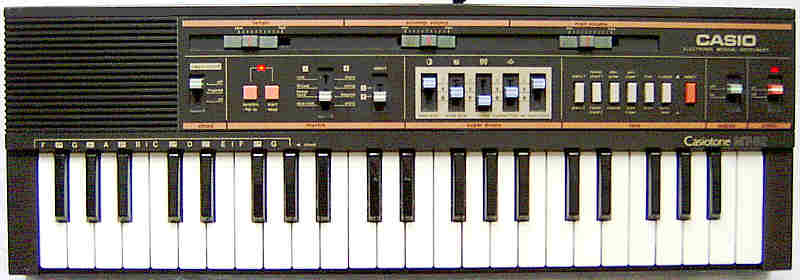
The general behaviour of this instrument has many similarities with Casio MT-500, but the percussion is semi- analogue instead of sample based and it also lacks the drumpads and drum trigger inputs. Also the timbres have a coarser multipulse squarewave- appeal that sounds less noble but nicely cheesy. The original German retail price of the MT-52 in a German Conrad catalogue from 1988 was 299DM (about 150€). Also a white version was made.
Due to the many similarities I only describe here the differences to MT-500.
Also the percussion sounds much like CT-410V. Despite only 8 preset
rhythms there are plenty of variations adjustable because each has 2 rhythm
variations and like with MT-500 there are 4 Super Drums switches
those switch 4 percussion tracks among 3 variations each. Annoying is that
also here the individual percussion tracks can not be muted individually.
The patterns differ from MT-500 but the accompaniment also here accepts
non- standard chords, and they are even programmed more versatile; e.g.
"slow rock" contains an arpeggio that plays the more notes the more keys
are held down in the accompaniment section. Also the fill-in pattern has
accompaniment. The bass and chord voices employ nicely sonorous multipulse
squarewave, that is less muffled than with MT-500.
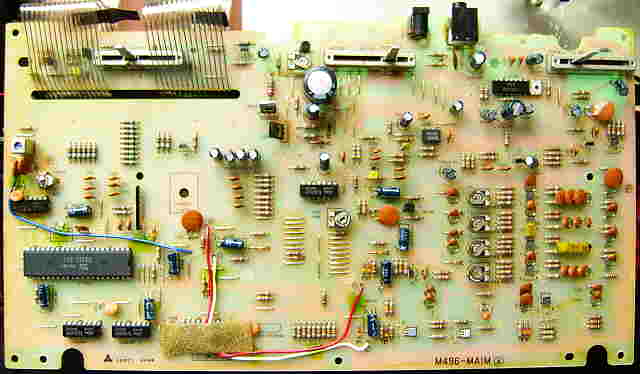
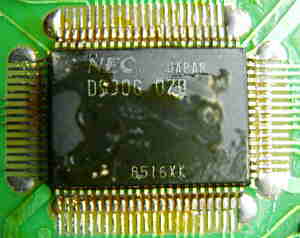
hardware detailsThe Casio MT-52 is based on the same hardware family like MT-65 and CT-410V. While the main voice sound IC "NEC D931C 011" is the identical, the accompaniment CPU "NEC D930G 020" here has a different software number to handle Super Drums. But despite semi-analogue percussion, the relatively small PCB is much simpler, well accessible and has a clear straight forward design like made for circuit bending.
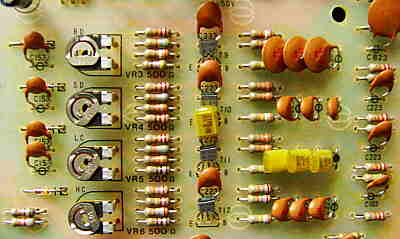
E.g. the 4 discrete analogue percussion envelope circuits form a well visible rectangular section and have each a trimmer for adjustment. This is what Casio considers the official percussion decay settings (fall time between first and 2nd last positive peak, found in MT-52 and CT-320 service manuals). |
| percussion | trimmer | duration | circuit abbreviation |
| base drum | BD VR3 (CT-320: VR1) | 13ms +/- 10% | B.D |
| snare | SD VR4 (CT-320: VR3) | 8ms +/- 10% | SD.N & S.D |
| low conga | LC VR5 (CT-320: VR5) | 80ms +/- 10% | L.C |
| high conga | HC VR6 (CT-320: VR4) | 40ms +/- 10% | H.C |
| rimshot | - | R.S. | |
| cymbal/hihat | - | CYM H.H. |
Trimmer VR1 tweaks the supply voltage (should be +5V). Trimmer VR2 is bit compensation for linearity of the main voice DAC.
A fixed lowpass filter (same like MT-65) modifies the main voice timbre.
These are the filter switch outputs of the D930 CPU shown in MT-52 and
CT-320 service manuals.
|
|
|
IO-2 | IO-3 |
| piano 1 |
|
|
|
| harpsichord 1 |
|
|
|
| elec. guitar |
|
|
|
| jazz organ |
|
|
|
| flute |
|
|
|
| trumpet |
|
|
|
| piano 2 |
|
|
|
| harpsichord 2 |
|
|
|
| celesta |
|
|
|
| pipe organ |
|
|
|
| violin |
|
|
|
| synth. reed |
|
|
|
|
|
|
|
|
|
|
|
|
|
|
|
|
|
|
|
|
|
|
|
|
|
|
C1 |
C#1 |
D1 |
D#1 |
E1 |
F1 |
|
|
|
|
|
F#1 |
G1 |
G#1 |
A1 |
A#1 |
B1 |
|
|
|
|
|
C2 |
C#2 |
D2 |
D#2 |
E2 |
F2 |
casio |
fingered |
|
|
|
F#2 |
G2 |
G#2 |
A2 |
A#2 |
B2 |
|
|
|
|
|
C3 |
C#3 |
D3 |
D#3 |
E3 |
F3 |
|
|
|
|
|
F#3 |
G3 |
G#3 |
A3 |
A#3 |
B3 |
|
|
|
|
|
C4 |
C#4 |
D4 |
D#4 |
E4 |
F4 |
|
|
|
|
|
F#4 |
G4 |
G#4 |
A4 |
A#4 |
B4 |
|
|
|
|
|
C5 |
|
start/stop |
synchro |
sustain |
|
|
|
|
|
|
piano |
harpsichord |
elec. guitar |
jazz organ |
flute |
trumpet |
select |
|
|
|
|
bass/chord II |
bass/chord III |
cymbal II |
cymbal III |
conga II |
conga III |
snare II |
snare III |
|
|
|
rock |
16 beat |
bossanova |
slow rock |
select |
base II |
base III |
|
|
The input lines are active-low, i.e. react on GND, thus any functions
are triggered by a switch in series to a diode from one "in" to one "out"
pin. Super Drums slide switches default to "I" when no other place selected.
legend: |
|
|
|
= keyboard key |
|
|
= function needs locking switch (i.e. stays active only so long the switch is closed) |
|
|
= preset rhythm |
|
|
= preset sound ('orchestra') |
|
|
= chord |
| orange
background |
= easteregg (unconnected feature) |
An MT-52 version with 49 fullsize keys was released as Casio CT-320
(released in a brown and a gold metallic case variant).
| removal of these screws voids warranty... | ||
 |
 |
|
|
|