|
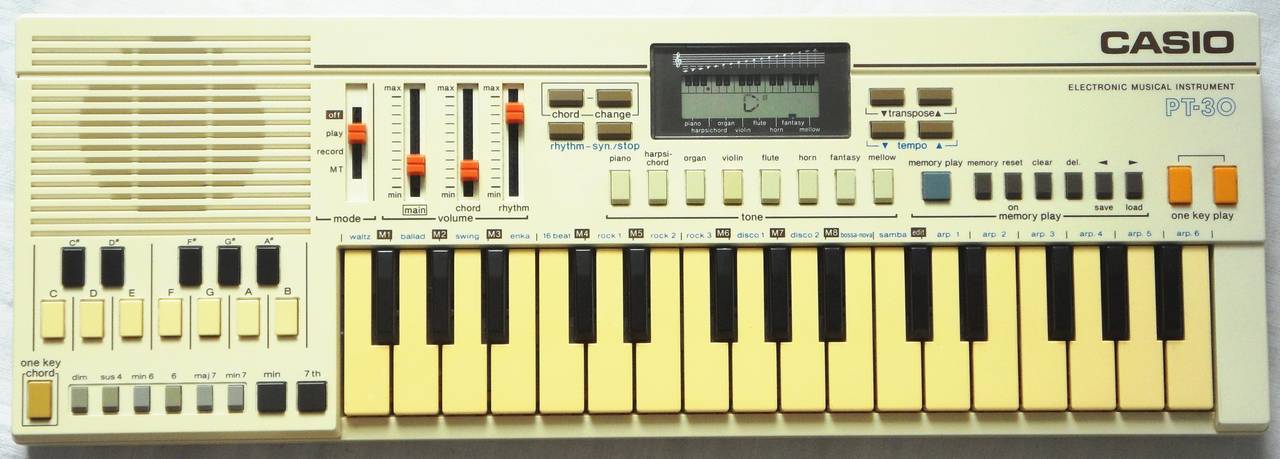
The instrument has only a monophonic main voice with warm sounding 4-channel chords, but it features 18 nice rhythms made from semi-analogue percussion with quite special sounding white noise cymbals. There is also a well useable editable sequencer. Thanks to partially different waveforms, separate bass channel and more analogue post-processing, the PT-30 is IMO the best sounding keyboard of the early PT-series.
A dark grey version of this instrument was released as Casio PT-31 and a wine red French version as Liwaco LW-630.
|
 |
 |
 |
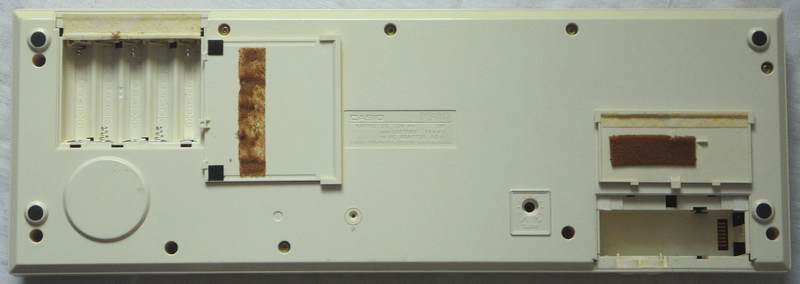
warning: By a hardware bug, the PT-30 tends to crash (lockup) during battery insertion and will not respond to controls anymore. If this happens, switch it on and press the tiny "P" (reset) button at the case bottom with a pointed object to clear memory (erases sequencer contents). To avoid the crash, if the instrument was left without batteries for over a minute (which corrupts SRAM contents) always slide the mode switch into "play" position before inserting batteries or connecting a power supply.
Although the single finger chord section looks interesting, its capability is very restricted; during rhythm the organ chord is always replaced by automatic accompaniment (like with most keyboards) and it is also generally impossible to play fewer or different tones than a standard 3 or 4 note chord, thus this instrument forces the player only to play tone combinations those its programmed musical dogma regards as a chord. A little confusing is also that it ignores further chord type button presses when a chord note key is held, thus you have to also release and press again that key before you can choose another chord type, which is bad for learning by direct comparison how chords sound.
But despite all this the PT-30 has some interesting sounds; generally the tones are a bit harsher than my Casio VL-1, and unique is that the 'mellow' sound (a sort-of vibraphone) has a tremolo envelope that turns faster while fading silent. The 'organ', 'violin', 'flute' and 'horn' all include short sustain and a 6Hz vibrato. 'fantasy' is (similar like on VL-1) a high synth flute timbre with longer sustain and 6Hz vibrato (that also turns a tiny bit faster during sustain?). Its a pity that the PT-30 has neither the famous VL-Tone ADSR synthesizer feature nor real polyphonic play. Much like with the VL-1, the 'harpsichord' suffers from a too slow attack rate, which makes it unrealistic. I also discovered that when shitshot by battery wiggling it sometimes makes other sounds than the built-in presets, much like my VL-1 does.
The analogue rhythms have an interesting timbre with partly long sustaining white noise "cymbals". The bongos & congas seem to be based on squarewave tones produced by the main CPU and muffled by external capacitors. But at least my PT-30 specimen has not the strange popping base drum of the technically similar PT-80. The manual organ chord mode plays a sort of thin metal pipe organ rank timbre layered with a warm and dull organ bass and a small dose of sustain. The accompaniment with rhythm simulates a kind of piano and e-bass sound using these waveforms with decay envelope. The 2 "chord change" buttons almost immediately restart the current rhythm pattern on each a different step, which can be used as a sound effect.
The sequencer works quite similar like with Casio VL-Tone 1. To record or edit anything in the sequencer contents, switch the power switch to "record". You can now simply play keyboard (including chords) and everything is recorded. Press "memory play" to listen to it. To change the note lengths, play the melody with the "one key play" buttons in the correct tempo. To delete the last heard note or chord press "del.". Use the arrow buttons "<", ">" to step back and forward (notes and chords sound alternatingly to ease deleting). Any now played notes or chords are inserted at the current position. With the "chord change" buttons you can step the value of a currently displayed chord up and down. To delete the entire song, press "clear". The sequencer supports 8 songs; to switch between songs, press "memory" followed by one of the black keys "M1".."M8". I have no manual for my PT-30, thus there may be still hidden features I don't know. E.g. you can select "edit" here, which in "play" mode simply behaves like an empty memory and in "record" mode mutes the keyboard. The arrow buttons are labelled "save" and "load", which likely refers to the optional TA-1 expansion module to save sequencer data on audio cassettes. Likely you have to set the power switch to "MT", select a song memory and press "save" or "load" to save or load data from cassette.
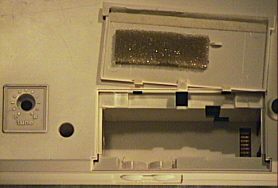 |
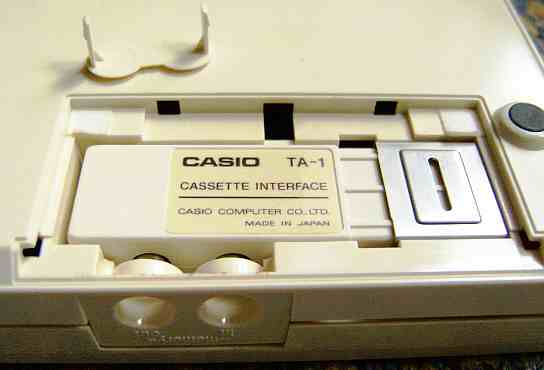
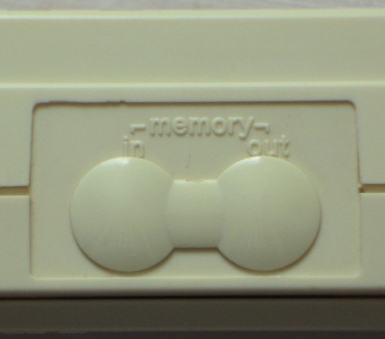
Here you see the open expansion cartridge slot at the bottom of my
PT-30.
At the back you see 2 plugged holes labelled with "memory in/ out"; the
expansion module Casio TA-1 could be inserted here for saving sequencer
data on audio cassettes.
To the left of it you see the pitch trimmer for tuning the instrument. |
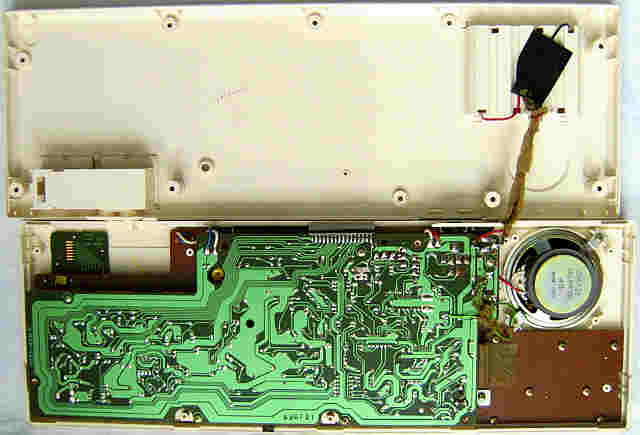
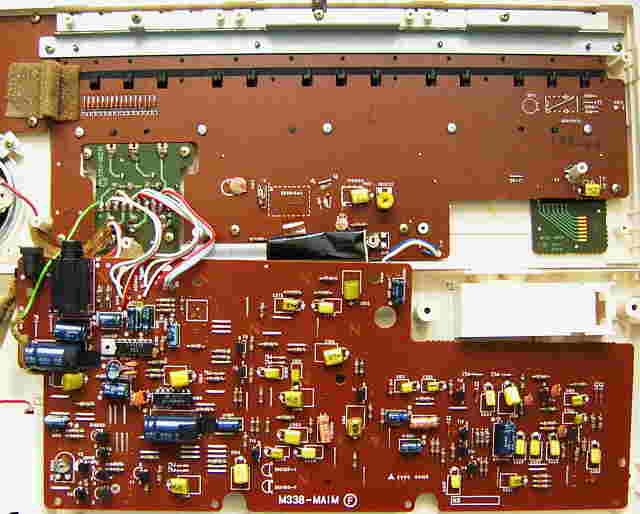
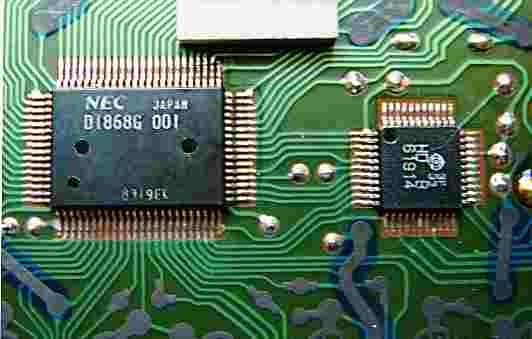
hardware detailsThe Casio PT-30 is built around the CPU "NEC D1868G 001" (600 kHz according to PT-50 service manual) with sequencer SRAM "Hitachi HD61914B". The Casio PT-20 is a downsized version of it that lacks 2 keys the LCD and has no TA-1 slot.The PT-30 concept is detailedly described in the US patents 4539882 (general with accompaniment algorithms). The tape storage is in US patent 4614983, which suggests an automatically controlled cassette drive (like with Casio KX-101) and alphanumeric file names. As this first software version of the CPU it did not support ROM-Packs but only the tape storage cartridge TA-1. So waveforms and implementation partially differ from Casio PT-50 and later models.
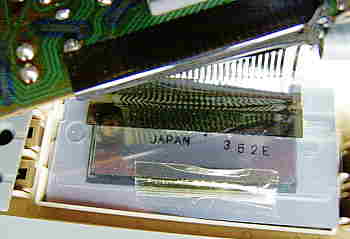 Unfortunately
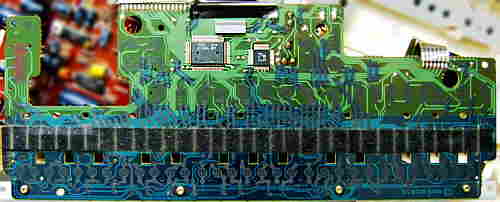
the SMD CPU sits at the rear side of the control panel PCB, which makes
this instrument extremely awkward to analyse because the buttons and silicone
contacts tend to fall out and the LCD with its fragile plastic foil cable
can easily break or get dusty inside during measurement attempts at the
CPU. So I finally bought a 2nd specimen for hardware examination (the LCD
survived). The CPU is of the same "D1868G" series like in Casio
PT-80, but the following 3 digits are different and it communicates
with an additional small IC "Hitachi HD B, 61914". Initially I had though
the small IC would be an external program ROM and the CPU would be the
same. But because my
PT-50 contains
also a D1868G series CPU and 2 identical "HD B 61914" ICs, and the latter
are also used in the RAM-Pack RA-1,
I conclude that the 61914 ICs are SRAMs for the sequencer, and the numbers
"001" and "007" at the end of the CPU type "D1868G" instead indicate that
both CPUs contain different software in their internal ROM. The PCB label
"HD61914" hints that the SRAM number with 3 letters above is read as "HD61914B". Unfortunately
the SMD CPU sits at the rear side of the control panel PCB, which makes
this instrument extremely awkward to analyse because the buttons and silicone
contacts tend to fall out and the LCD with its fragile plastic foil cable
can easily break or get dusty inside during measurement attempts at the
CPU. So I finally bought a 2nd specimen for hardware examination (the LCD
survived). The CPU is of the same "D1868G" series like in Casio
PT-80, but the following 3 digits are different and it communicates
with an additional small IC "Hitachi HD B, 61914". Initially I had though
the small IC would be an external program ROM and the CPU would be the
same. But because my
PT-50 contains
also a D1868G series CPU and 2 identical "HD B 61914" ICs, and the latter
are also used in the RAM-Pack RA-1,
I conclude that the 61914 ICs are SRAMs for the sequencer, and the numbers
"001" and "007" at the end of the CPU type "D1868G" instead indicate that
both CPUs contain different software in their internal ROM. The PCB label
"HD61914" hints that the SRAM number with 3 letters above is read as "HD61914B".
The SRAM is wired to the same CPU bus pins like the ROM-Pack port in later models. The boombox version Fisher SC-300K (seen in forum) has a different PCB with already integrated TA-1 hardware instead of a slot. Strange is that its case and PCB were prepared for amp section, speaker mount and MT port jacks despite none were built in. This keyboard instead communicates with the boombox through a 9 pin connector at case bottom. audio channels The 16 pin ribbon cable has pins 3..16 directly connected to CPU pins 80..67, so all the audio goodies can be directly accessed from there. Only the white noise out (CPU pin 72) has a resistor in series (to reduce RFI?). Pin 1 is reset (CPU pin 21), 2 is not used. multipulse squarewave & timbre filter The main voice is based on multipulse squarewave sound synthesis and
strongly resembles Casio VL-1. The
digital oscillator outputs for each timbre an up to 16 steps long repeating
bit loop of square blocks of equal height. (Because the internal rotation
is unknown, I sorted them by the longest sequence of '1' as the start;
'organ' is the same like in Hing Hon EK-001.)
The waveform is multiplied in a VCA with the coarse digital envelope control
voltage from a separate CPU pin. The envelope height differs among sounds
to match the volume (and shorten certain sounds?). The main voice is routed
through 2 fixed timbre filters, those are controlled by CPU outputs pins
68 O4 (highpass) and 67 O5 (lowpass) for 3 timbre settings (both lo = unfiltered).
Casio
PT-20 likely lacks the highpass and thus has no 'harpsichord' button.
Despite the melodic drums waveform (plain squarewave) already contains a very grainy digital decay envelope (about 3-bit, even trying hard to look logarithmic by multiple linear sections), they are postprocessed by an analogue filter. Possibly the CPU was originally designed not to need external envelope hardware, but it turned out that the resulting blip percussion sounded such poor (as everybody can hear in PT-82) that Casio added it. The cymbal/hihat is analogue (with trigger and envelope duration pin), and likely also the snare (has its own trigger pin). Both employ digital white noise from a CPU pin. MT-Port pinoutThis is the pinout of the MT port for the digital cassette interface.
keyboard matrixThe keyboard matrix layout is an absolute illogical mess. Despite the PT-30 hardware is definitely not derived from existing pocket calculators, like in Casio VL-1 the keys are cluttered everywhere across the matrix without any logical order. I can only guess that possibly this should ease internal computation of pitch from matrix positions, or should reduce the risk of accidental matrix shiatsu when pressing nearby keys together. Successors had all different matrix layouts those look cleaner, which makes me conclude that their software was always rewritten from scratch instead of making only small changes to an existing framework.In PT-30 the matrix inputs use 2 groups of diodes (one row on PCB) for chord section and piano keys to make them not interfere when pressed simultaneously. Panel buttons vary in to which group they are connected. The outputs KO1..KO3 and inputs KI1..KI8 are accessable (top to bottom) at the ribbon cable to the chord section PCB. The other outs are spread everywhere across the main PCB. I found no interesting eastereggs. At KO8->KI9 a 3rd 'one key play' button can wired, that behaves like
the 2 others. It even works while one of the others (but not both) are
held down, which proves that the algorithm does not confuse it with them.
The input lines are active-high, i.e. react on +Vs. Any functions can
be triggered by a non- locking switch in series to a diode from one "out"
to one "in" pin.
The only halfway interesting easteregg is 'HALT'. While connecting KOI1->KI5 through a diode it stops rhythm and vibrato. It also halts keyboard scanning, so any pressed or released keys or buttons are ignored. A still held note is stopped when HALT is released. Likely it disables internal multitasking or stops a timer. It may be that this was meant to become an unfinished 4th mode of the mode switch, but unlike its other modes it needs a locking switch, so it may be also a test feature or just a bug. |
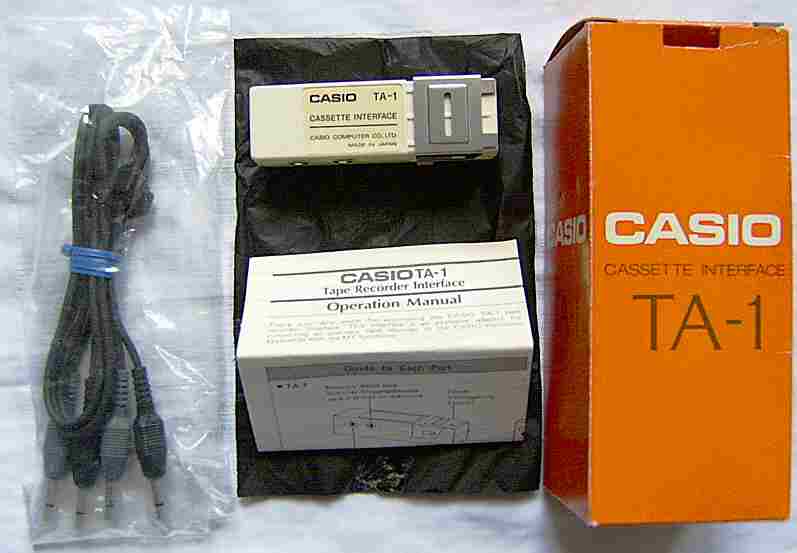
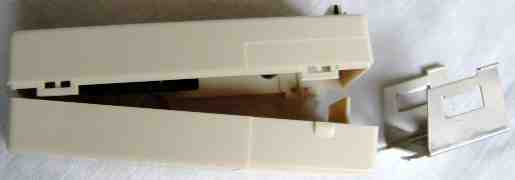
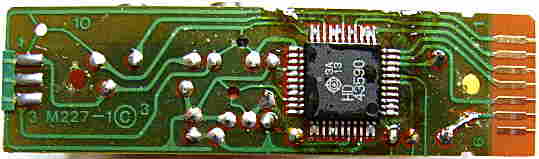
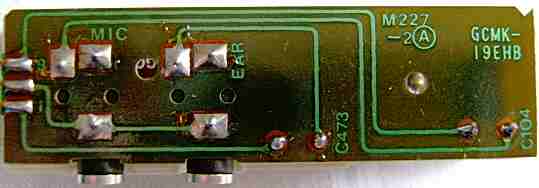
| Casio TA-1 (tape
storage cartridge for sequencer data)
I finally got the occasion to buy the very rare Casio TA-1 cartridge ("Tape recorder interface for CASIO electronic keyboard"), originally packaged with manual and connection cable.
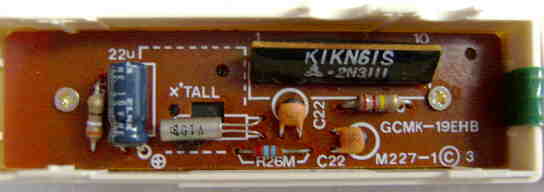
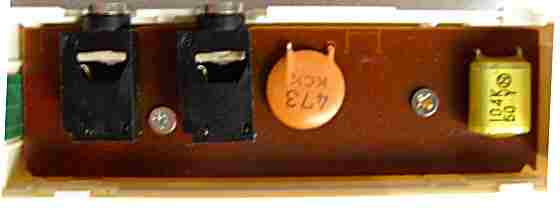
Unlike my expectation it is not just an empty "pay additional luxury" dongle plug with a few jumper wires or cheap resistors inside to fool customers, but it contains indeed 2 ICs, a clock crystal and some discrete components soldered on 2 small PCBs. The ICs are "HD 43590, 3A, 13" (44 pin SMD) and "KIKN61S, 2N3111" (10 pin COB).
I don't know if "Kansas City standards" is anything documented or just
a fancy name for a proprietary data format. The tape storage is described
in US patent 4614983, which hints that it may refer to a data compression
method. Apparently also certain 8-bit homecomputers used it, so it may
be compatible with emulators. I yet haven't tested to save and load data
with it. As far I know, only the Casio PT-30
and PT-50 have a cartridge slot for
the TA-1, but also others may exist; in the TA-1 manual there is no list
of compatible instrument models included.
An interesting fact is that Casio first advertised this tape saving feature as "MT" (for "magnetic tape") and later(?) named their entire midsize keyboards series "MT-..." despite none of them included a tape interface. Later Casio named a midsize toy keyboard with built-in stereo cassette player Casio TA-10, which also has no sequencer functions. |
Also the rare boombox Fisher SC-300 Stereo Composer (aka Sanyo KBX-7) contains on its top a detachable PT-30 (with integrated TA-1, no speaker, different case style resembling PT-50). A direct successor of the PT-30 was the Casio PT-50, which case layout looks almost identical but has a ROM-Pack music cartridge slot (without key lighting) in the upper right corner and the strange case groove is gone. It could not only save sequencer data on cassettes (using the optional TA-1), but even on very obscure RAM-Pack cartridges those look like ROM-Packs but are undoubtly as rare as the TA-1. In detail there are many small differences between PT-30 and PT-50; e.g. some sounds and especially the entire rhythm set is different.
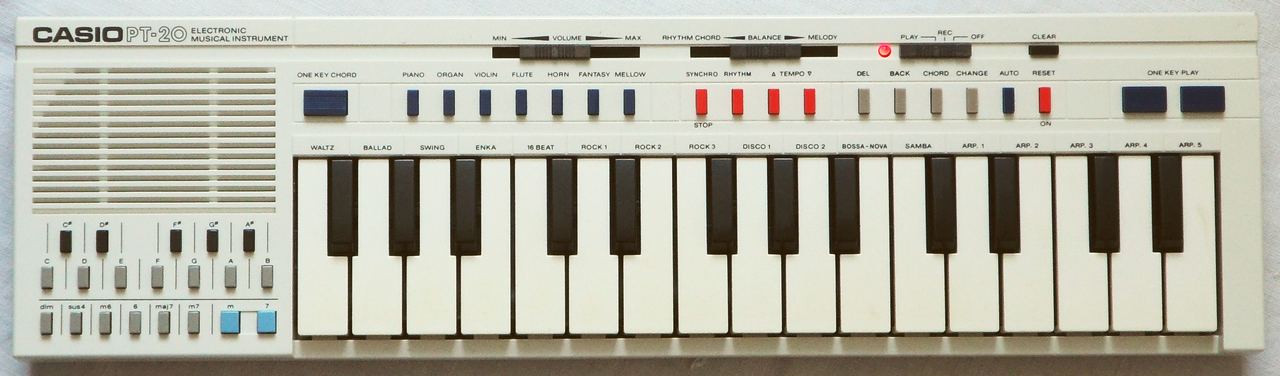
Unlike the latter it is missing the LCD, the cartridge slot, 2 keys and several buttons. Instead of separate rhythm and chord volume sliders it has only a combined slider. Its small case resembles the Casio PT-1. The original German retail price in a German Conrad catalogue of 1986 was 199DM (about 100€).
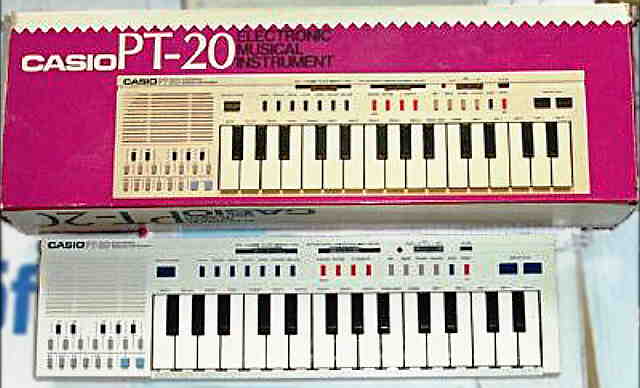 (old eBay photo of my specimen)
 |
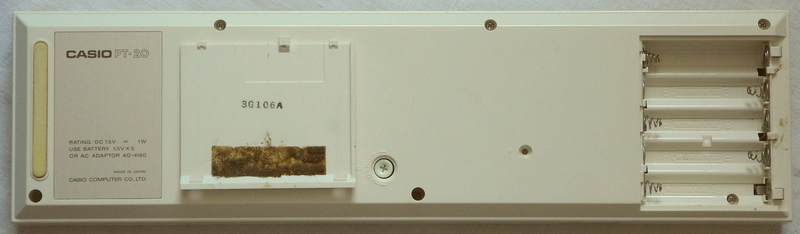 |
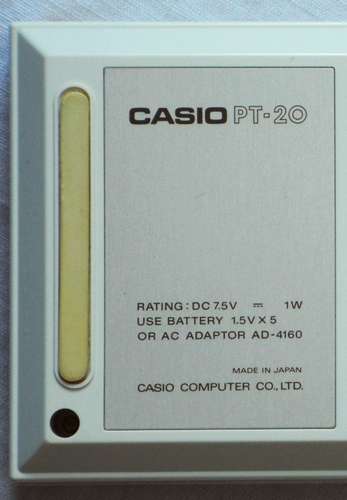 |
 |
The most advanced member of this hardware family was the ultra-rare
keyboard boombox Casio KX-101 (37
mini keys, chord button pad, complex sequencer that saves data on audio
cassettes), which was even 4-note polyphonic.
| removal of these screws voids warranty... | ||
 |
 |
|
|
|