 |
 |
|
|
|
Very little is known who invented this awesome single chip sound generator.
It was likely made by Holtek. I don't know if the following was
indeed the manufacturer or only an importer of the keyboard, but here is
the (now likely outdated) company address of 1999 from Asian Sources:
|
 |
 |
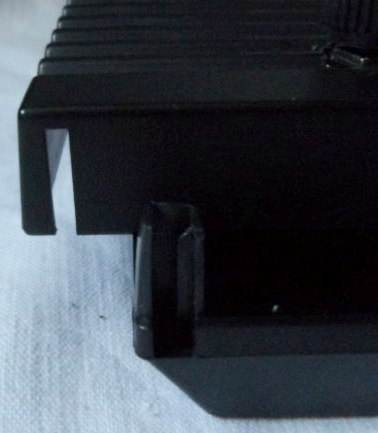
strap slot |
| warning!
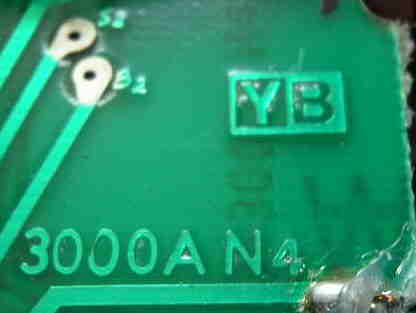
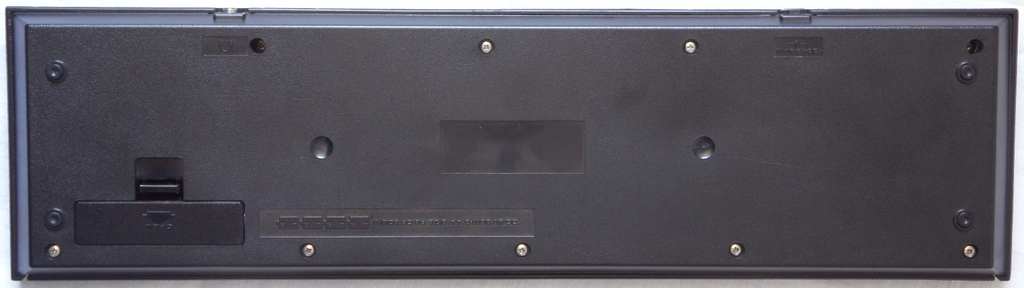
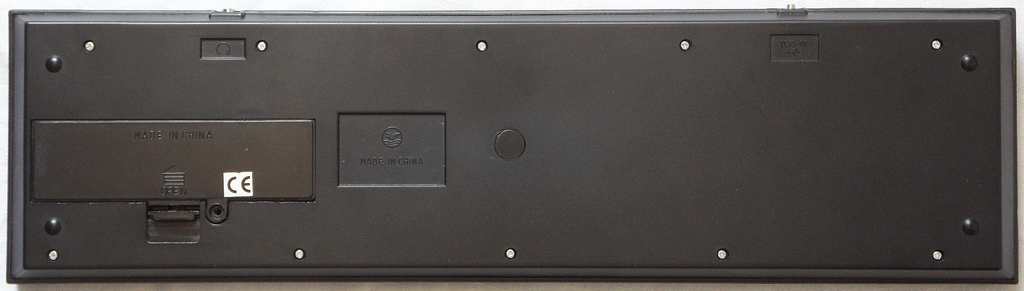
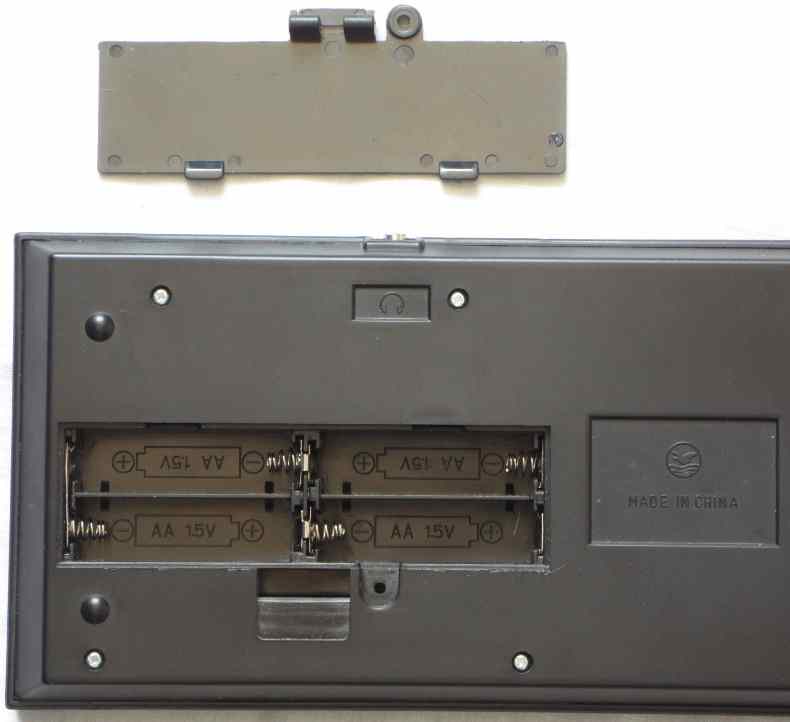
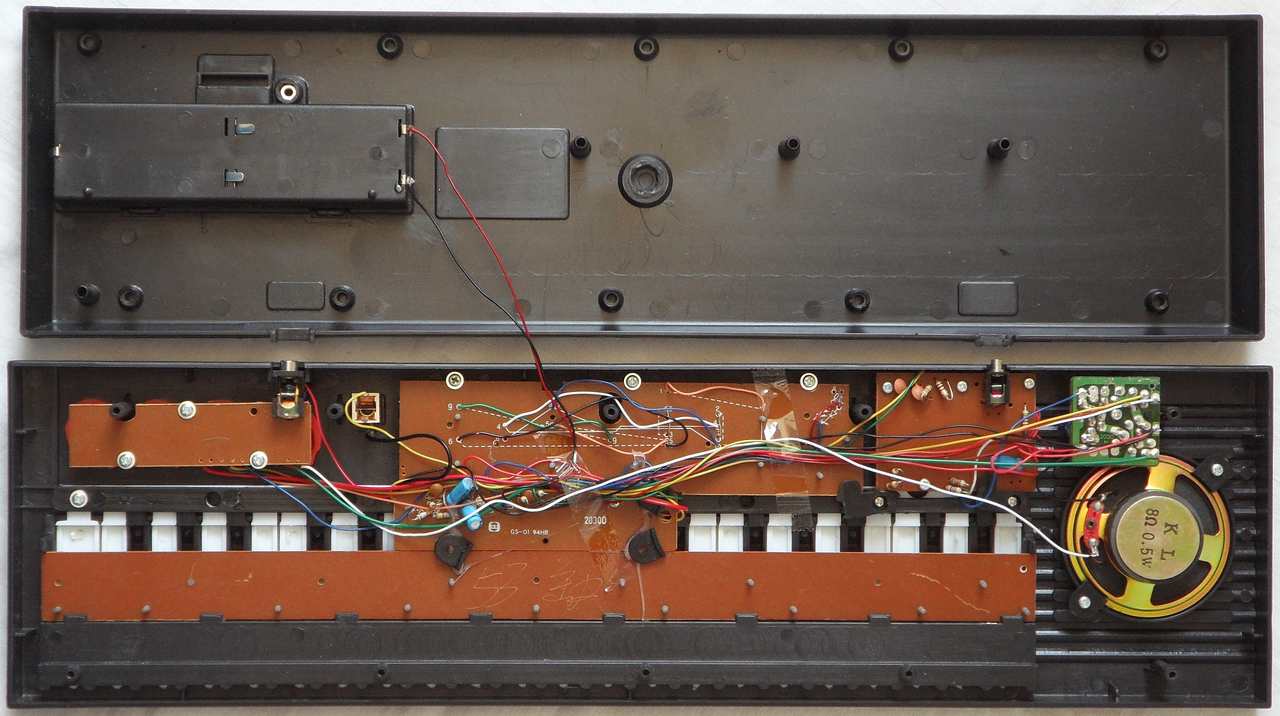
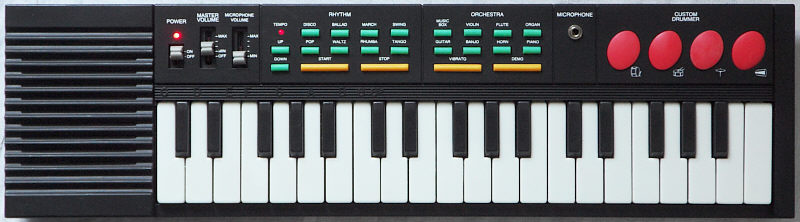
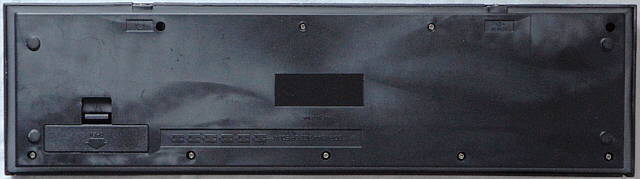
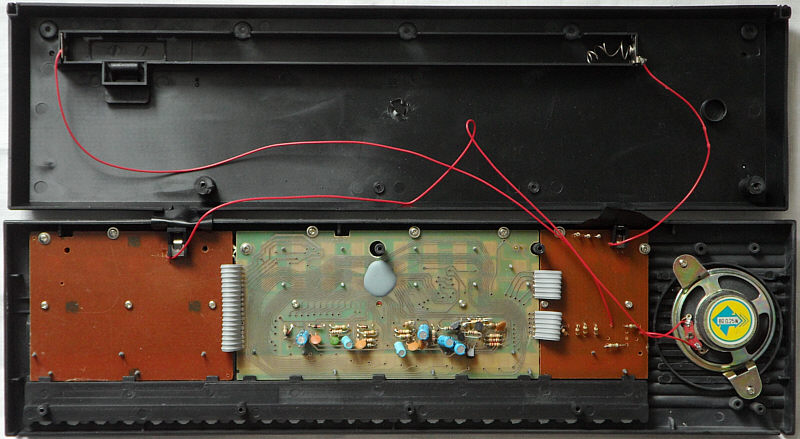
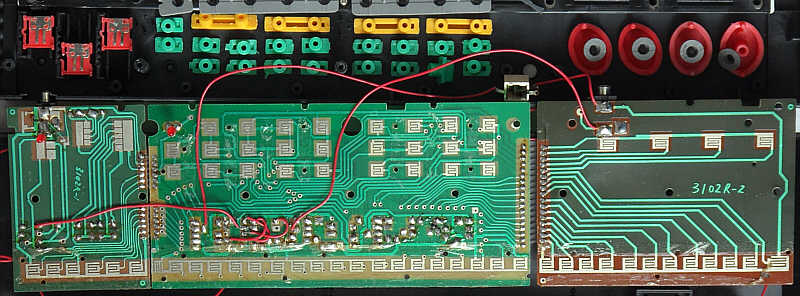
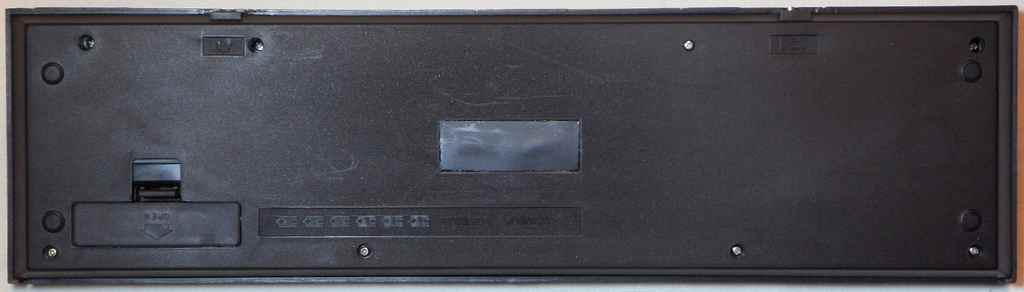
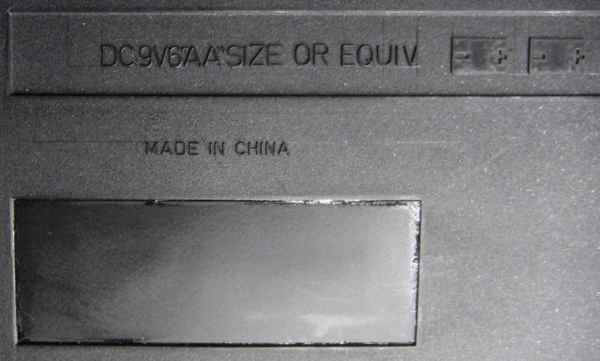
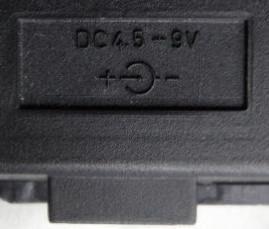
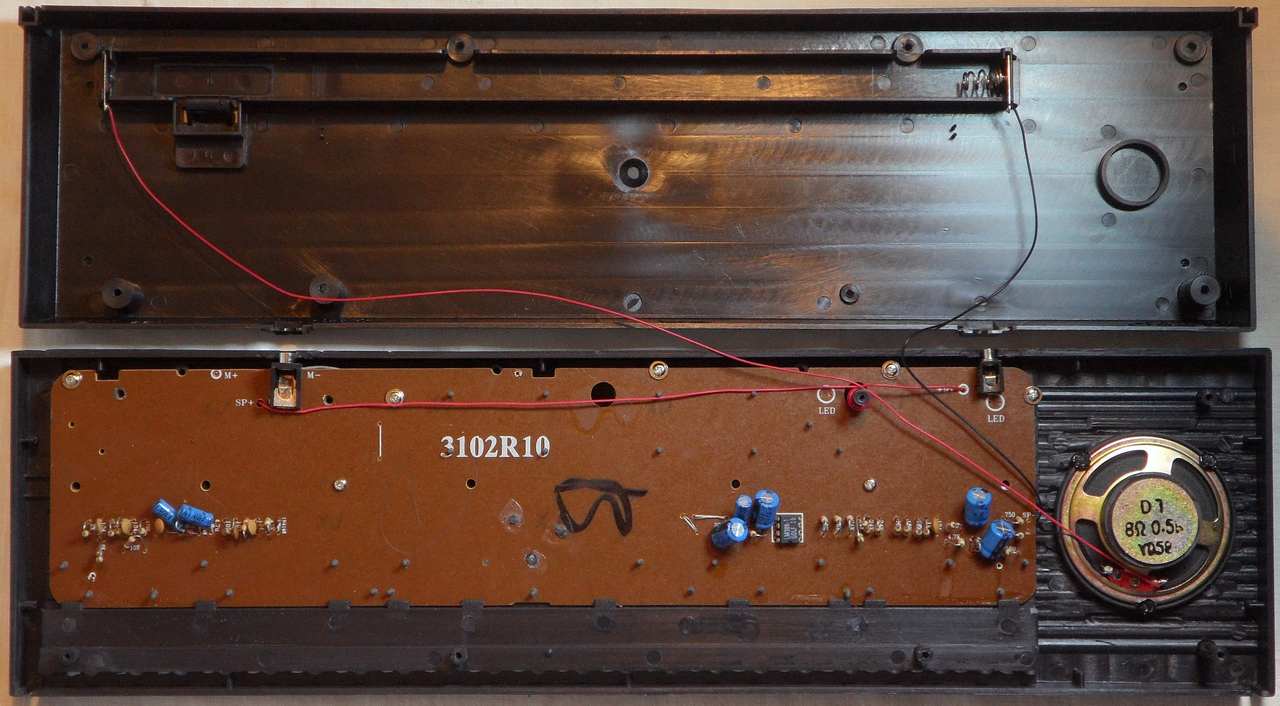
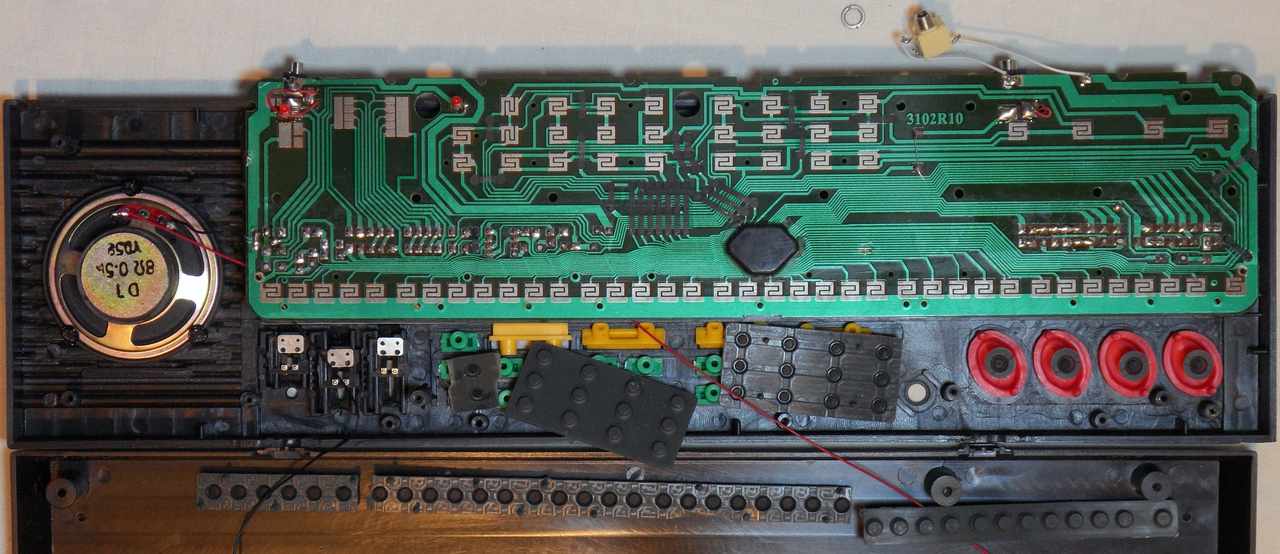
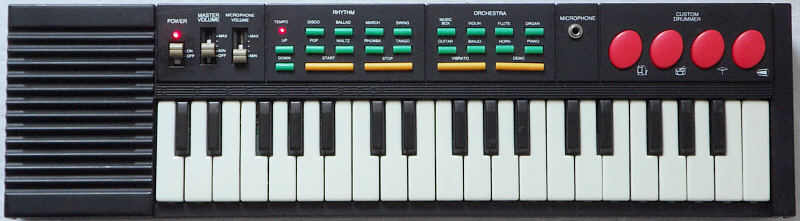
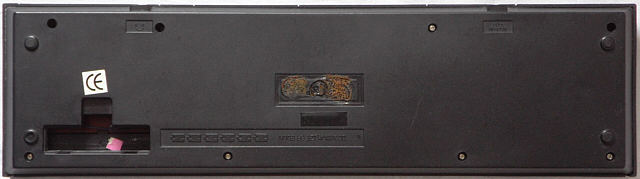
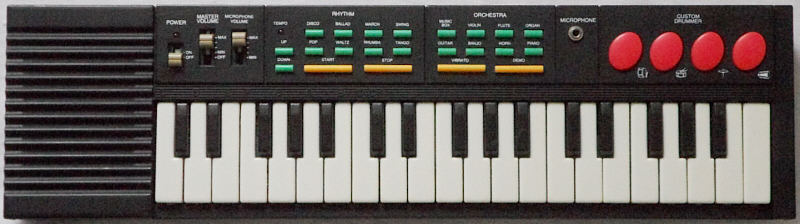
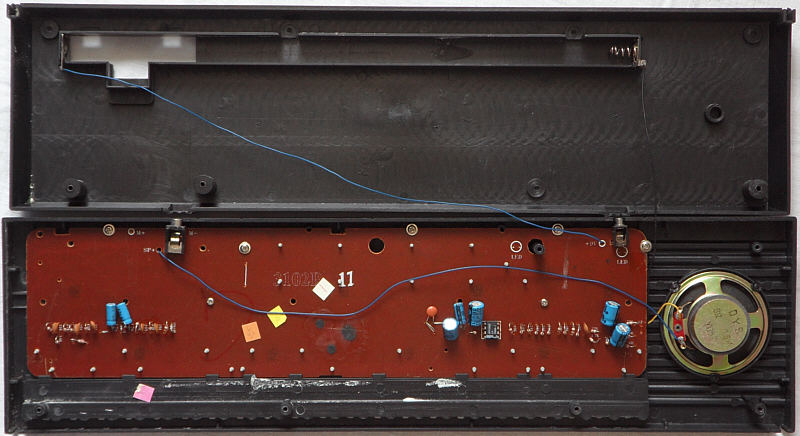
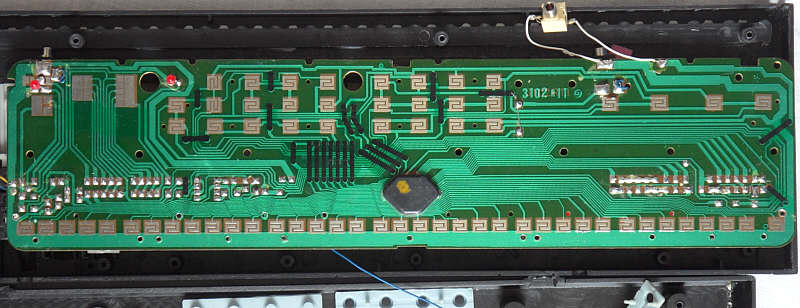
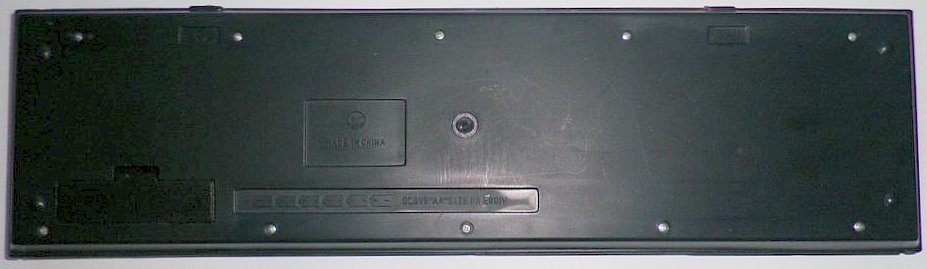
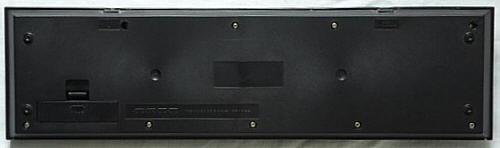
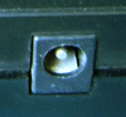
The Hing Hon EK-001 was released in many versions (made by different factories), of those some are of much lower build quality (e.g. switches and battery springs fail) and can sound terribly distorted. Thus buying one is like mushroom picking. You strictly need an identification chart to avoid a terrible experience. (Here is the detailed overview.) Bad ones can be used (do not discard them!) but need modification to work properly. The best sounding version (PCB "YB 3000A N4") has its LED label "TEMPO" misplaced at the power LED (above the power switch under the word "POWER"), while others place it correctly. It has only 4 AA batteries in one row (others have 6 or 2x 2 rows), 5 step volume switches and smooth plastic. This makes me conclude that it was the 1st generation and likely designed as direct successor of the similar looking Elite MC-2000, which SC-MC-2 CPU indeed flashes its power led to indicate tempo. Another good sounding version has the PCB label "2030". The grey slide switches and their grooves are much wider and in different order (POWER, MICROPHONE VOLUME, MASTER VOLUME). It has 4 AA batteries in a changed compartment (2 rows of 2) and many case details differ from all others. But it contains many small PCBs interconnected with flimsy solder joints those may fail over time and need resoldering. Mine is detuned by 4 full notes. I also found e.g. an awful sounding cheapened EK-001 version (PCB "3102 R"), which has 6 batteries and a 2.5mm phones-style AC-adapter jack. It is of rougher and brittle plastic (volume switch nib broken) with changed text size and icons (lowest volume setting labelled "OFF"), and its too big rear jack holes have a bezel of black plastic foil. The bottom is embossed "MADE IN CHINA" and has a plain black rectangular sticker covering a center hole. It distorted extremely when volume is not at maximum, because the amp IC was replaced with a lousy 4 transistor circuit with too low bias current (but still drains battery faster). It has a smaller thin sounding speaker and tuning trimmer was omitted, so mine played 1 full note detuned. Mine even had a way too long and stiff battery spring, so I could not get all 6 in (the plastic would surely break by using raw force, so I had to shorten it). Do not use a power supply on the 3102 R; mine had the jack polarity embossed wrongways, thus connecting like depicted for sure will destroy it. Also feeding >9V overheats its amplifier. In a similar variant "3102 R S1" the switch contacts fell off by too flimsy plastic. Another quite similar looking version I found (PCB "3102R11", tempo led is farer left) has a proper amp IC, but the tempo led causes clicking and pressing buttons causes a thin buzz noise due to poor voltage stabilization. |
The preset sounds are made from multipulse squarewave with simple capacitor envelope, thus despite most don't sound realistic at all, they have a great own electronic style. The 'piano' has 4 seconds sustain and unfortunately ignores key press duration. 'violin' is made from a semi- sonorous multipulse timbre. 'organ' is the famous black and sonorous droning multipulse squarewave timbre with 4 seconds sustain that attempts to simulate a metal pipe organ rank. (The church organ turns more realistic when the decay pot is turned a little down; though the reverb starts with a lower volume than the tone itself.) Also 'horn' has that sustain. The 'banjo' is made from plain squarewave (i.e. unrealistic dull) with 8Hz mandolin ring and knocking attack that resembles more a trilled xylophone or undistorted marimba; pressing more than 2 keys immediately retriggers both already held notes and so modulates the phase of the ring effect. 'music box' is the typical high pitched plain squarewave musicbox timbre with 4 seconds sustain; its percussive attack makes it surprisingly realistic. 'guitar' is a bright sonorous multipulse timbre with such sustain, that is somewhat sitar- or banjo-like and may imitate a steel string or even Dobro sheet metal guitar. The vibrato button adds to all sounds a 6Hz vibrato (by modulating the clock oscillator); it seems to be operated by the same internal LFO like the mandolin ring, since with held notes it retriggers (changes phase) by trilling any additional key. Decaying sounds ignore key press duration and employ a different channel assignment algorithm that truncates held notes when more than 2 keys are pressed and responds a bit bouncy (too sensitive). Trilling any single key on decaying sounds increases volume (likely by charging the envelope capacitor), which is also noticeable when key contacts bounce.
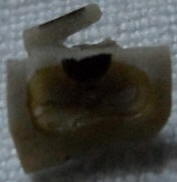
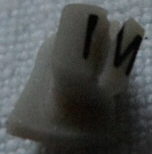
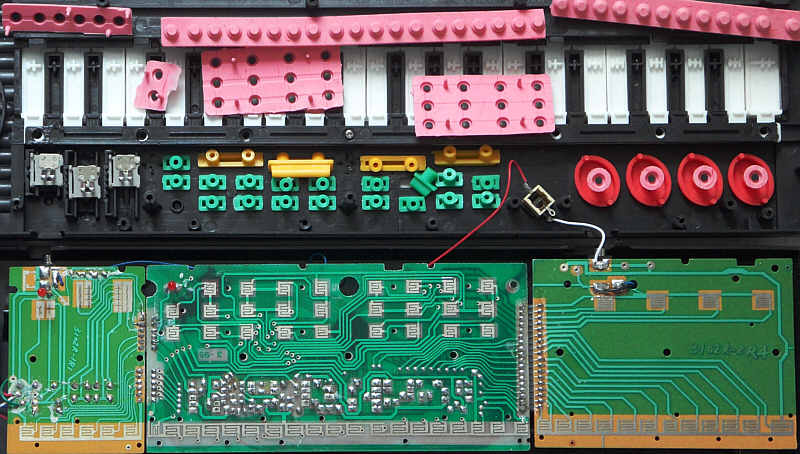
caution: The long buttons of the classic version (PCB "YB 3000A N4") can tip over and fall in when pushed too hard at a corner. If this happens; remove the PCB screws at that side, slightly lift the PCB and carefully poke under it with the thin end of a cable tie to realign the button into its hole.
The percussion are all made from either squarewave or shift register
noise with grainy digital envelope and have a wonderful POKEY style. The
cowbell (high squarewave with digital envelope and zipper noise) sounds
like a glass bottle hit. The snare uses a very rough and impulsive hissing
shift- register noise (like a historical videogame's MG shot), the hihat
uses a quieter hiss. The base is just a quick fading squarewave. These
percussion in spite of their basslessness sound incredible vigorous and
are an as outstanding sound discovery as the nowadays so well known and
everywhere imitated TR-909 base drum. An odd behaviour of the rhythm generator
is that the start button (like a tape recorder) continues the patterns
exactly at the same note they were stopped instead of starting on the '1'.
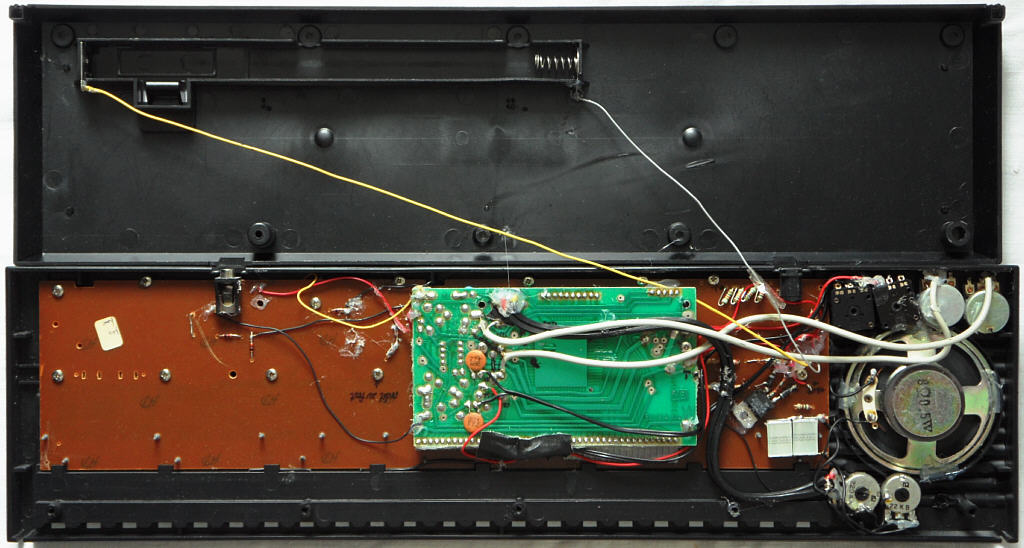
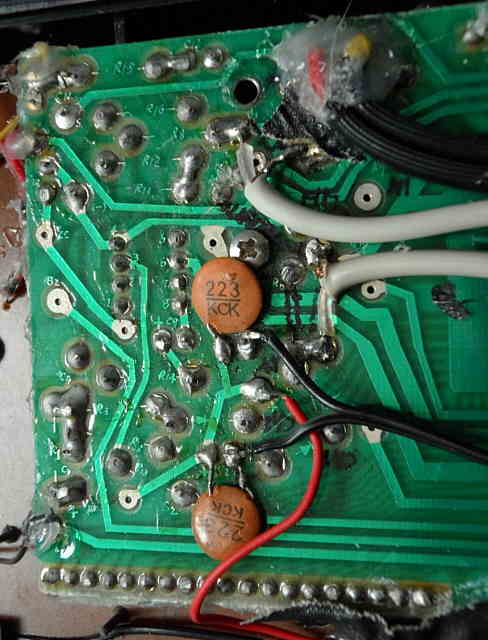
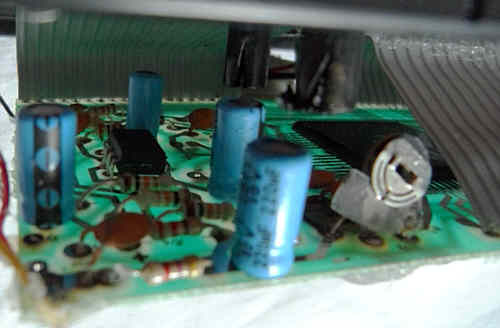
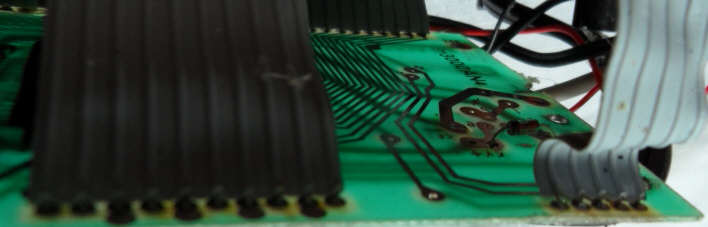
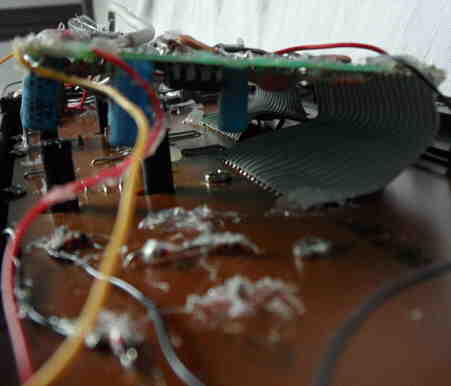
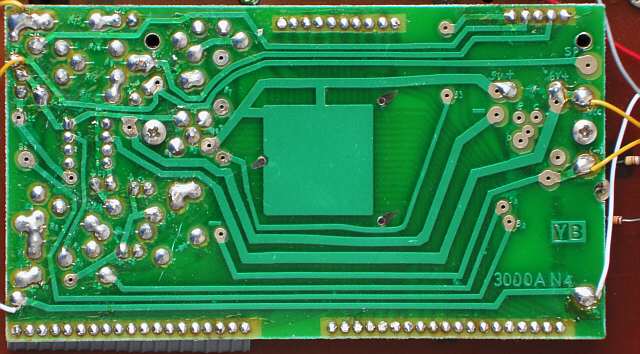
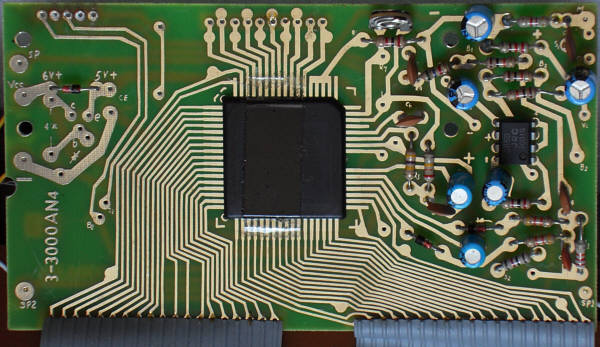
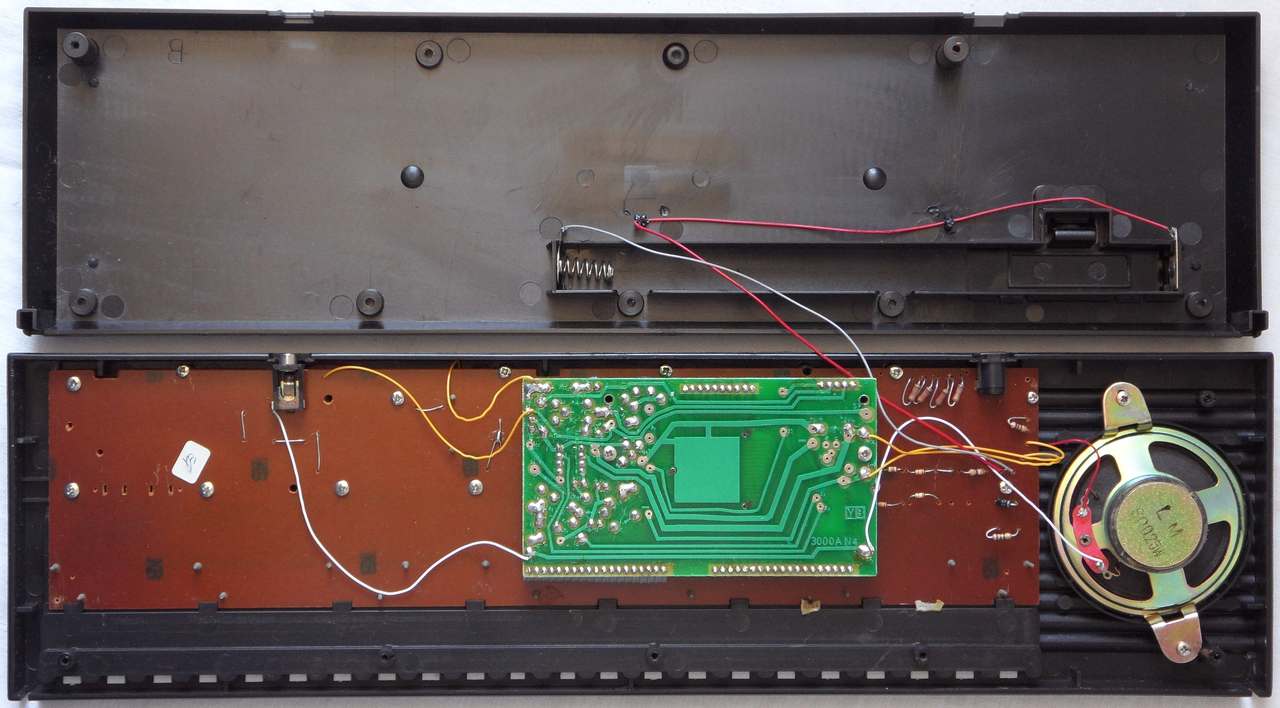
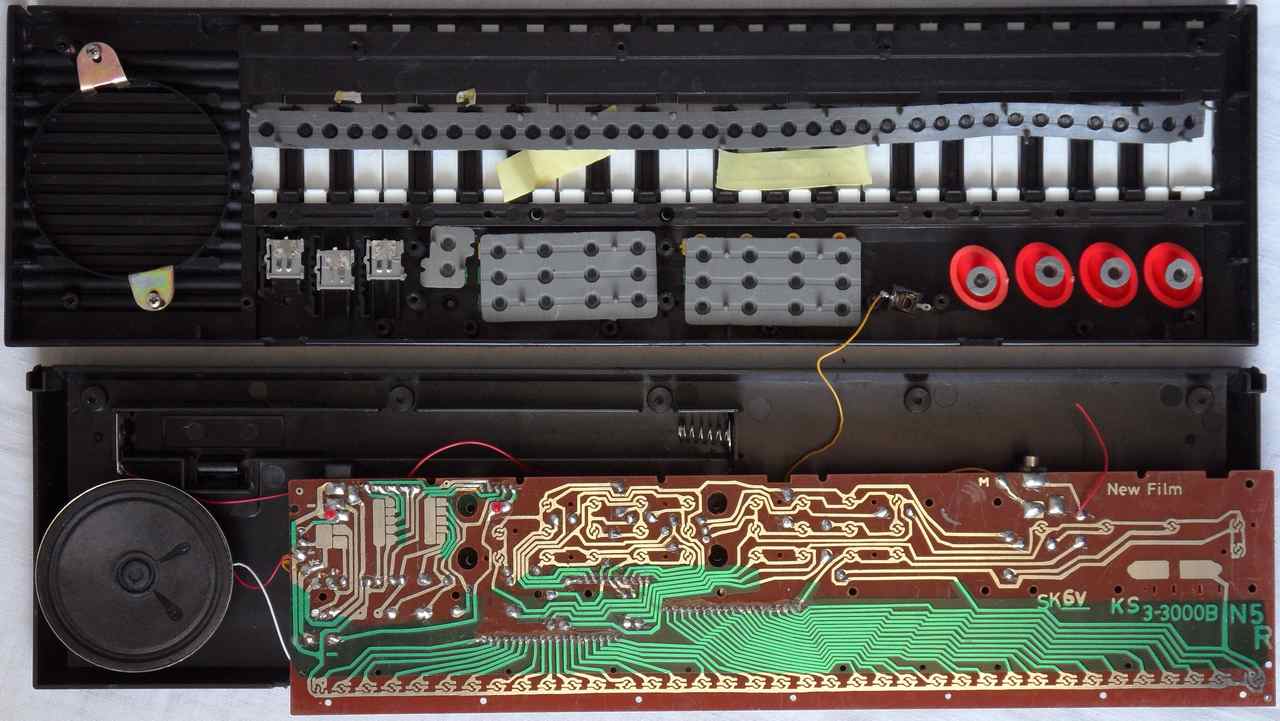
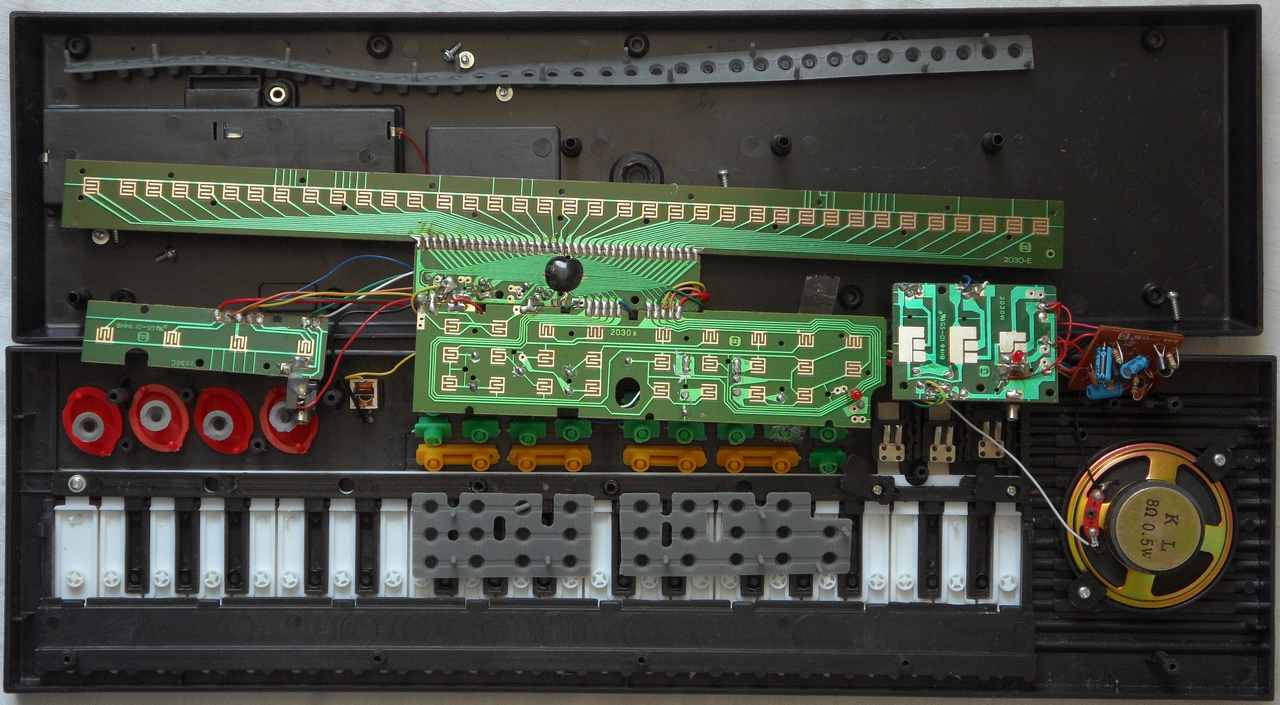
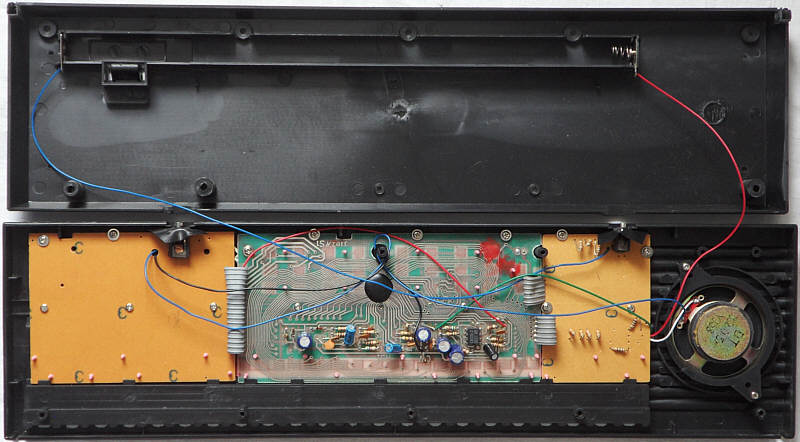
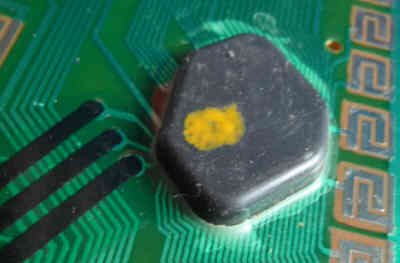
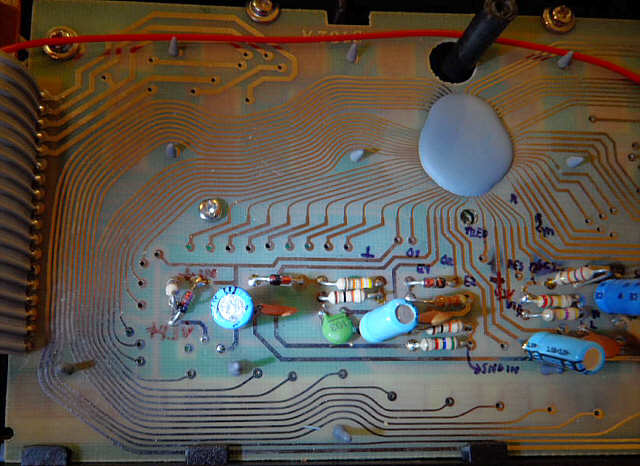
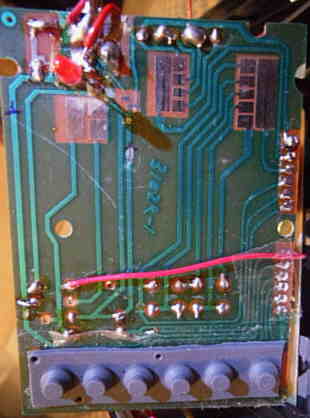
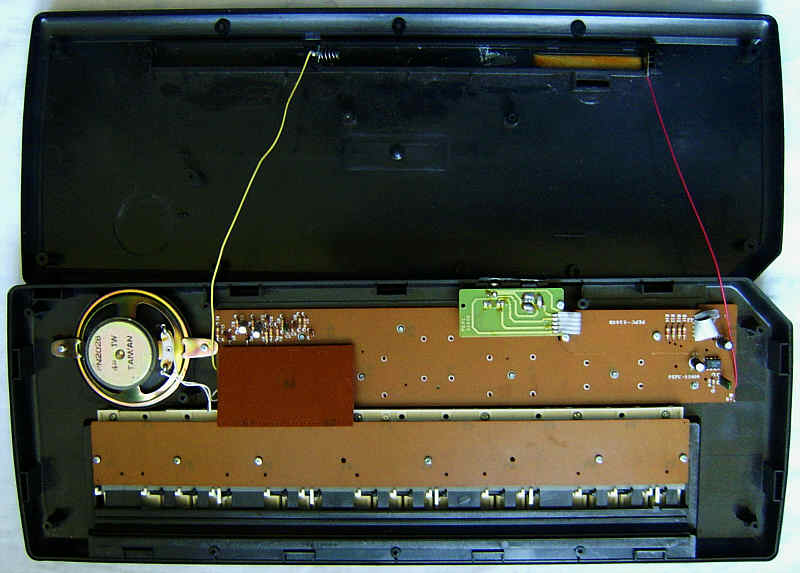
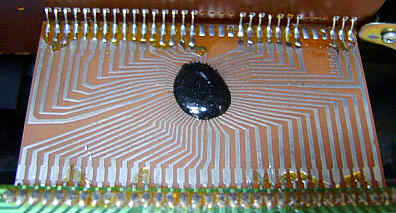
circuit bending detailsThe unlabelled CPU of Hing Hon EK-001 is a Holtek HT3371 (identified by datasheet) and in the classic version is directly bonded to the small doublesided mainboard "YB, 3000A N4"; very strange is that unlike normal COB this is no blob but a square black package (held only by melted plastic bolts on the back?). I am not sure if this is only an additional protective cap over a soft silicone blob or indeed supposed to seal the bare chip. It doesn't look reliable and mine has adhesive film on it (to seal a crack or pinhole in the top?), so better do not touch this; I worry that the silicon may corrode over time. The power amp IC is an LM386 (8 pin DIL). (Many technically different EK-001 versions exist, those I describe below.)The mainboard hangs on too short and brittle (Angeltone style) grey ribbon cables those make the situation hard to examine.
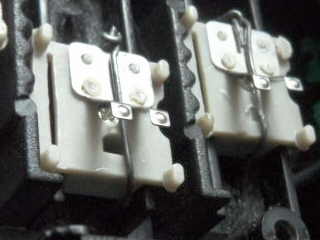
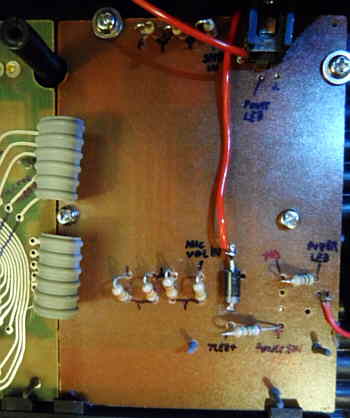
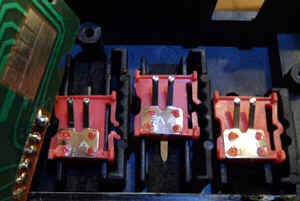
hardware identification chartIt is crucial to know that several other hardware version of the Hing Hon EK-001 exist, those despite similar case contain very different PCB layouts. While sound set and CPU behaviour seem the same, the placement of components and timbre quality strongly differs (i.e. cheapened versions may distort extremely).(For very differently shaped case variants see below on this page.) All hardware versions more or less suffer of tuning instabilities, i.e. pitch changes or howls when voltage drops by battery drain or poor contact of the simple power switch. Thus I recommend to install at least an easily accessible tuning trimmer. Also adding a mechanically better or electronically supported power switch (passing the operating current through a mosfet transistor (like a standby circuit) and only a control voltage through the switch contact) may be a good idea to get rid of the howl. - switch repairThe slide switches are of brittle plastic with a sheet metal contact crudely attached by molten plastic bolts. These tend to loosen or crack off, causing bad contact. In my "3102 R S1" specimen I fixed this by folding a stiff wire loop vertically around each plastic switch block to prevent the metal piece from flopping around or falling off.
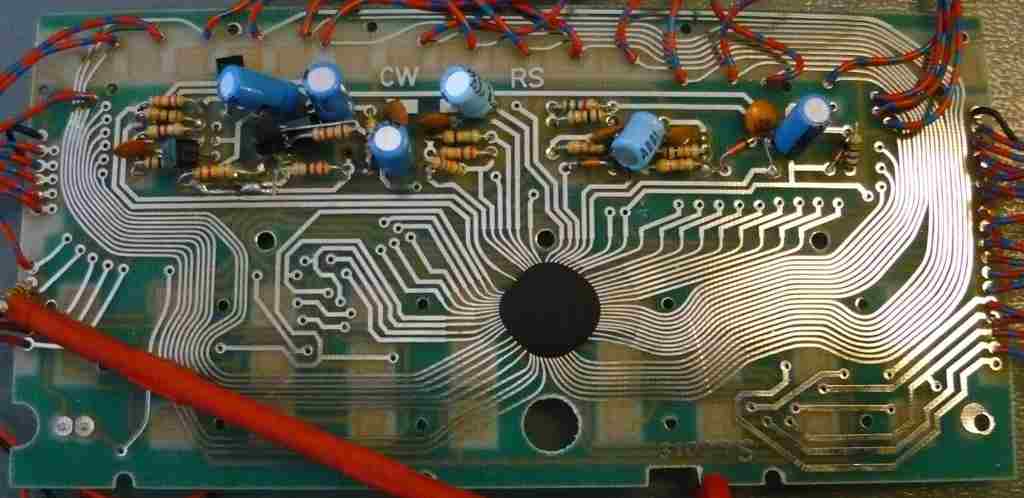
- version "3102 R" flaws fixDanger: Do not use a power supply on this version before measuring polarity; my specimen had polarity embossed wrongways (positive instead of negative center of the 2.5mm jack), which will destroy the CPU if connected like that. To check polarity, measure continuity between outer jack ring (no plug inserted) and the positive contact in battery compartment. If there is low resistance (direct connection), your polarity is center negative. I installed a polarity protection diode (schottky, SB240) and also rewired my polarity to standard. (Empty solder pads suggest that the PCB was even designed for changeable polarity.)The hardware version "3102 R" has many flaws. Particularly it distorts horribly because the LM386 amplifier was improperly replaced with 4 transistors. This amp section has cut traces and stray wire bridges on the back, and looks like if the piecework factory ran out of correct parts and soldered in what they had to finish the job in time. The distortion is so high that decay envelopes end too soon and polyphonic play crunches badly; only at maximum volume distortion is reduced. But even after improvement, model "3102 R" sounds cheap and thinner than the original "YB 3000A N4", so I recommend to get the real thing if you can find it, unless you like this one as a timbre variation. (The correctly working transistor version is not bad and has its own sound.)
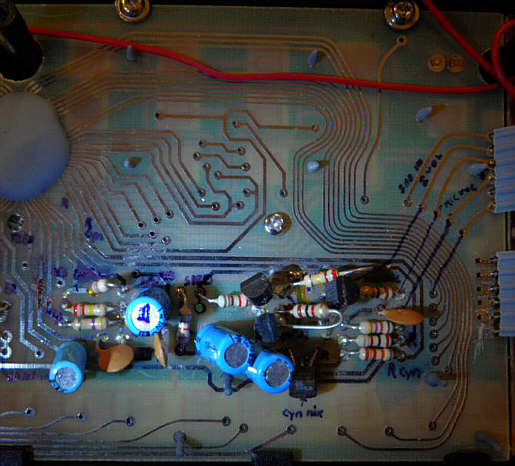
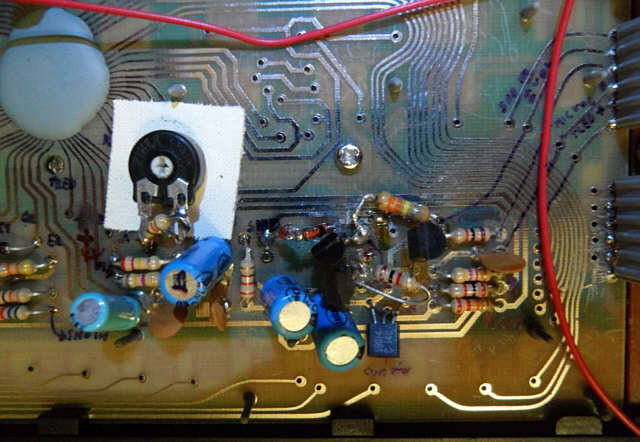
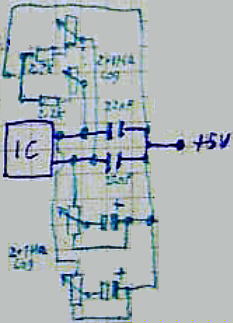
The amplifier is a very basic 3 transistor class AB push-pull circuit with neither drift compensation nor overheat protection. The upper right transistor (T4= "9014, B321", NPN) is the preamp, the lower left transistor (T2= "S8050, C334", NPN) forms the positive and the upper left (T1= "S8550, C326", PNP) the negative halve of the power amp. Their interconnected output goes through a 220uF capacitor to the speaker and through a 220k resistor as feedback loop to the base pin of preamp T4. To that base pin goes the volume control (resistor chain) output of the sound (that is mixed through resistors in various locations) and through an 1k resistor the microphone volume control. To reduce distortion, an additional resistor Rx can be installed from
the base of T1 (left side of the 220k resistor) to either a +Vs or GND
trace nearby to increase bias current (not recommended).
Another working solution (less idle current) would be to decrease the 220k feedback resistor instead. Wiring e.g. 100k parallel noticeably reduces distortion, but also amplification and hence volume. Thus making it even lower is no help. So I recommend to replace the 220k resistor with 2x 22k in series, and connect between them a sufficiently big (I used 470 nF) capacitor against +Vs (at the 1k resistor of the collector of T2) as a lowpass. This way only the DC operating point is shifted to a reasonable level, while the audio feedback gets damped by the capacitor and so still has full volume. My idle current increased from 18.2 to only 23.7mA, which does not drain batteries too badly. But regard that by lack of temperature drift correction, this amplifier tends to overheat when fed with >9V, and may burn out because hot transistors increase current further. Already at 10V I had >70mA, thus if you don't want batteries, I recommend to use a regulated power supply or install a 9V voltage regulator. The CPU itself runs on only 4.34V (through a zener diode + resistor) and the power supply jack is labelled "DC4.5-9V", thus using 1.2V rechargeables should be no problem. That is to say, the main flaw of the amplifier design is that bias voltage is set by a 220 Ohm resistor between the base pins of both output transistors. According to generic class AB template schematics, there instead always should be 2 diodes in series, because their nonlinear curves stabilize the bias. With my transistor exemplars 220 Ohm pulled the voltage way too low which caused the distortion. Likely the 220 Ohm resistor did its job well enough in a laboratory test specimen, but not in real life with out of specs transistors. (I expect that such cheap tablehooters are even made from rejected low-grade components to cut cost.) Some template schematics therefore recommend an additional trimmer between both bases to tweak bias, but never a fixed resistor without diodes. So the proper solution is to remove the 220 Ohm bias resistor (at the base of T1 (located to its left), with trace connected to base of T2) and replace it with [2 silicon diodes (e.g. 1N48) in series]; their rings must face to the base of T1 (upper left transistor). Do not install them wrongways, else both output transistors conduct and will rapidly overheat when powered on. (Feel them with fingers and immediately remove batteries if they get hot.) For better drift compensation, these diodes should theoretically touch T1 and T2 as heat sensors, but it is mechanically easier to make them touch only T1. With this upgrade, the amp sounds quite clean and idle current 30mA (35mA when warm) is still bearable. (I conclude this may have been the originally intended behaviour if the transistors would exactly match their specs.) The only flaw is that the amplifier plays a little quiet. To make it louder, replace the original 220K feedback resistor with 330K (do not install the earlier suggested 2x 22k, which runs too hot), which also reduces idle current to 25mA. With this upgrade, the amp will run even with unregulated power supply without hum. At 8V ("4.5V" setting) idle current is 25mA, and even at 10.4V ("6V" setting) the current rises only to about 45mA idle, which seems safe to me. If your current is too high, solder an additional trimmer (about 1k?) between both bases (parallel to your diode chain) to adjust bias lower. The sound is quite ok now, although my classic EK001 version "YB 3000A N4" still plays louder with more bass. (The necessary resistor values and behaviour may vary depending on the transistor exemplars. An eBay vendor of an identical looking used specimen (same case details and box) told me that his one did not noticeably distort (but he had to fixed some contact problems and installed a 9V battery clip), so it may be that not all "3102 R" suffer of distortion.) The "3102 R" lacks a tuning trimmer and my pitch sounded over 1 full note too high. To fix this, replace the 27k clock resistor with a trimmer (I used 50k in series with 1k for safety) to make it adjustable.
My exemplar had a crooked and way too long battery spring, which made it impossible to insert all 6 AA batteries. (So I initially used one AAA instead.) Insertion with raw force for shure would have shattered the brittle plastic compartment bottom - possibly by design as planned obsolescence (if not immediately, then certainly after some weeks by material fatigue), so I shortened the spring to 1/3 its length and bent it into shape with 2 pliers. The rubber contact strip under the keys was misaligned and is partially held in place only by double sided adhesive film, that may make some keys fail when the glue dries. To realign it without taking all PCBs out, move it with a piece of cable tie between the keys. By placing a ring shaped cardboard or sheet plastic bezel around the too small speaker to seal the gap, its efficiency and bass response may get slightly improved. But this speaker sounds crappy anyway, so you may want to replace it with a correctly sized one. upper right ribbon cable pinout: (top to bottom) 1 = mixed sound out (to volume switch 3x 18k resistor chain)
The lower right ribbon cable has at the lowest pin GND; the rest are keys 2..6. The lower right resistor is hihat (CPU pin HH), the resistor above that is mixed percussion. - version "3102 R S1" flaws fixThis is mechanically like "3102 R" but has an LM386 amp IC instead of transistors. Like the latter it lacks a tuning trimmer and mine played 1 note too high (fix see there). Volume can not be set lower than medium. Fortunately the power supply jack polarity is correct. Like versions "R10" and "R11" the tempo led causes weak clicking and held buttons produce key matrix buzz; I haven't analyzed this further.
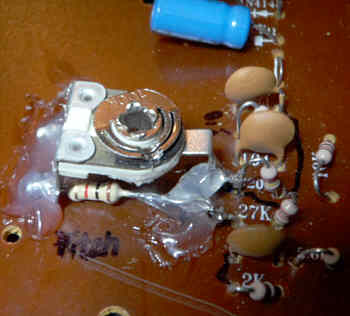
- versions "3102R10" & "R11" flaws fix Traktor told me that version "3102R10" (I didn't own this one) has problems with beeps and pop noises those crosstalk from the tempo led. The problem seems to be that the other pole of this led pulls down the supply voltage line of the amp or analogue section of the CPU. Because the led is PWM modulated to show reduced brightness during others than the 1st beat of a bar, it can also cause beeps. Traktor told me, that disconnecting the positive pole of his tempo led and connecting it instead to the 750 Ohm resistor of the power led eliminates the noise. (This makes the led quite dim - for a better fix see below.) Also the keyboard matrix produces a thin buzz so long any buttons or drumpads (but not keys) are held down (which is particularly annoying if you want to install locking switches for the waveform arpeggiator synth mod). I later found on eBay the almost identical version "3102R11", which has the same flaws. This is a very cheapened hardware design with only one large PCB. E.g. the speaker lacks screws and was simply welded by soldering iron into its plastic frame, so you can not take it out without breaking the plastic (use hotglue if necessary). Instead of a 4.7V zener diode (printed on PCB) only a resistor was installed (likely to cheapen production), but the tempo led click (quickly tested with parallel 3.9V zener diode) does not seem to be cause by this. Mine arrived defective; the slide switches failed, so the instrument only turned on by firmly holding power and volume sliders down with fingers. It turned out that the leaf switch contacts were crushed flat; after carefully bending them upward (do not break the flimsy welded plastic bolt) they work fairly ok. Possibly the contacts were crushed during poorly packaged shipping by weight of other parcels, thus do not lay heavy objects on these instruments. Like version "3102 R" pitch strongly fluctuates and howls down when the power switch makes poor contact or batteries fail. And also here the battery spring was a bit (less extreme) too long and thus to tight, so I took it out and squeezed it flat with pliers to make it shorter. The general timbre quality is cleaner (better?) than "3102 R", but below the classic "YB 3000A N4". In my specimen the pitch was at least one note too low. The clock rate is controlled by the 3rd resistor from the left. Its value is 27k (printed on PCB). Replace it with a trimmer; I used 100k in series with 1k protective resistor, but 30k should be sufficient if you don't want to tune lower. The lower pin of the 27k is connected with the upper pin of the 220k (vibrato) to the right of it, thus the trimmer can be easily wired between both. You need to remove the 27k resistor (or cut the upper pin) only if you want to tune lower or have no high resistance trimmer. Mine sounds correct when total resistance is set to 23k (Holtek suggests 22k in schematics, thus the choice of 27k appears a bit strange).
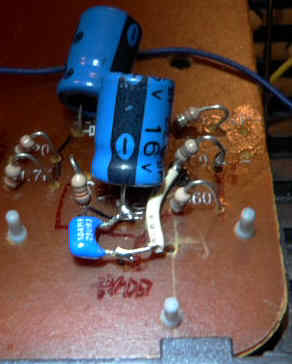
A better fix for the clicking tempo led is to connect one of its pins through a capacitor to GND. The tempo led is wired to the CPU TEMLED output and its other end through a resistor from +Vs (positive supply voltage). The resistor is the middle one (labelled "750") at the right end of the PCB; solder at the left end of that resistor a capacitor against GND (e.g. the negative pin of the lower "220uF 16V" electrolytic cap next to it). A capacitor of at least 10nF (100 to 500nF recommended, I used 100nF) will sufficiently suppress the click. But you may also install smaller capacitors (e.g. switchable or through pots) to only modify the click as an additional percussion sound effect; the timbre here also depends on which end of the tempo led is wired to the capacitor.
I found no fix yet for the keyboard matrix buzz bug. Possibly serial
resistors need to be installed into each keyboard matrix out line to reduce
the current flow. Also installing a real 4.7V zener diode instead of the
resistor may help to stabilize the CPU voltage better.
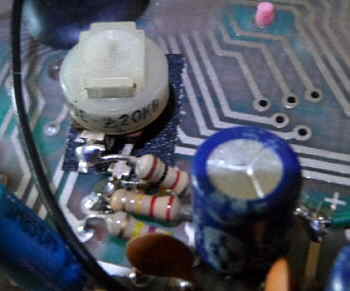
When not indicated otherwise, in the following I will refer to the classic version with PCB "YB 3000A N4" which sounds best. While the here discussed modifications likely all can be done with others too, you may need to figure out the wiring to find out where to connect parts. Their CPU pin order is likely the same, although unused pins may have been omitted on their COB. power amp oscillation vs. blip percussionWhen examining the waveforms by oscilloscope, I noticed that in the unmodified instrument the power amp is such broadband that it outputs strong HF residues of the clock frequency to the speaker (which blurs the audio waveform and may spoil recording). Touching the amp IC "JRC 386D" with a test lead made it even quietly play radio by demodulating a near broadcast station. To fix this, solder a capacitor of some nF between pin 3 and 4 of the amp IC. I tested several values and decided to use only 1.2nF; although it does not remove the residue perfectly, larger values make the percussion a bit dull and boring. With 1.2nF the "hihat" shiftregister noise in the output stays strongly visible, while already 4.7nF muffles it. Despite this all happens above 20 kHz, a slightly oscillating amplifier seems to be necessary to enrich the timbre of blip percussion. When tamed to much, it looses its fiery impulsive character, which makes me conclude that an oscillating amp IC excited by the rough edges of shiftregister feedback noise may be a key element in blip percussion. During experimentation with Casio MT-88 I made a similar observation, that an oscillating op-amp did dramatically improve its blip percussion cymbal (which from a thin semi-metallic tone turned into an almost natural timbre with changing hiss spectrum during decay; only a too strong noise floor made it unusable).The EK-001 blip percussion is output by the CPU through 4 connected pins (one pin in other versions) with coarse digital decay envelope that has strong zipper noise. Unlike early blip percussion, the decay curve has no visible linear sections. The 'cowbell' is plain squarewave between high B and C in octave 4. The 'base' is plain squarewave on C in octave 0 (1 octave below C1 with 'flute', hipass filtered). 'snare' and 'hihat' are made from shiftregister feedback noise. In rhythms the percussion generator can play accents. Powering the instrument on, fires all 4 drumpads simultaneously (at reduced volume), which may be a matrix- or software bug. multipulse squarewave tone generatorThe EK-001 is a perfect example for multipulse squarewave sound synthesis. The digital oscillator outputs for each timbre a more or less long repeating bit loop of square blocks of equal height. In each of the 2 polyphony channels the analogue envelope uses a switched capacitor (charged and discharged through hi and lo PWM pulses?), which voltage is multiplied with the main voice tone; the VCA seems to be implemented with open-collector outputs of the CPU. So during decay, the floor of the squarewave pattern is gradually pulled to the top. The oscillators never stop, which permits smooth decay of envelopes without sudden end click.According to my analogue scope, the multipulse patterns seem to be up to 16 bit long. Because the internal rotation is unknown, I sorted them by the longest sequence of '1' as the start. They may be produced by a shift register feedback circuit or stored as 16 bit words in a small rom. To improve visibility, I omitted the redundant part of shorter periods. The multipulse bit loops look like this:
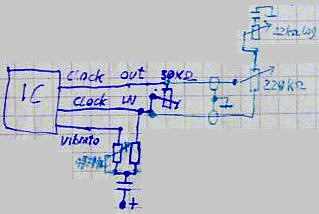
Although superficially influenced by early Casio mini keyboards (see VL-1), the analogue envelope control of EK-001 is very different and rather resembles analogue Yamaha PortaSounds (e.g. PS-2). The whole sound engine behaves very archaic, so decaying preset sounds ignore key press duration. The vibrato works by modulating the clock oscillator with a squarewave (about 6Hz, derived from clock speed) that temporary pulls clock rate lower. It seems to be operated by the same internal LFO like the mandolin ring; with held notes it retriggers itself (changes phase to normal pitch) by pressing (trilling) any additional key. Pressing additional keys apparently restarts the LFO counter and so make vibrato and mandolin ring halt for a fraction of a second. Attention: I have only incomplete draft schematics of my modification, thus this description may be partly inaccurate or even wrong where it is based on them. keyboard matrixBecause the CPU itself is hard to reach and delicate, I list the pinout from the back of the main PCB. The keyboard keys are not in a matrix at all but employ each an own CPU pin (i.e. 37 in total, on the lower 2 ribbon cables), which hints to the archaic nature of this hardware class. The button matrix pins are on the upper middle foil cable (pins numbered from right to left). Pin names were taken from the HT3371 CPU. I found no eastereggs, but it is important to document this technical oddity.
The input lines are active-low, i.e. react on GND. Any functions can
be triggered by a non- locking switch in series to a diode from one "in"
to one "out" pin.
The volume slide switches crudely approximate potentiometers using a chain of each 4 resistors. You may replace them with a real pot. The upper right ribbon cable has this pinout (counted right to left): 1 = master volume common
important: Because pinouts differ among CPU variants, I also have marked the keyboard matrix pins by their "C" ("columns" = out pins) and "R" ("rows" = in pins) numbers found in Elenco AK-900 schematics. These are CPU pin names, not capacitors and resistors! The synthesizer DIP switches basically do the same like holding multiple preset sound buttons. Important is to wire a diode in series with each switch to prevent unwanted matrix problems when pressing other buttons. Also the drum pads should be upgraded with each such a diode to prevent mess. Theory of operation: It is unknown what exactly is going on inside the CPU, but I suspect it is something like this. Because the tiny hardware has extremely little RAM, all functions are set immediately during the keyboard matrix scan. So any held preset sound button immediately writes sound hardware registers for timbre and envelope duration at the moment the button is scanned. Thus when multiple buttons are held (which is simulated by the DIP switch) the sound registers get rewritten in the speed of the key matrix scanning loop, which makes the timbre rapidly toggle between the corresponding preset multipulse squarewave waveforms (or do other wicked stuff with bits of the shift register feedback generator) and so produce complex grainy digital timbres. The result sounds very similar like fast arpeggiator effects made with program loop synthesis on 8bit homecomputers. This is not to be confused with melodic note sequences played by a regular arpeggio; the tone switching happens here without restarting volume envelope and almost at sound frequency, and so rather makes a kind of very crude square frequency modulation. Also the envelope capacitor output is switched at that rate, which affects the note duration. All preset sound switching other than between 'violin' and 'organ' or 'flute' and 'organ' (but not 'violin' and 'flute') and vice versa switch the envelope of held notes to key release, which may hint to different internal synthesis parameters. pitch control / tuning
main voice envelope
rhythm volume
voltage regulator With a power supply the instrument hums badly and may easily burn out
when PSU voltage is set to high, thus I replaced the 1A diode from the
9V input jack with a 7805 voltage stabilizer which I equipped with each
a 1A diode in the input and output line, and [2 diodes in series] in the
GND reference line to rise the output voltage to about 6V, which corresponds
to the battery pack voltage.
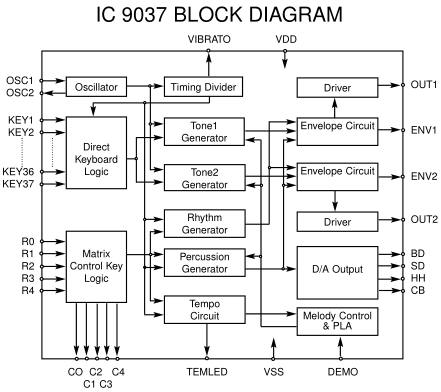
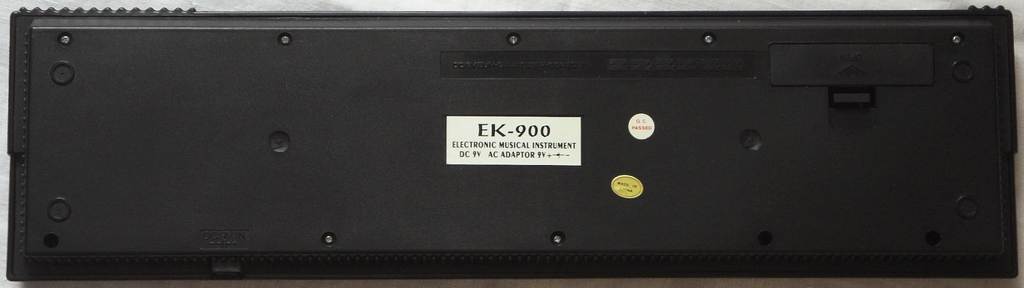
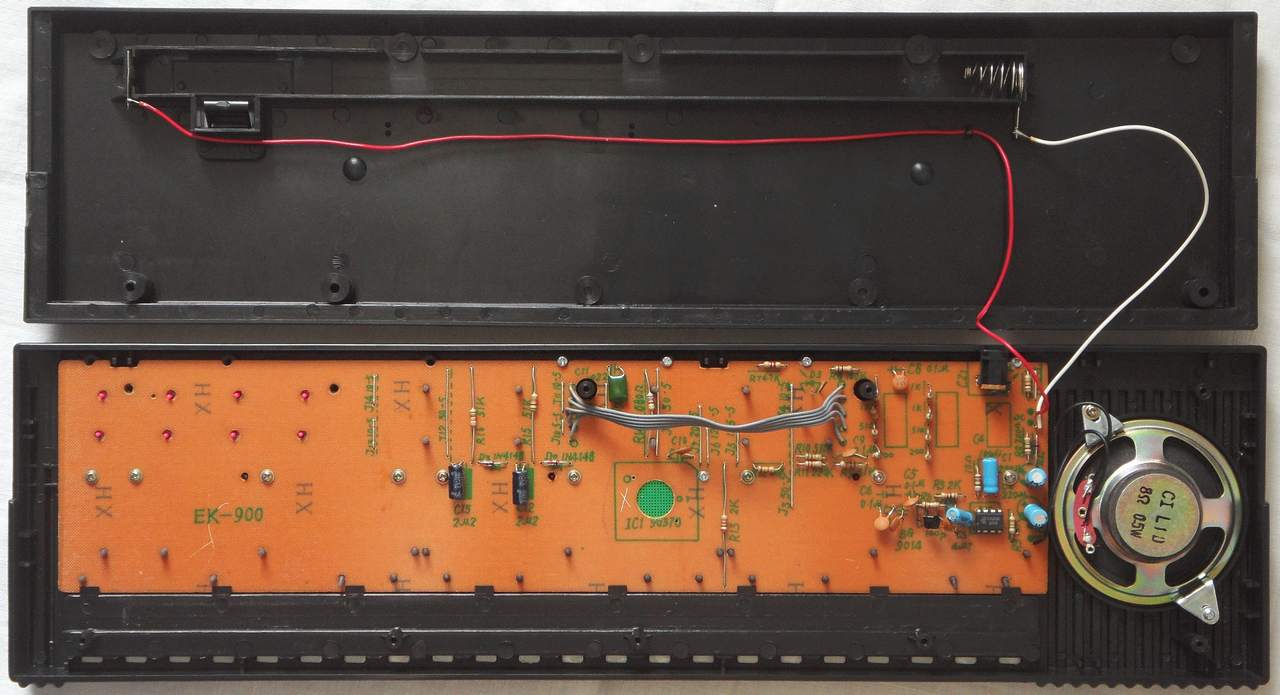
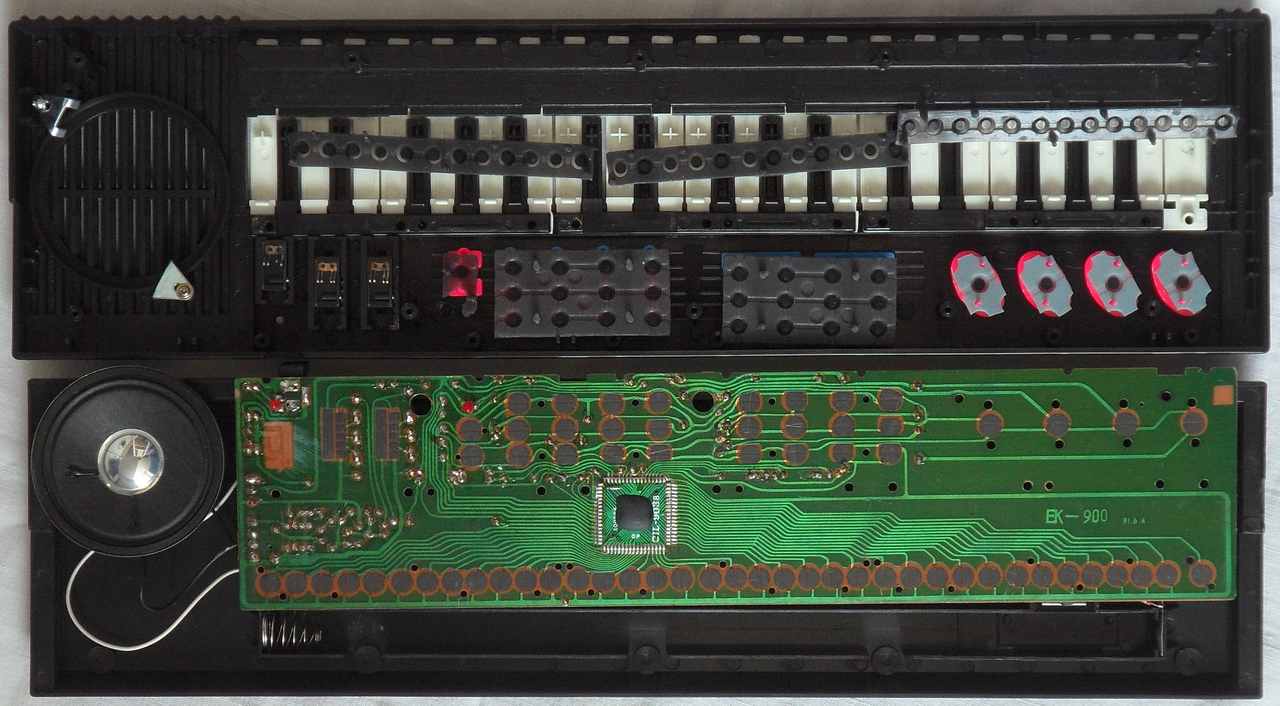
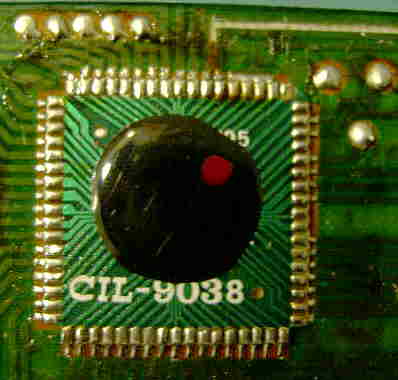
pinout HT3371, CIL-9038The CMOS LSI "Holtek HT3371" (68 pin square COB module, pins count anticlockwise) is the CPU of Hing Hon EK-001. I identified it by the Holtek HT3371 datasheet ("37 Key 2 Channel Multi-Function Instrument") of 1996-06-28. The LSI "CIL-9038" (same pinout) is the CPU of my Superb Sound EK-210 and Stereophonic EK-900 with slightly changed rom.The Stereophonic EK-900 is
an EK001 variant that according to schematics has its COB CPU "9037" (a
renamed HT3371) soldered to the large main PCB instead of being directly
bonded to a daughterboard full of analogue stuff. The EK-900 was released
in 1997 by the company Elenco Electronics Inc. as the electronics
kit "MODEL AK-900". In the Assembly and Instruction Manual
(electronic_keyboard_kit.pdf) the depicted keyboard on the photo is labelled
"Stereophonic MODEL: EK-900". I later bought a specimen with CPU
"CIL-9038" (same shape).
By block diagram and behaviour, these are not CPUs in the stricter sense, but LSI made from simple gate logics with very little software control. By the naming of its sister chip, the "9037" was possibly also released as "CIL-9037". But according to the HT3371 datasheet, the genuine creator appears to be Holtek. Apparently the test pins 51, 52 were omitted in EK-001 (empty gap between traces). CIL-9038 still has them. The tempo led (pin 53) is PWM modulated to show reduced brightness during others than the 1st beat of a bar. (Seen on oscilloscope in version "3102 R".) The percussion out pins 62..65 are shorted with each other, but certainly can be separated for individual analogue processing. In version "3102 R" the hihat pin 65 is separate, and externally connected through a transistor to the CPU pin that outputs the 3 other percussions. note: If anybody owns an EK-001 with dead CPU (like those many
corpses of failed circuit bending attempts), it would be interesting to
donate it to a chip specialist for decapping (dissolving the COB blob in
chemicals) to make microscope photos of the actual chip. I expect this
to be a Pong-age hardware design made from only few thousand transistors.
Decapping the dead chip may make it possible to figure out the exact algorithm
of the blip percussion sound generator.
Successors of this hardware family are based on the Holtek CPU HT3421A, which was used in Yongmei MS-210B and a variant with changed rom in PlaySkool PS-635. Both are only monophonic, have a real key matrix, simple sequencer and 12 demos. |
This instrument may seem hard to find on eBay because it has usually no model name printed on it, but they aren't rare. I saw there many specimen sold as toy keyboards. The EK-001 was also released as GPX MC-2000B (see here what the direct predecessor Elite MC 2000 looked like), as Music Pool 3-3000 and another was claimed to have the brand name Treton. I was e-mailed that also a variant CX500 exists (only 3 step volume sliders, louder sounds brighter) and also one by Philco. Also instruments with differently coloured EK-001 case variants (e.g. yellow, red or white) were made, those often contain My Music Center or My Song Maker hardware variants (seen on eBay).
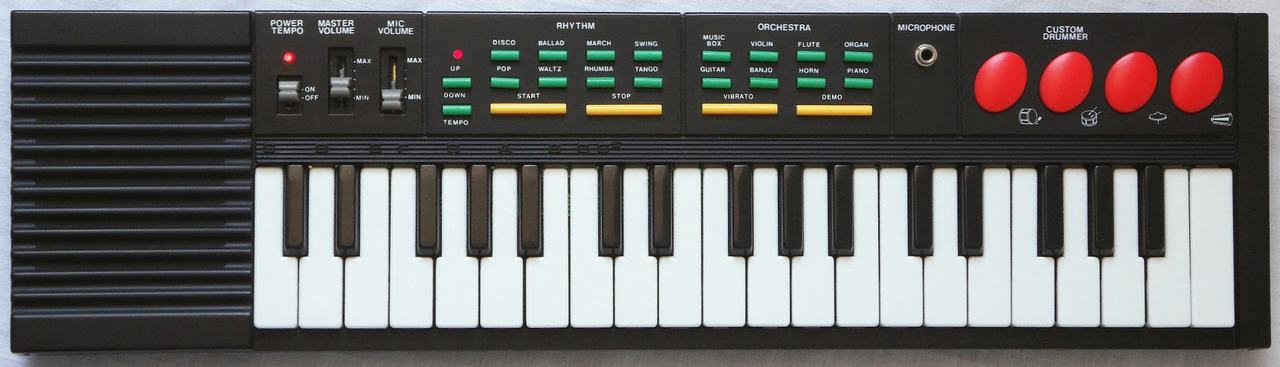
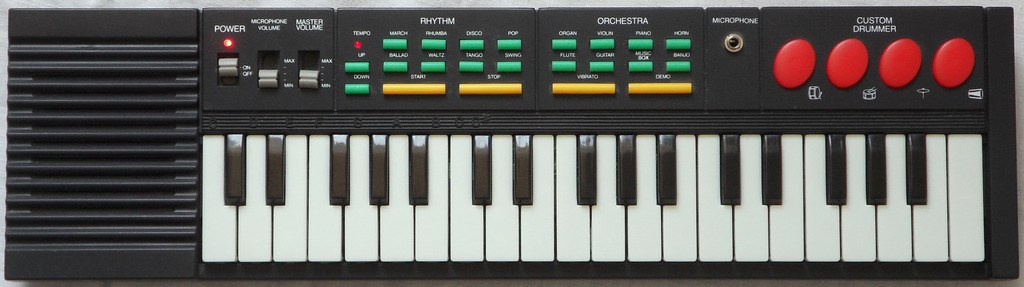
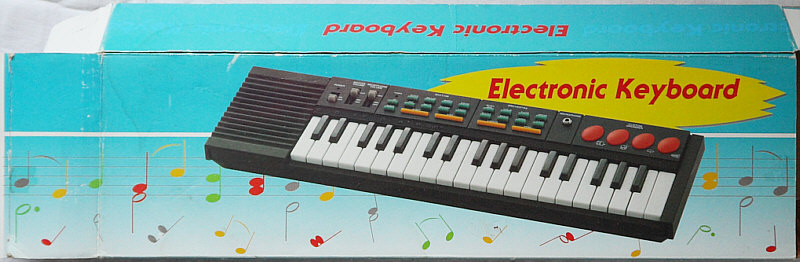
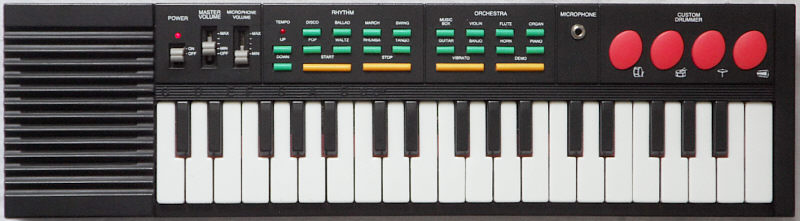
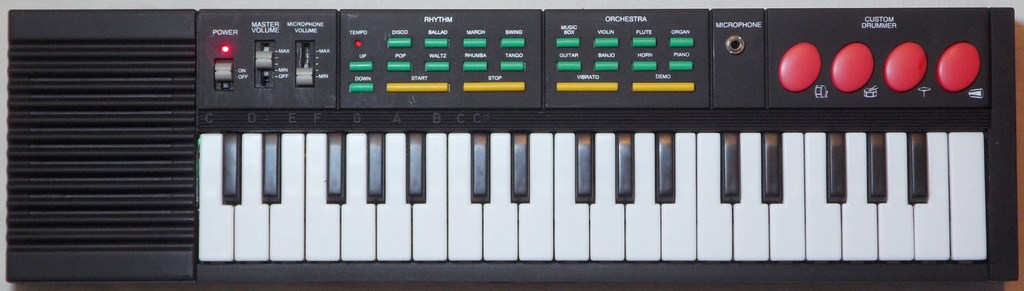
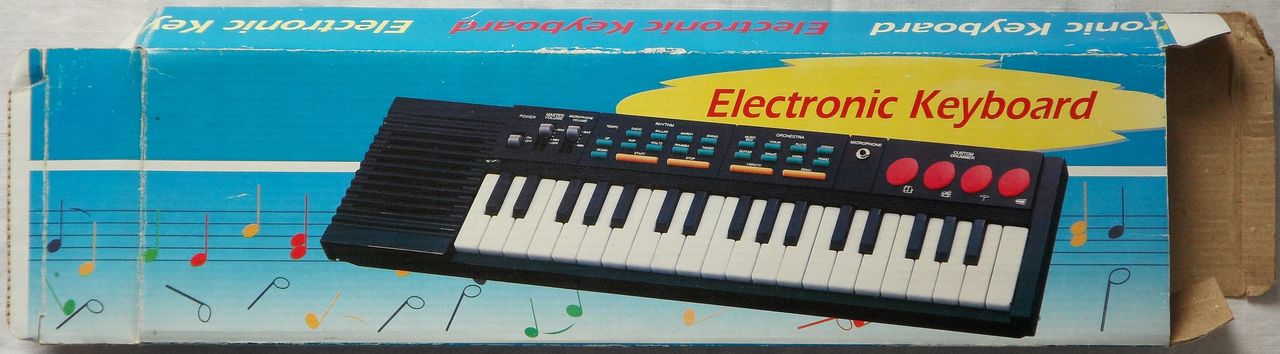
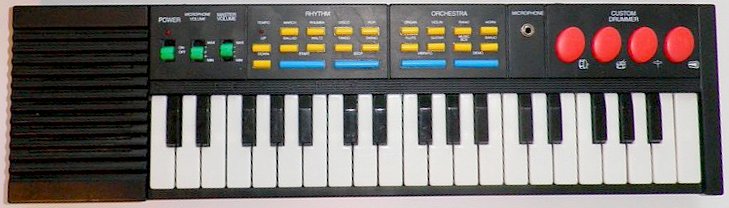
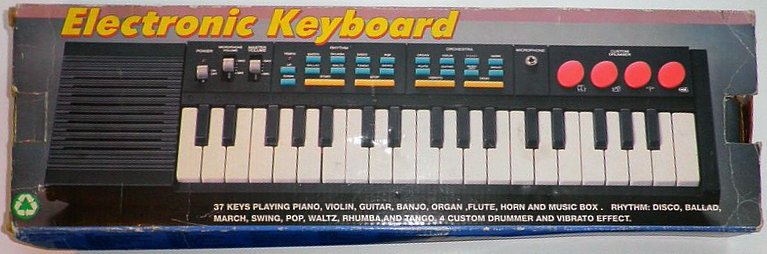
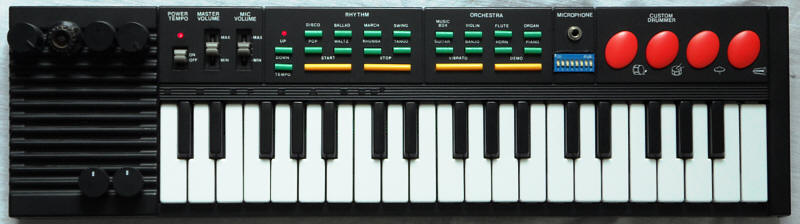
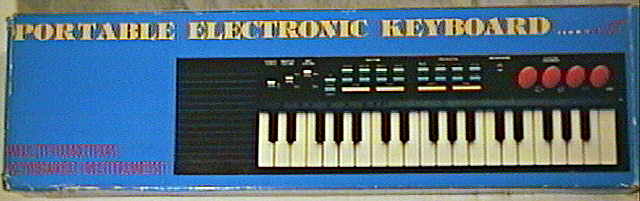
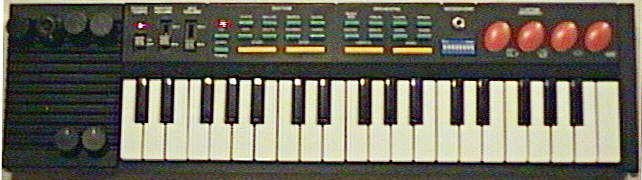
The normal EK-001 version has a black, rectangular case, the speaker left next to the keyboard. Above the keyboard are (from left to right) 3 vertical grey sliders, 2 fields of green and some yellow rectangular buttons, then the mike jack and as the most recognizable feature a row of 4 red, slanted, oval and lens- like shaped drumpad buttons, but the button colours may vary. Typically the box is labelled "PORTABL ELECTRONIC KEYBOARD". A Danish/ Swedish variant with different button colours and no microphone jack is known under the brand name "Music Time". It has instead of the microphone volume a rhythm volume slide switch and also the power switch looks different. Likely a very different looking variant (round speaker to the right with square drumpads below) was the Unimax keyboard (white case with 29 midsize keys, semicircular blue speaker to the left, white handle to the right, buttons yellow and knobs red - seen on eBay). Other case variants include the Elenco EK-900 (with blue rectangular drumpads & sliders, speaker to the right) and Music Designer CX-500 (told by e-mail). Another midsize variant was likely the Shen Quan SQ37F-921A (case style similar like Fujiyama KS-37). Possibly the EK-001 was also released under the Fujitone brand.
The Hing Hon EK-001 case is a close imitation of Yamaha PSS-30, which looks almost identical beside it is shorter and has no drumpads. The direct EK-001 predecessor was apparently the Elite MC-2000, which had exactly the same case (besides some buttons and only 3 drumpads) but contained MC-2 hardware like Pan Toys MC-7. MC-2 keyboards have indeed one combind power & tempo LED (lit when on, flashing during rhythm), while the classic EK-001 version ("YB 3000A N4") has its power LED mislabled "POWER TEMPO" despite its tempo LED is elsewhere and stays off without rhythm. Also the text "custom drummer" above the EK-001 drumpads normally stands for a programmable rhythm pattern mode, that after initial use by Yamaha became typical in a series of squarewave instruments likely created by Medeli. The EK-001 lacks this mode, which in Elite MC-2000 (MC-2 hardware) was still functional, which strongly hints that the MC-2000 came first.
Monophonic relatives of EK-001 sound hardware are the Playskool - Kid Keys PS-635 and Yongmei MS-210B.

 |
 |
 |
 |
 |
 |
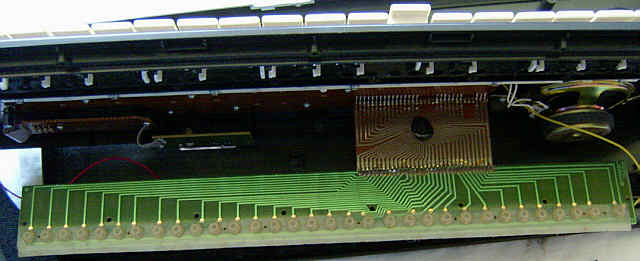 The CPU module hangs like a bridge between main and keys PCB.
 |
 |
 |
 |
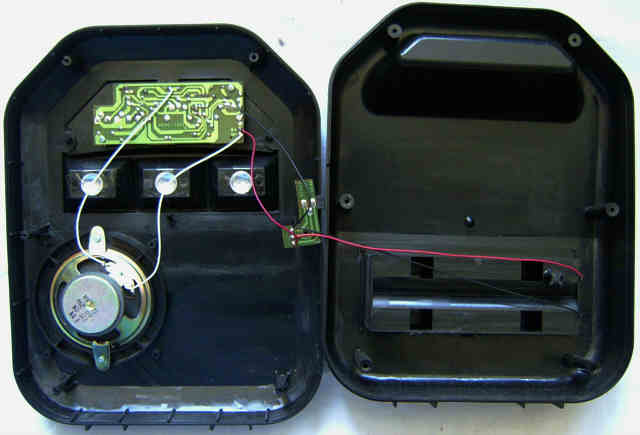 |
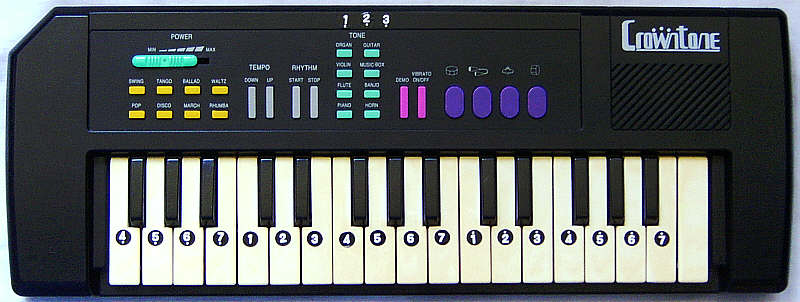
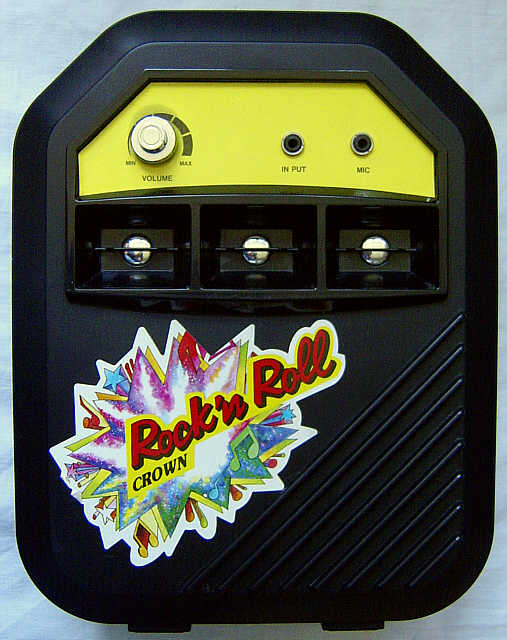
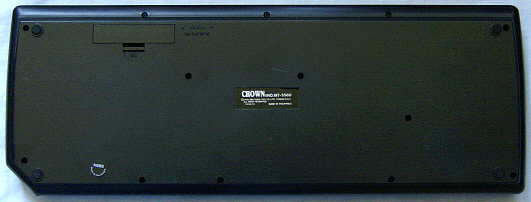
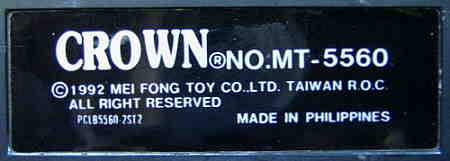
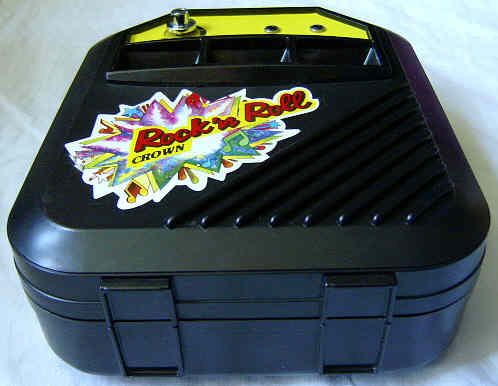
This keyboard seems to be very rare; I never saw another one, nor any other Crown or Crowntone instruments yet. However the box of my Intersound - Guitar Star - Rhythm Guitar MT-7112 shows a version labelled Crown MT-7112.

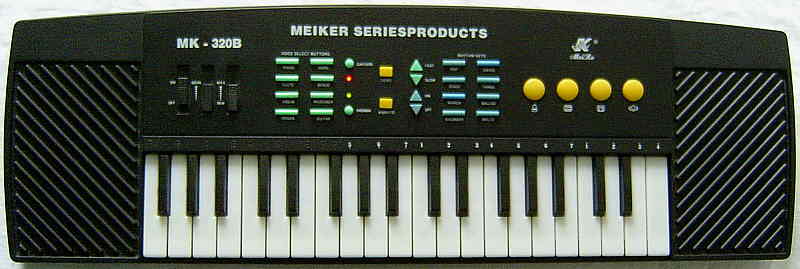
Also this quite big and loud playing midsize tablehooter is based on Hing Hon EK-001 hardware; unlike the latter it has instead of the rhythm volume control a sustain switch.
 |
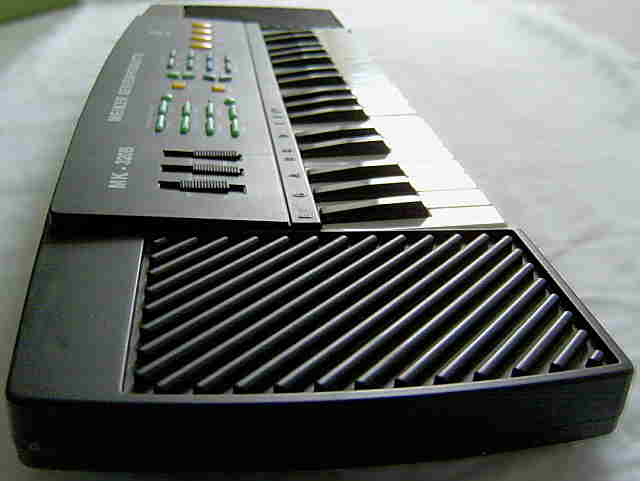 |
 Bizarre
is that the manufacturer's name has 3 different writings on the case; the
logo spells "MeiKe" (abbreviated?) while the control panel writing
says "MEIKER SERIESPRODUCTS" (note the 'R') and the "Quality Certificate"
sticker at the case bottom even has a writing in a strange font that looks
like "Meiskesgs" or "Meirkergr". I could imagine that the
word "MEIKER" was genuinely intended to be "MEIKE ®", but the Chinese
control panel designer didn't understand what an "®" sign is. Likely
the genuine manufacturer is Meisheng (aka Miles), which belongs
to Yongmei, the creator of the worst keyboards of the world (see
Golden
Camel 7A and Miles - Golden
Camel-11AB). The name "MeiKe" possibly abbreviates "Meisheng Keyboards".
Also my Golden Camel-11AB had a similar "Quality Certificate" sticker
underneath, which is black and only says "Miles". Bizarre
is that the manufacturer's name has 3 different writings on the case; the
logo spells "MeiKe" (abbreviated?) while the control panel writing
says "MEIKER SERIESPRODUCTS" (note the 'R') and the "Quality Certificate"
sticker at the case bottom even has a writing in a strange font that looks
like "Meiskesgs" or "Meirkergr". I could imagine that the
word "MEIKER" was genuinely intended to be "MEIKE ®", but the Chinese
control panel designer didn't understand what an "®" sign is. Likely
the genuine manufacturer is Meisheng (aka Miles), which belongs
to Yongmei, the creator of the worst keyboards of the world (see
Golden
Camel 7A and Miles - Golden
Camel-11AB). The name "MeiKe" possibly abbreviates "Meisheng Keyboards".
Also my Golden Camel-11AB had a similar "Quality Certificate" sticker
underneath, which is black and only says "Miles". |
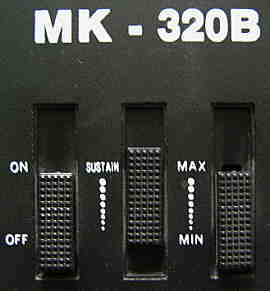
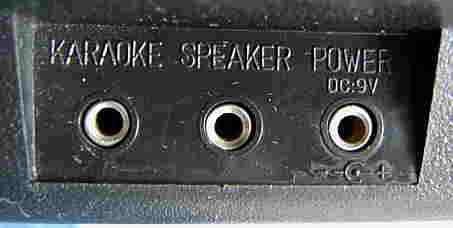
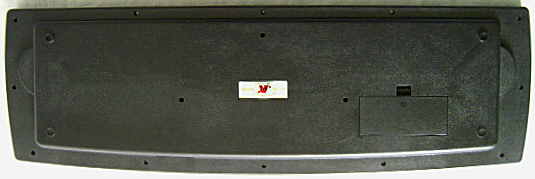
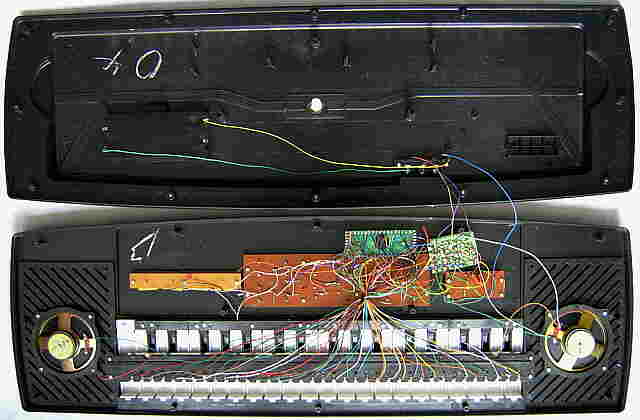
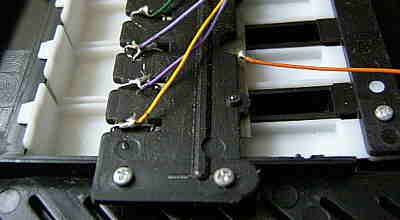
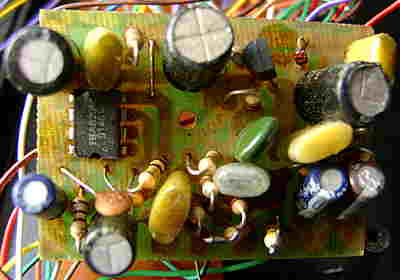
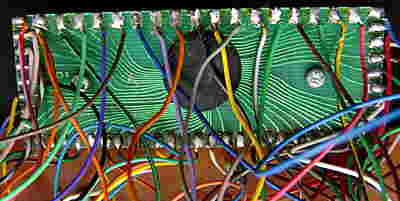
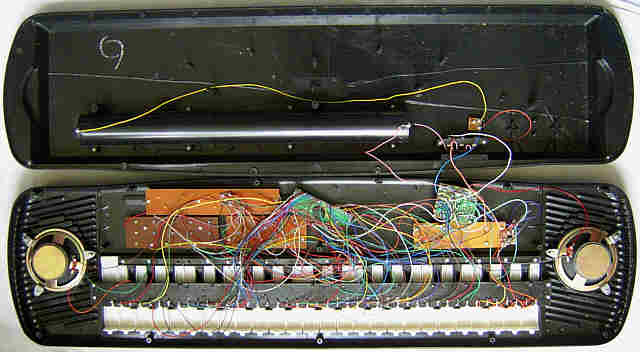
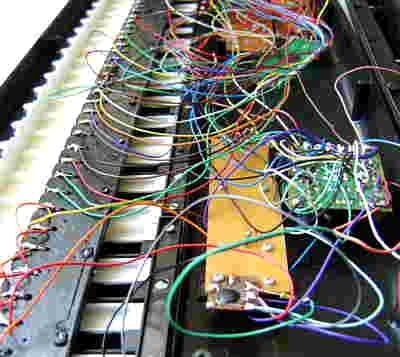
Like those Golden Camel shanzhai tablehooters, also the hardware of MeiKe MK-320B looks like soldered together as piecework in a Chinese concentration camp, since it contains an incredible mess of loose cables. Also the keyboard keys employ instead of a PCB a row of sheet metal contacts with a zillion of hand soldered cables instead of modern silicone rubber contacts. And worst - the "DC:9V" AC adapter jack is also here wired parallel(!) to the battery compartment, thus any attempts to use it with batteries inserted may cause the batteries to EXPLODE (and also the microphone would certainly not survive to be accidentally plugged in here instead of the identical "karaoke" jack next to it).
This instrument was also released as DigiTone Expert (seen on eBay).
 |
 |
 |
 |
 |
 |
 |
 |
A likely direct predecessor of this hardware was the monophonic Yongmei MS-210B (same sound generator but different percussion). A successor of this thing was possibly the Miles 3738. Another great multipulse squarewave keyboard with fast (C64 style) arpeggiator sounds and synth features is the Yamaha PSS-100. Another instrument with great POKEY rhythm is the Creatoy keyboard.


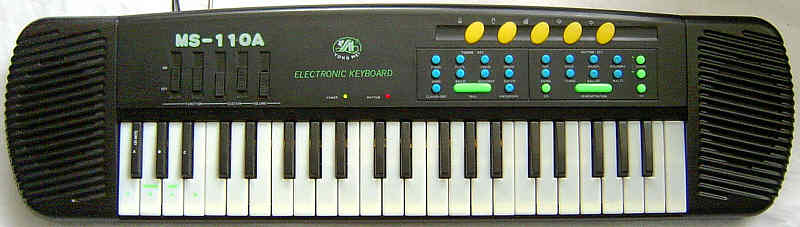
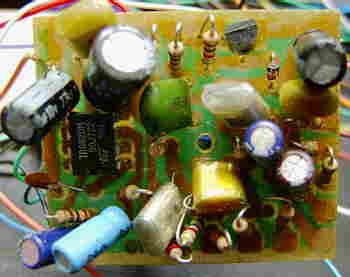
This extremely rare keyboard is technically almost identical with the MeiKe MK-320B, but it includes an additional melody chip for 8 additional demos. The demos are primitive monophonic tooting squarewave monotos, but these very short melody loops can be abused as tekkno accompaniment. The extremely flimsy plastic case is the same like with Yongmei MS-210B.
 |
 |
warning: Never send a keyboard with this case through mail without multiple centimeters(!) of padding (styrofoam, firmly crushed paper, fanfolded cardboard or similar), because the plastic is brittle like glass and will unavoidably shatter into a zillion of pieces as soon they toss it around in the mail. (Older Yongmei keyboards original packaging contains no end padding at all and thus is absolutely unsuited(!) for mail shipping.)
A year ago I had ordered my first MS-110A specimen, which arrived slightly shattered at one side. When I reported that damage in a Deutsche Post post office, the spirt- nosed post office clerk smeared a few words across the damage report form (instead of filling out the entries), intentionally smashed the remains of the wrapped keyboard with a huge 20kg parcel on a trolley and sent it back to the sender despite I explicitly requested to sent it back to me after damage analysis. I never saw that keyboard again nor I got any money back. Later I fortunately found another specimen of this extremely rare keyboard on eBay; first the vendor indeed followed my instructions to pad the parcel ends very well etc. etc., thus it indeed stayed in one piece, but when I took it out, it turned out that despite outer parcel he had for no reason at all ruined the original box with brown adhesive tape - arrg! I managed to remove it without too much damage, but afterward he even gave me a negative rating because I did not immediately bike through the mountains down to the bank to transfer the remaining 90ct of postage. Why the #@*!% are sellers of rare Yongmei keyboards always such assholes?!?
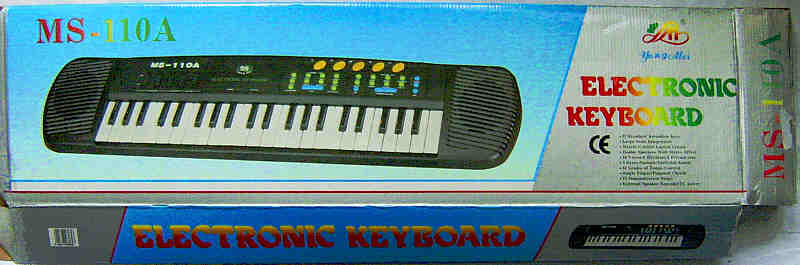
The box has the same old style like with the first generation transistor tooter Yongmeis (see Golden Camel-7A), and like with these the box feature list is full of lies:
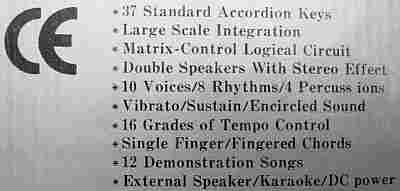 |
In reality it has neither a "Stereo Effect" (the amp is mono) nor "Encircled Sound" nor " "Single Finger/ Fingered Chords" and only 8 instead of 10 "voices"/ preset sounds. Instead of "12 Demonstration Songs" there are only 8+1=9 demos. But instead of "37 Standard Accordion Keys" it has even 44 keys (but only 37 are real). | . o O |
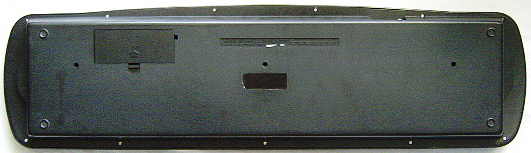 |
 Made in Mei Sheng electronics factory Jiexi Guangdong China.
 |
 a blank sticker...
 |
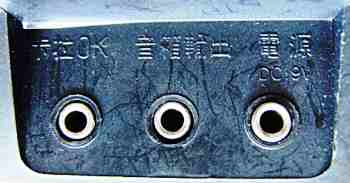 The jacks writing is in Chinese.
 |
 |
 |
 |
 |
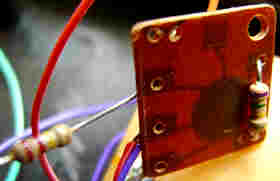 |
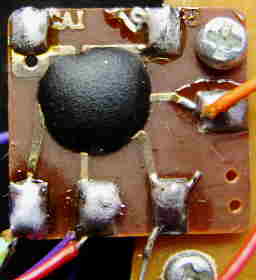
This thingy is the melody IC. |
The preset sound and rhythm names contain plenty of Engrish misspellings. The vibrato is named 'trill'.
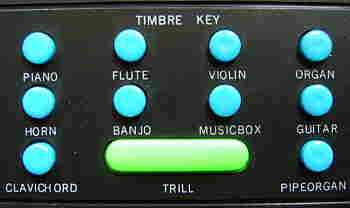 |
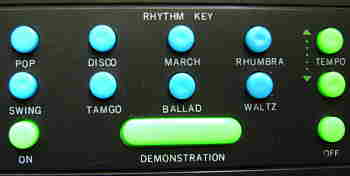 |
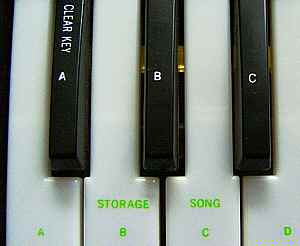 When
the melody chip is enabled (switch 2 is on), the leftmost 7 keys select
the demos. Any white one selects the next melody (and keeps it repeating
when held), while any black key stops the melody and selects melody 1 again
by resetting the melody chip. (Warning: The power LED dims a bit
by black key presses, thus it may overheat the chip when pressed too long
by a missing resistor thanks to the infamous Yongmei hardware bugs.) But
genuinely the melody chip has only 2 button inputs anyway; the leftmost
4 white keys and switch 4 are simply wired parallel as melody select, while
the 3 black ones are wired parallel as melody reset, thus they all do the
same. When
the melody chip is enabled (switch 2 is on), the leftmost 7 keys select
the demos. Any white one selects the next melody (and keeps it repeating
when held), while any black key stops the melody and selects melody 1 again
by resetting the melody chip. (Warning: The power LED dims a bit
by black key presses, thus it may overheat the chip when pressed too long
by a missing resistor thanks to the infamous Yongmei hardware bugs.) But
genuinely the melody chip has only 2 button inputs anyway; the leftmost
4 white keys and switch 4 are simply wired parallel as melody select, while
the 3 black ones are wired parallel as melody reset, thus they all do the
same. |
The 8 melody chip demos are:
A direct successor of this instrument was Yongmei MS-210B (monophonic, 12 demos in main CPU).
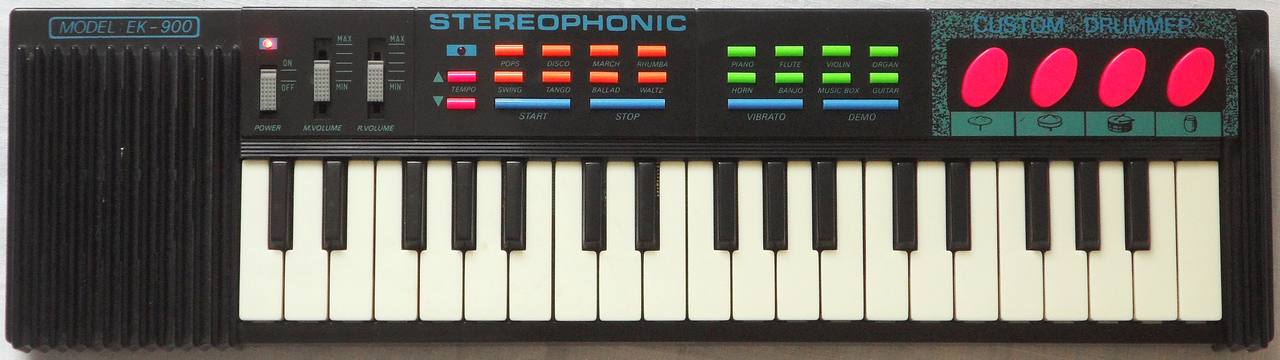
Despite its name "Stereophonic" there is nothing stereo in this single speaker keyboard. The button and drumpad order differs from a standard EK-001. Mine has the CPU "CIL-9038" (68 pin COB) with changed demo "Evening of Moscow's Suburbs"; the Elenco schematics lists a CPU "9037".
 |
 |
 |
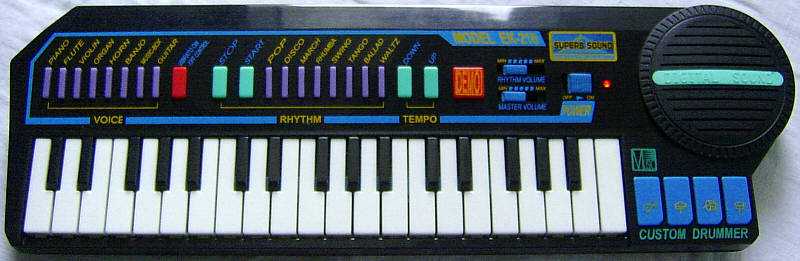
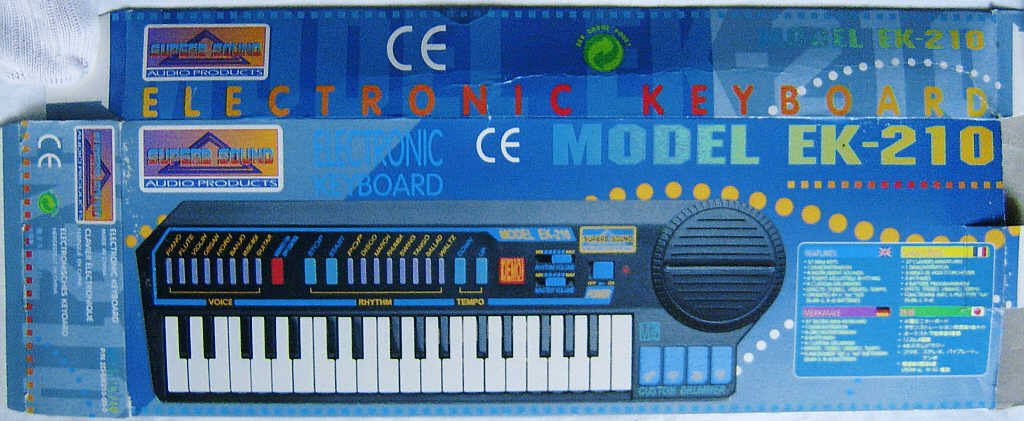
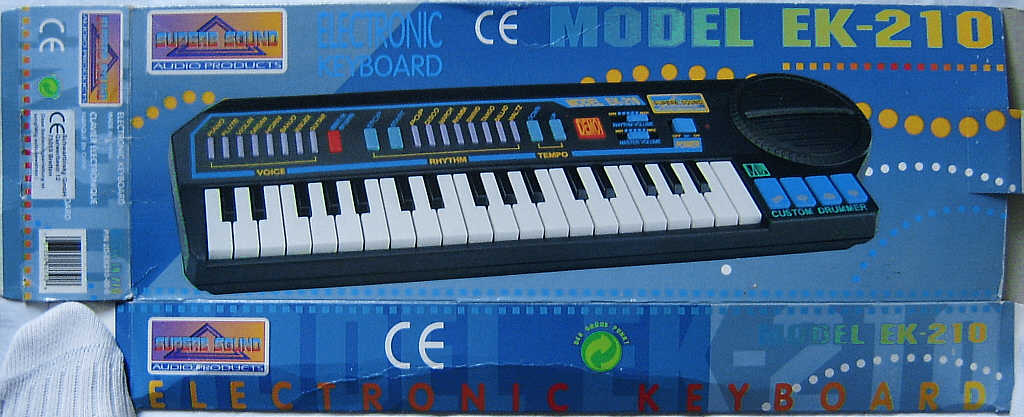
The ergonomic control panel layout with responsive buttons eases realtime timbre modulation of held notes by pressing multiple preset sound buttons with fingers of the left hand. Annoying is that the instrument is detuned 3 semitones too high (C is on A). The bigger speaker at least has more bass. The box text falsely claims "EFFECTS: STEREO, ..." despite it has neither 2 speakers nor sound output.
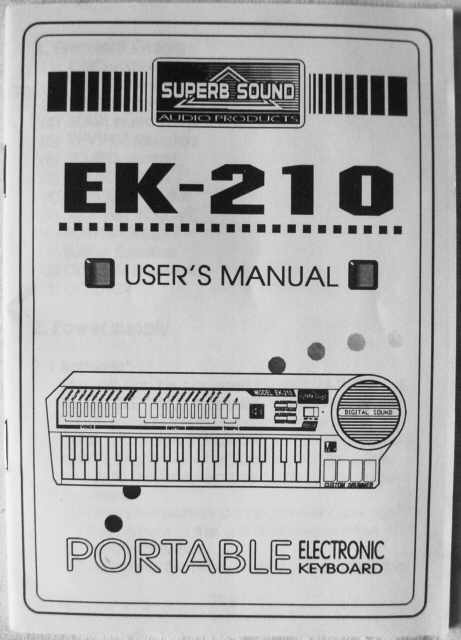
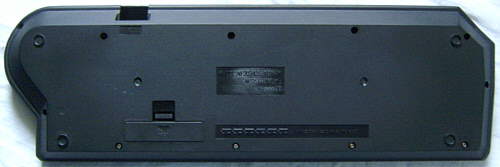
The German manual mentions the importer(?):
Schwartinsky GmbH
Gerwerbestr. 12
75015 Bretten
 |
 |
 |
 |
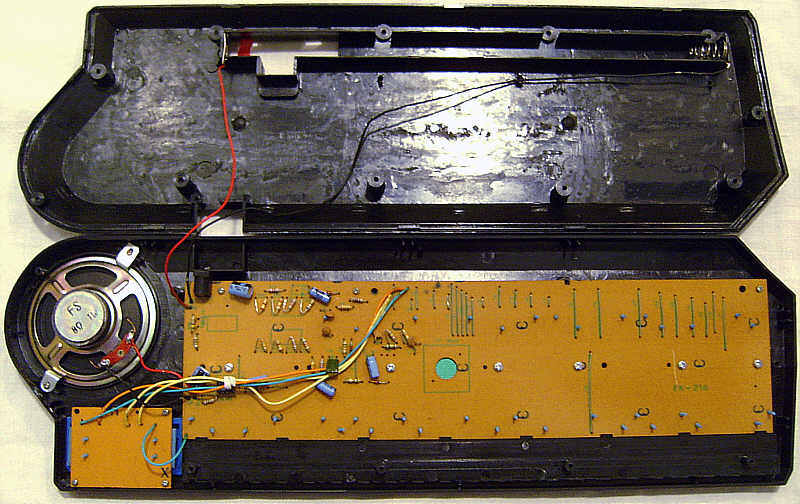 |
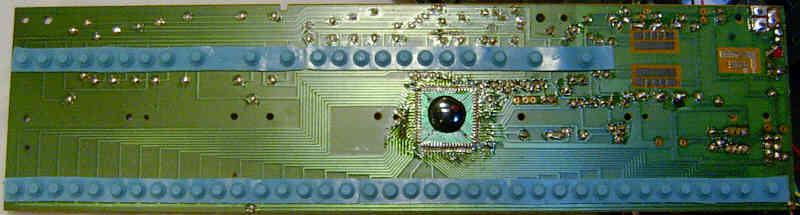 Also here the CPU and PCB look completely different.
 |
 |
A midsize keyboard of this hardware class was the SBS Superb Sound
EK-911 (case shape like EK-922
with EK-001 style drumpads, demo named in manual "Moscow Nights", seen
on eBay). It also came out as Superb Sound - Satellite AJ-911.
question: Was there ever a higher
grade home keyboard (higher polyphony, accompaniment etc.) made with the
same sound engine (i.e. 16 step multipulse squarewaves and blip percussion)
like EK-001? If it exists, I would love to buy one.
| removal of these screws voids warranty... | ||
 |
 |
|
|
|