|
|
|
|
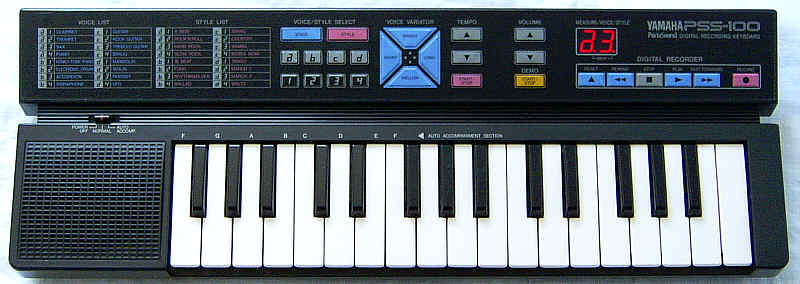
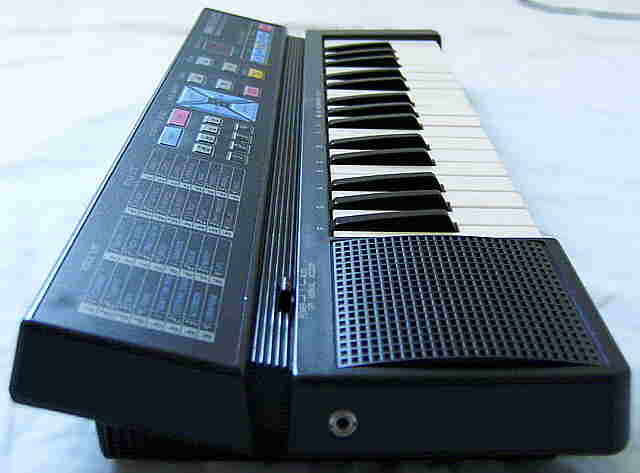
This multipulse squarewave synth keyboard from 1989 has wonderful C64 homecomputer sounds, including some of the famous arpeggiator timbres those are missing on most other squarewave keyboards. Although this is not a SID Station and has no filter, it is one of the most versatile and interesting sounding squarewave instruments and (like MC-3) basically a "must have" for a real squarewave lover.
 |
 |
(Note: This keyboard sounds great, but don't buy one of these so far your only intention is to get a keyboard with faithfully imitated natural instrument sounds. Remember, this is a squarewave instrument and though many of its sounds sound not even remotely like what is written on its buttons, though bought with wrong expectation it may disappoint you.)
 |
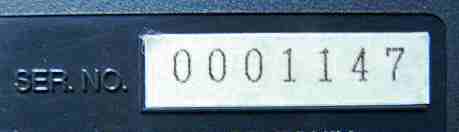 Mine seems to be an early specimen; it has the low serial no. 0001147.
 |
The sounds are multipulse squarewave with audible zipper noise. Those with same names sound like on PSS-80 sound identical, so decaying (piano-like) sounds still ignore key press duration. The 'trumpet' starts with a strange smack, has a fast and strong vibrato and its harsh timbre is at least slightly more natural than trumpets on other squarewave instruments. The 'sax' is similar, but without vibrato and duller; it still sounds fairly realistic. Interesting is that its scratchy attack phase starts with a bright multipulse waveform that switches to a normal thin squarewave. The 'honky-tonk piano' (only 6 timbre variations) on this instrument is very special, because instead of a normal chorus it here has a fast arpeggiator-like effect that rapidly toggles between 2 pulse widths to approximate the detuned chorus sound with only 1 sound channel. This is a very typical C64 sound effect that was used in many historical computer games (e.g. the bass line of the C64 "Mario Bros." title music). The 'electronic organ' has a fast and weak vibrato. The 'guitar' has a percussive attack phase and fades silent too soon due to linear envelope decay. The "tremolo guitar" is harsh with strong tremolo and fades silent (timbre resembles the famous "frog" on Casio MT-60). The "banjo" is harsh with very short decay envelope (like the wannabe "xylophone" on the HBATEC). The "violin" has fast vibrato. The "UFO" is a bizarre organ tone that starts with a strange smack, has strong vibrato and short sustain. Like with Yamaha PSS-80, also on the PSS-100 you can use the "voice variator" synthesizer to select a great variety of different timbres and envelopes to modify the preset sounds. Particularly "ufo" and "honky-tonk piano" provide here a lot of additional lovely C64 timbres.
The "digital recorder" sequencer of the PSS-100 is modelled after a cassette recorder, thus you can record, play and overwrite any section of the virtual tape (but not insert a part). The display acts as the tape counter (counts from 00 to 99); with the "forward" and "rewind" buttons you can step forward and back (hold button to step faster, but this doesn't play the recording during winding but only blips every counter step). "reset" immediately winds the tape back to "00". The sequencer records all sounds (polyphonic), you can play to it and it has battery backed-up memory.
Beside this the display indicates either the currently selected preset sound or rhythm (switched with the "voice" and "style" button like with other sound bank keyboards), but not the 2 synthesizer parameters, tempo or volume.
Unlike the boring PSS-80 monoto, the demo of the PSS-100 contains a complex medley of great POKEY- style musics (the LCD slowly counts from 00 to 99 during this) and you even can play to them. The demo consists of the following melodies:
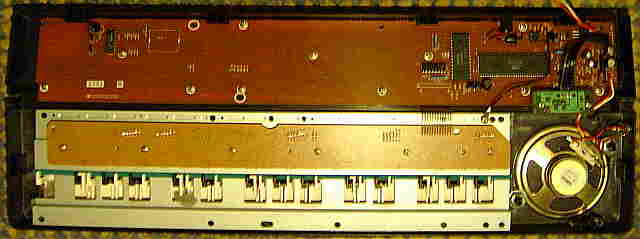
circuit bending detailsThe Yamaha PSS-100 is the more complex sister model of PSS-80. So it has a larger, faster CPU "Yamaha XF852A0" (crystal clocked @ 5.568 MHz) with external 8 KB SRAM "Sanyo LC3564PL" and 2 digit LED display "SL1285". Only the sound IC YM3427 and power amp is the same.
The CPU is a Hitachi 8 bit microcontroller and strongly resembling HD63A01YOP (which contains 16 KB ROM and 256 byte RAM). note: For traditional circuit bending (random crash sounds) the Yamaha PSS-80 is better suited than PSS-100. Although PSS-100 has more sounds and features, it also tends to lock up or mute easier during crash, and its sound IC does not tend to re-sync itself to the CPU by repeated shitshots. Also analogue tempo control is here impossible (no external timer). While a PSS-100 can be used, the PSS-80 responds more graceful and spectacular and will need manual reset way less often. Good is that the foil button panel has ordinary rubber contacts underneath
(touching carbon traces on a PCB), which makes it safe to dismantle and
modify without risk of tearing delicate contact foils.
While the sound engine of PSS-100 compared with PSS-80 has some additional effects, I suspect that also these are features of the sound IC rather than software based. E.g. the 'sax' during attack rapidly switches the waveform from 1010100000000000 (3 spikes) through 1:4(?) to 1:15 to produce a smacking sound. The 'UFO' has a deeper vibrato. The 'honky-tonk piano' uses a fast LFO (about 8 Hz) to toggle the pulse width between 2 settings to approximate a chorus effect; strange is that in voice variator it only supports 6 instead of 8 waveforms (2 multipulses omitted, to avoid wraparound?), which may have to do with the algorithm. keyboard matrixThe keyboard matrix layout is grouped by 6 and resembles PSS-80. But because inputs are switched on the bus through inverting drivers, here they are fed into IC5 (TC40H365P) instead of the CPU itself. Except 4 lower note keys I found no eastereggs.I had hoped to discover additional features (like fingered chord or
more keyboard octaves) in this most advanced version, but I found none
(haven't desoldered unused pins), thus also Yamaha likely never planned
to make a more serious variant of this. So squarewave keyboards remain
an oddity. The unused places at pin 21 do nothing, but connecting 2 through
diodes disables the panel buttons (likely to prevent mess by omitted diodes).
In "test program" these each sound a note. The "accomp." switch is outside
the matrix; it enables single finger accompaniment while CPU pin 23 is
pulled lo.
The input lines are active-low, i.e. react on GND. Any functions can
be triggered by a non- locking switch in series to a diode from one "in"
to one "out" pin.
pinout XF852A0The "Yamaha XF852A0" (64 pin DIL) is the CPU of Yamaha PSS-100. It controls the sound IC YM3427 and has on own sound output for button click. It also controls a 2 digit 7 segment LED display and external SRAM. It is very software controlled (visible by shitshot) and apparently a generic Hitachi 8-bit microcontroller with internal ROM.The software number (part number) in service manual is "XF852A00", while the IC type (in description) is "HD63A01YORH98P". The most similar variant I found a datasheet of was "Hitachi HD63A01YOP", which has 16 KB internal ROM and 256 byte RAM. This pinout was examined by me. I initially had only very grainy incomplete
photo fragments of a Yamaha PSS-100 service manual but later found a complete
PDF. For comparison I have also included its pin names for Expanded Mode
(bus) and SCI port of HD63A01YOP, those are not used in PSS-100.
Bizarre is how much the pin order of the SRAM was shuffled (likely to ease PCB layout; logical function is not affected) and that the serial sound IC YM3427 is wired to pins 62, 63 of port P7 (likely handled in software) instead of using the CPUs dedicated SCI port P2. Unlike PSS-80 the YM3427 data out (pin 7) is not used (despite a pullup resistor shows data on oscilloscope); so apparently the tempo is controlled by an internal timer of the CPU. After crash the sound IC of PSS-100 doesn't easily re-sync with the CPU (often stays mute or static noise), which may have to do with the ignored data-out. The button click sound (3 squarewave cycles) is output at CPU pin 15, but the idle level sometimes randomly toggles at its end. Unlike the HD6305V0 of PSS-80, this CPU has no "NUM" test pin, but the datasheet has a strange warning, that if the HALT signal is accepted during WAI instruction (waiting for interrupt) will make the CPU fetch an "incorrect" interrupt vectoring address. Who knows what this may be good for... But because the documented HD63A01YO is a "modern" CPU, it does prefetch and fires a TRAP interrupt in case of illegal instructions and some access violations. The clock rate is internally divided by 4; touching crystal pin 3 causes hum and complete lockups (controls don't respond anymore) but crashes are less interesting than with PSS-80 (likely by the TRAP feature). Unlike e.g. with Intel MCS-51 there are no security (rom copy protection) features mentioned, which may permit to dump the rom. Interesting are the mode pins 4 and 5 (here both wired hi for Single-Chip Mode) those according to the datasheet can make the CPU access external ROM (Expanded Mode, i.e. ports 1, 4 and 7 become bus) when one of them is lo. Not mentioned is what happens if both are pulled lo, so this may have replaced the "NUM" pin to enter a hidden test mode. (I didn't desolder pins for testing, because on the dark side of the moon they are less pleasant to access than with PSS-80.) |
Another great keyboard with complex squarewave sounds is Letron
MC-38, and another multipulse squarewave instrument with fast arpeggiator
timbres is the circuit- bent Hing Hon EK-001.
Do not confuse the Yamaha PSS-140
with a PSS-100 variant; although the PSS-140 has a similar case, additional
drumpads and even 100 preset sounds, its sounds are not editable and not
squarewave, but made from ordinary FM synthesis.
| removal of these screws voids warranty... | ||
 |
 |
|
|
|