 |
|
|
digital squarewave keyboard
with complex C64 sounds, accompaniment & songbank |
|
|
|
|
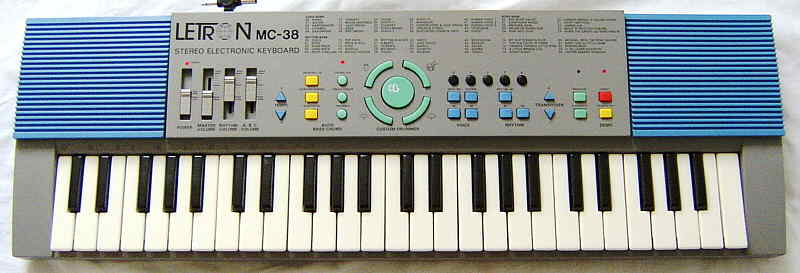
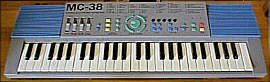
This was the direct successor of the famous Letron
MC-3 and one of the very last non-toy squarewave keyboards; later
"MC" series keyboards (created by Medeli)
of this size already used samples or FM instead of this archaic electronic
sound. The timbres still have that great classic Commodore C64 home
computer appeal, but are programmed slightly more complex than in MC-3
and partly include simple pitch envelope or chorus effect by layered subvoices
(which halves polyphony).
With accompaniment it can now play up to 3 main voice notes, rhythms feature
intro and ending, and the "vibrato" and "manual bass" features of MC-3
are gone, but the rest is extremely similar. Unlike its predecessor, the
MC-38 has no OBS sound and rhythm select buttons anymore, but uses cipher
buttons like modern sound bank instruments. It also features a 20 song
bank with simple lesson function (mutes melody). What in 1990th appeared
rather cheapish and silly as a kind of imitated wannabe product, is nowadays
enjoyed for its unique polyphonic lofi synth style.
This instrument was also released as "MC-38" by Medeli, as CCE
EK-55X and as
Intersound PK-380. A black version with funky
orange speakers was released as
Thompsonic TS-38 (seen on
eBay).
A black version with black speakers came out as Passenger's MC-38
(got photo by e-mail).
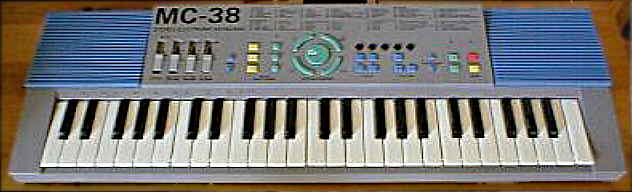
"MC-38" version (eBay photo)
|
(Note: This keyboard sounds great, but don't buy one of these so
far your only intention is to get a keyboard with faithfully imitated natural
instrument sounds. Remember, this is a squarewave instrument and though
many of its sounds sound not even remotely like what is written on its
buttons, thus bought with wrong expectation it may disappoint you.)
main features:
-
49 midsize keys
-
polyphony 4 notes (3 notes with accompaniment; with chorus sounds only
2 note or 1 with accompaniment)
-
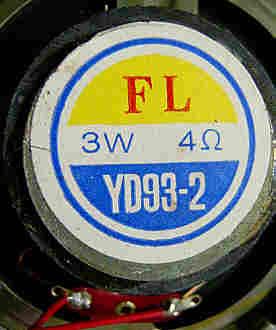
stereo (quite loud 2x 2W amp with slightly bassless 10 cm speakers)
-
25 preset sounds {piano, guitar, harpsichord, cowbell, saxophone, trumpet,
brass ensemble, jazz organ, oboe, pipe organ, violin, synth 1, clarinet,
synth brass, synth 2, synth 3, mandolin, harpsichord & jazz organ,
organ & string, electronic piano & oboe, human voice 1, human voice
2, human voice 3, telephone, ghost}
-
25 preset rhythms {disco, pops, slow rock, hard rock, rock a ballad, pop
rock, rock & roll, funk, shuffle, boogie woogie, rhythm & blues,
8 beats, 16 beats, big band, swing, waltz, jazz waltz, march, country,
rhumba, bossanova, reggae, salsa, samba, tango} with intro, fill-in and
ending
-
functions selectable through 5 cipher buttons.
-
each 2 sound and rhythm memory buttons for OBS access.
-
separate faders for main-, rhythm- and accompaniment- ("A.B.C. " = auto
bass chord) volume controls.
-
5 rubber drumpad buttons
-
5 percussion sounds {base, conga, snare, open hihat, closed hihat} of special
electronic style.
| base & conga |
= low & higher squarewave blips |
| snare |
= shift register noise |
| open hihat |
= unique electronic metallic timbre (low- res waveform sample??, or
2 mixed squarewaves?) with truncated decay and audible end click. |
| closed hihat |
= dto.' with shorter envelope |
|
|
-
programmable(!) rhythm pattern ("custom drummer")
-
auto-accompaniment in single finger chord or fingered (=normal) chord mode
(manual organ chord keyboard split with rhythm off). For chords always
the same, envelope- less squarewave organ tones are used.
-
sustain button
-
tempo +/ - buttons (16 steps)
-
transposer +/- buttons (-12 semitone steps, works only in "fingered"
or "single finger" chord mode)
-
all sounds beside snare and hihat are squarewave or sawtooth based and
sound much like C64.
-
multi-chip hardware:
-
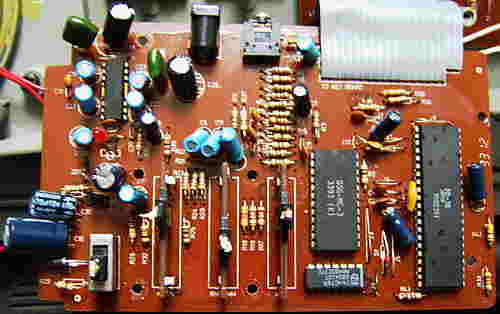
CPU= "MC-38, 3502351, Japan" (42 pin DIL | likely MC-3DX
with changed software)
-
sound IC= "DSG-MC-3, 3393 (K)"
(24 pin DIL)
-
amp IC= "LA4550, *J7(?)" (14 pin DIL)
-
20 demo melodies song bank (with standard accompaniment & monophonic
main voice; songs restart after end and cycle through all preset sounds)
-
lesson function (mutes main voice of the demo tunes)
-
jacks for AC adapter & headphone
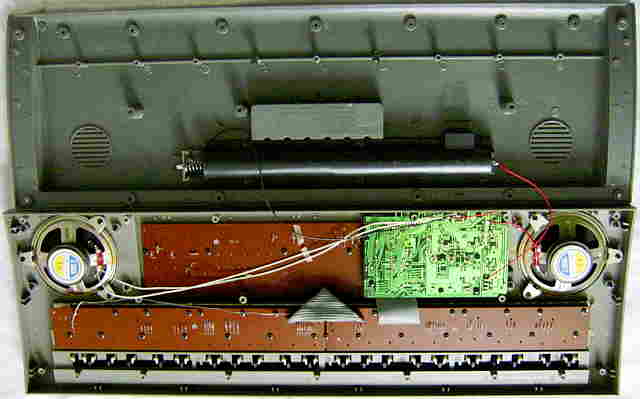
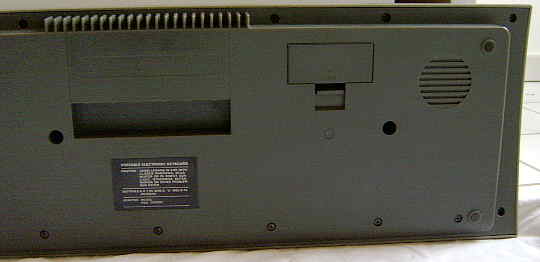 At the top you see the fake plastic heatsink and the plastic handle hole.
 |
eastereggs
-
keyboard percussion on/off button (uses 5 highest note keys as drumpads).
notes:
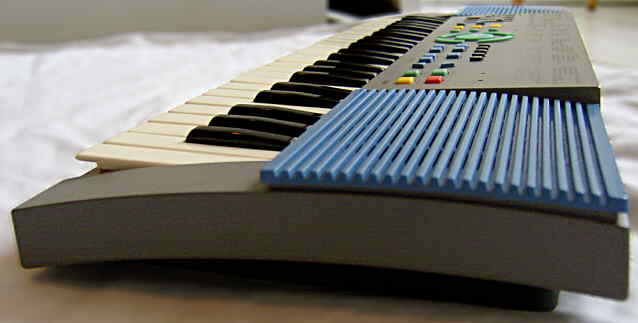
Despite the outer case layout of the Letron MC-38 resembles in top
view very much the Letron MC-3, it is also in detail much more elegant
since it has stylish curved side edges and a slanted control panel, a bottom
with handle hole and even a fake plastic amplifier heat sink in the middle
of the back (which rather sharp edges relativate the value of that handle
hole). Otherwise it lacks the zillion of red rectangular LEDs those were
the eye catcher of its predecessor. (The new green silicone rubber drumpad
circle assembly was also used in the Fujitone
6A (MC-6), which has an even more stylish case shape and great
FM sounds.) The cipher and "play/space" buttons sound a blip, which disturbs
live performance. Unfortunately they often were assembled very poorly (see
below),
and many broken ones have been likely thrown away, so they are getting
rare now. The MC-38 sound awesome and are definitely worth to keep.
The main voice preset sounds partly include vibrato, pitch envelopes
or chorus effects, unfortunately the manual "vibrato" button of the MC-3
is gone. Like with the MC-3, many sounds are not remotely realistic (even
within the limited capabilities of the sound chip); e.g. the "trumpet"
is still an envelopeless plain squarewave toot ("jazz organ" and "synth
1" also). The "violin" and "clarinet" contain fast vibrato. The saxophone
is just a louder version of the violin with a slower vibrato. The "mandolin"
rings and the sounds "brass ensemble" and "synth brass" include a chorus
effect (half polyphony). Also the sounds "harpsichord & jazz organ",
"organ & string", "electronic piano & oboe" half the polyphony
despite they don't sound at all like 2 different layered sounds - at least
not with independent envelopes (a program bug?). The "synth 2" and "synth
3" have a pitch envelope, i.e. the quickly howl 1 note down and up again
at the begin of a note and fade silent (decay envelope). The 3 "human voice"
sounds don't sound at all like voices - they are also just made from a
squarewave timbre which starts 1 note lower and quickly howls up to the
final note (resembling bagpipes), and these all have a different pulse
width and version 1 and 3 fade silent (by decay envelope). The "telephone"
is simply the chorus version of "mandolin". The "ghost" is a thin timbre
with fast, strong vibrato that fades silent. The pitch envelopes of the
sounds are very coarse and grainy, thus they do rather a portamento than
a glissando. (Possibly this was done to save ROM space by omitting intermediate
pitch lookup tables.)
The accompaniment section behaves much like on MC-3, but an improvement
is that although this instrument employs the same 4 note polyphonic DSG
sound chip like the MC-3 (also see
there), it
provides in accompaniment and chord mode up to 3 notes main voice polyphony
instead of only 1, because it generates 2 envelopeless plain squarewave
organ tones in the CPU itself and so only occupies 1 DSG channel alternatingly
for sawwave e-bass and 3rd squarewave chord channel. In organ chord mode
(without rhythm) every new chord starts with an e-bass sound. When in fingered
mode with no rhythm (i. e. organ chords) multiple keys of a chord are pressed,
the chord continues sounding until all of these keys have been released
or a different chord is played; this prevents strummed/ chinked chords
and other more advanced play tricks. 7th chords can't be played due to
the limited polyphony. Interesting is that the DSG
seems to be identical with a Yamaha YM2163
sound chip that I found in the
Testron CL-60910
and several other similar keyboards. By behaviour and hardware features
the MC-38 is a cross between the old MC-3 and the toy-like Elite
MC2200 (which also employs cipher buttons, a CPU with integrated
tone generators, song bank and combined power & tempo LED). So even
with accompaniment volume turned fully down, the 2 squarewave chord channels
from the CPU stay audible, thus their volume slider rather changes the
mixing ratio and dynamics than muting chord and bass entirely.
The rhythm has the same great "custom drummer" feature (stepwise programmable
drum pattern) like the MC-3, and now every rhythm even features an intro,
fill-in and ending pattern (with accompaniment). Unfortunately the MC-38
has no OBS rhythms and sound select buttons anymore and every sound/ rhythm
select buttons press always makes a blip noise, which limits their realtime
use. But as a compensation there are now OBS memory buttons (M1,M2) for
each 2 sounds and 2 rhythms those can be assigned from the currently selected
ones by holding "voice" or "rhythm" and then pressing one of these buttons.
Pressing M-buttons alone selects the stored sound or rhythm. This is a
quite unusual feature for a midsize beginner keyboard and only existed
on very old Casio instruments (like MT-30
and MT-60). The sound memory buttons
however stop notes of held keys, which makes them far less versatile than
the great OBS sound buttons of the MC-3. Also the MC-3 custom drummer trick
with selecting different rhythm and accompaniment pattern lengths doesn't
work anymore, and even entering a pause during rhythm programming now makes
a blip noise. This button click is produced by the CPU on an own squarewave
tone channel that works independently from the limited polyphony of the
rest (and may be safely disconnected). At least the annoying battery alarm
tone of the MC-3 is gone now - perhaps the manufacturer wanted to give
the thing a more professional appeal by preventing the thing from outing
itself every minute as a cheap squarewave tablehooter.
circuit bending
details
The Letron MC-38 is based on the CPU "MC-38" (variant of MC-3DX)
with squarewave sound IC "DSG-MC-3".
Unlike the predecessor MC-3, the CPU is crystal
clocked at 4 MHz because it additionally outputs 3 envelopeless squarewave
tones for chord channels 1 and 2 and the button click. The DSG produces
the 3rd accompaniment channel (squarewave, pin 4) and bass voice (sawtooth
wave, pin 5). To generate 1MHz clock for the DSG, the logic IC "74HC74N"
(14 pin DIL, 2 D-flipflops) is used to divide the master clock by 4.
All polyphony channels are mixed through resistors, so you may install
potentiometers to tweak their ratio.
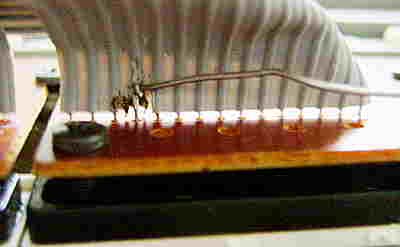
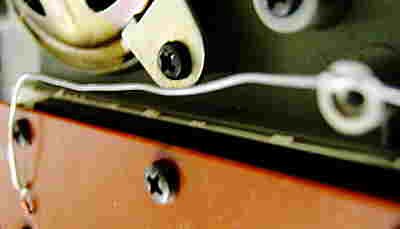
The hardware of my MC-38 was assembled very badly and looks quite prone
to short circuits. E.g. screws were driven through cables and a torn off
ribbon cable lead at the keys PCB was patched by soldering a 30cm long
piece of bare solder(!) wire between ribbon cable and the very end of that
PCB. Also some keys respond unevenly. Someone e-mailed me that in his MC-38
a resistor burned out, which likely was result of such Chinese piecework
mess.
disable button click
The button press blip sound comes through an electrolytic capacitor from
an own sound channel at CPU pin 30. You may disconnect this nuisance if
you don't like it.
keyboard matrix
The keyboard layout corresponds to MC-3, but
the panel buttons strongly differ. The only easteregg is keyboard percussion
on the 5 highest note keys.
|
41
|
40
|
39
|
38
|
34
|
35
|
36
|
|
CPU pin
|
|
out 4
|
out 3
|
out 2
|
out 1
|
out 5
|
out 6
|
out 7
|
out / in
|
|
o
B4
|
o
B3
|
o
B2
|
o
B1
|
demo
|
transpose
+
|
P.
open hihat
|
in 12
|
4
|
o
A#4
|
o
A#3
|
o
A#2
|
o
A#1
|
R.
select (M3)
|
transpose
-
|
P.
snare
|
in 11
|
3
|
o
A4
|
o
A3
|
o
A2
|
o
A1
|
O.
select (M3)
|
tempo
+
|
P.
conga
|
in 10
|
2
|
o
G#4
|
o
G#3
|
o
G#2
|
o
G#1
|
'4'
|
tempo
-
|
P.
base
|
in 9
|
1
|
o
G4
|
o
G3
|
o
G2
|
o
G1
|
'3'
|
sustain
|
P.
close hihat
|
in 8
|
8
|
o
F#4
|
o
F#3
|
o
F#2
|
o
F#1
|
'2'
|
C.
fingered
|
R.
M2
|
in 7
|
7
|
o
F4
|
o
F3
|
o
F2
|
o
F1
|
'1'
|
C.
single finger
|
R.
M1
|
in 6
|
6
|
o
E4
|
o
E3
|
o
E2
|
o
E1
|
'0'
|
C.
off
|
O.
M2
|
in 5
|
5
|
o
D#4
|
o
D#3
|
o
D#2
|
o
D#1
|
-
|
keyboard percussion
|
O.
M1
|
in 4
|
16
|
o
D4
|
o
D3
|
o
D2
|
o
D1
|
-
|
R.
start/stop
|
demo
chord only
|
in 3
|
15
|
o
C#4
|
o
C#3
|
o
C#2
|
o
C#1
|
-
|
R.
ending
|
R.
play/space
|
in 2
|
14
|
o
C4
|
o
C3
|
o
C2
|
o
C1
|
o
C5
|
R.
start/fill-in
|
R.
program
|
in 1
|
13
|
The input lines are active-low, i.e. react on GND. Any functions can
be triggered by a non- locking switch in series to a diode from one "in"
to one "out" pin.
legend:
|
|
|
"o"
|
= keyboard key |
|
R.
|
= preset rhythm |
|
O.
|
= preset sound ('orchestra') |
|
C.
|
= chord |
|
P.
|
= drumpad |
orange
background |
= easteregg (unconnected feature) |
A button at 16->35 switches the 5 highest note keys into keyboard percussion
mode {base, conga, snare, open hihat, close hihat}. Press itagain to exit.
|
The instrument has a song bank library of 20 demo melodies in minimalistic
but nice C64 squarewave sound:
-
Red River Valley
-
Camptown Races
-
Brother John
-
House Of Rising Sun
-
Rain And Tear
-
My Cup Runneth Over
-
The Old Folks At Home
-
Twinkle Twinkle Little Star
-
A Little Brown Jug
-
Silent Night
-
London Bridge Is Falling Down
-
Happy Birthday
-
Jambalaya
-
Night in Moscow Suburb
-
When The Saints Go Marching In
-
Michael Row The Boat Ashore
-
Mary Had a Little Lamb
-
Rowing Boat
-
O. Du Lieber Augustin
-
Umterlanders Heimweh
These demo melodies play in a loop and cycle through all available sounds.
Each demo includes a matching rhythm and initial sound, but they only use
a monophonic main voice with standard accompaniment end end with the special
ending of that rhythm. In spite of this I like many of them. These tunes
also include the German folk song "Unterlanders Heimweh" (misspelled "UMTERLANDERS
HEIMWEH"), but this tune sounds very different from the wonderful music
called "Unterlanders Heimweh" on the ROM-Pack RO-551
(which corresponds to the famous demo of
Casio
VL-Tone 1) and instead corresponds to the Casio
MT-36 demo, which sounds just like a rural folk waltz and resembles
a bit "Little Brown Jug". (Read more about the unofficial Casio anthem
"Unterlanders Heimweh"
here.)
Also some other melody names are written in badly misspelled Engrish. When
only the "demo" button is pressed, the MC-38 plays all songs in a sequence.
When a demo song is selected by its number and then "demo" is pressed,
the instrument repeats only that song and cycles through a different main
voice at each repeat. The red lesson function button is mislabelled "chord";
when pressed, it mutes the main voice and permits to play on the keyboard
to its accompaniment.
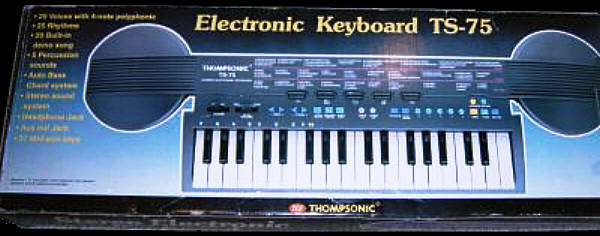
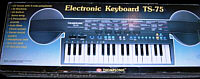
| A 37 midsize keys variant of MC-38 (odd black case with sideways protruding
round Mickey Mouse ear speakers) came out as Thompsonic TS-75 (seen
on
eBay). |
Thompsonic TS-75 (eBay photo)
|
The direct predecessor of the Letron MC-38 was (as already mentioned)
the Letron MC-3. Another great keyboard
with complex squarewave sounds is Yamaha
PSS-100.
Note: Do not confuse the MC-38 with the MC
3800; although many technically identical MC keyboards exist in
model name variants with either 2 digit or 4 digit MC numbers (like "MC-**"
or "MC **00" where ** are the same ciphers), the MC 3800 is an exception
of this rule and technically very different. This may hint that it is one
of the oldest MC series instruments.
| removal
of these screws voids warranty... |
|
|
 |

|
|
| |
back
|
|