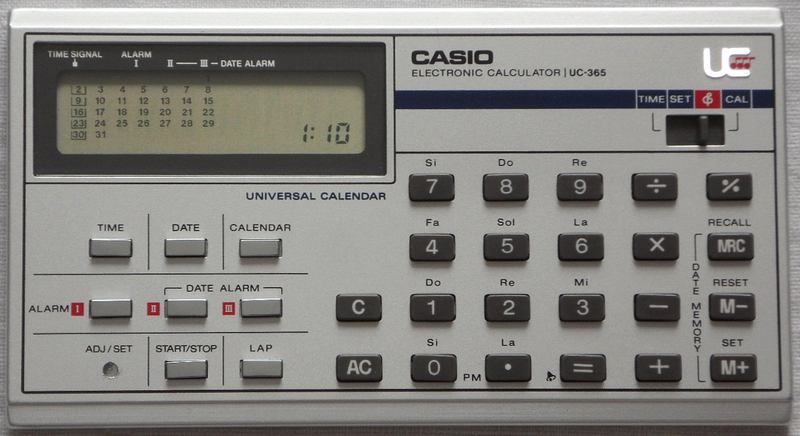
This musical calculator of 1981 resembles Casio ML-81 with additional universal calendar. The LCD can show a full calendar page made of single-segment numbers. But it can not playback calculator results or memory as note sequence, which makes it musically boring.
 |
 |
The hour chime here sounds like 2 short thunderer whistle tones and stays not always active when in music mode. Instead it is toggled in set mode with "." (bell icon).
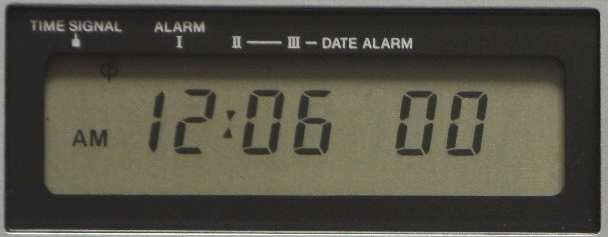
Alarms II and III are date alarms. To set a date alarm, in set mode enter it in hhmmMMDD format, press '%' to select buzzer instead of melody and press its alarm button. I.e. enter e.g. 'AC' 8051203 'DA-III' for the time 8:05 at date 12-03 (3rd December). For setting it as a normal alarm type only the time (hhmm format) instead. You can toggle an alarm on/off with its button when in set mode. Regard that selecting buzzer (kind of chirp) will also make its button only sound the buzzer instead of melody so long it is set. So if a melody is gone, clear that alarm (e.g. set it to 1200 and press its button twice).
There is even a countdown timer with alarm (chirp). In set mode type the count of hours and minutes (hhmm), '-' and 'start/stop'. You can not set seconds. You can use start/stop to pause/resume and the lap button to display the running alarm. Using the stopwatch clears a running countdown.
The calendar can handle dates from 1901-01-01 to 2099-12-31. It depicts
a whole calendar page of a month and can do date calculations. To see a
page, type year and month in (YY)YYMM format and press 'date'. Step through
pages with '+' and '-'. To memorize a date, in set mode type 'AC', date
in YYMM format, 'date', the day (DD) ans 'M+'. So the day will have a flashing
mark in the calendar. To clear that date, do the same with 'M-' instead.
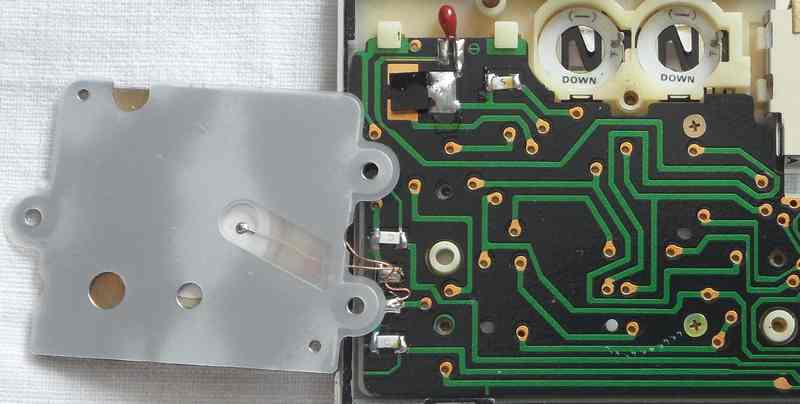
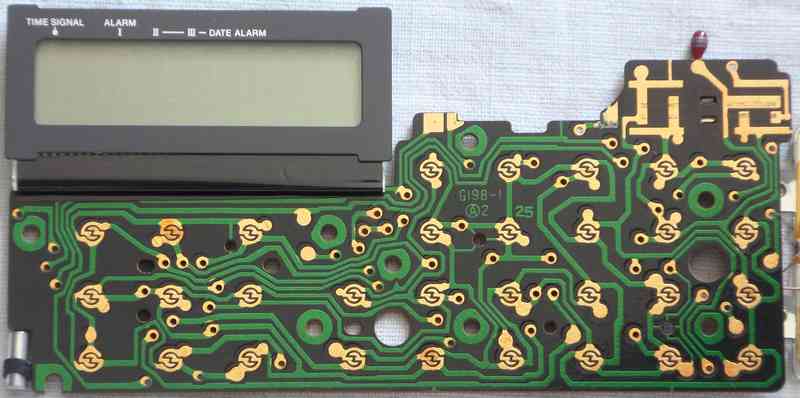
hardware detailsThe Casio UC-365 is Casio's only musical calculator based on the CPU "Hitachi HD43194". It has 60 pins, which was likely necessary because the LCD has 2 sandwiched layers to display full calendar pages made of single-segment numbers. Also the keyboard matrix is strange.
keyboard matrixThis diodeless keyboard matrix has no separate in and out pins but in turns toggles the mode of each pin to reduce pin count. It is hard to figure out how it works in detail. All pins also output signals. Like with other Casio musical calculators, pressing multiple keys keeps a held note of the first pressed key sounding untill all keys or buttons are released.
All lines for buttons toggle their role between input and output. As
inputs they are active-low, i.e. react on GND. Any functions can be triggered
by a non- locking switch in series to a diode from one "in" to one "out"
pin. Only different is pin 13 for the slide switch, which is input-only
and active-hi.
Connecting matrix place 4->8 in music mode quickly trills the button blip (like pressing a function button). Connecting matrix place 10->12 seems to be a buggy variant of the "lap" button. It shows the stopwatch (like "lap") but stops a running stopwatch (without blinking the dot). Sometimes it only displays "0" of the calculator. pinout HD43194The "Hitachi HD43194" (60 pin SMD) is the CPU of the musical calculator Casio UC-365. It supports a dual layer LCD with many segments (40 pins) and a special keyboard matrix with 10 pins those each toggle between input and output to reduce pin count. The monophonic plain squarewave (1:1) tone generator has digital decay envelope (3 large steps and silence = 2-bit DAC?). Through an internal bipolar amplifier it can directly drive a piezo speaker.There is no service manual, so all CPU pin names were choosen by me
(loosely inspired by the naming convention of Casio
VL-1).
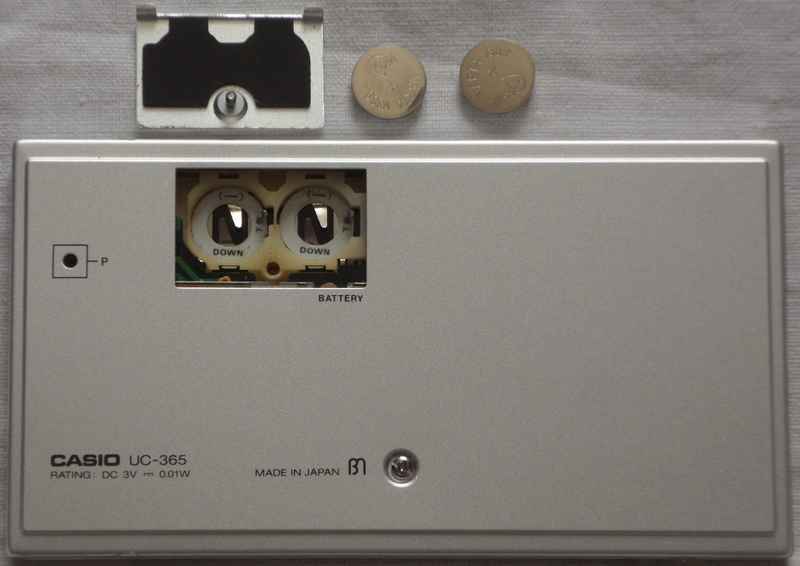
The whole hardware is wired in series to a 60 ohm resistor in the GND line to the CPU. Also the speaker has a serial resistor (105 or 110 ohm) in each output line from the bipolar output. As usual, the LCD pins have 4 voltage levels. The reset ("P") button pulls pin 14 to ground 0V. Pin 21 and 22 are both wired to positive supply voltage, so one of them may be a test pin. (I didn't desolder it.) The piezo voltage of the alarm bleep is not higher than of music; it is only louder by resonance. Shitshot by battery wiggling or touching clock pins makes plenty of mess, but does nothing spectacular like the R2D2 glitch. During this the LCD shows plenty of segment garbage, but it never combines parts of the calendar (number table and small clock) with the normal (calculator) display, which hints that both LCD layers are electrically separate (e.g. toggled by a flipflop), which was possibly done to reduce the internal count of LCD lines inside the CPU. During glitches the sound hardware can play a higher "ding" note than normal (likely pitch of the beeper), but the note sequences are less random than in other Casio calculators. When I first probed the matrix with an oscilloscope (I likely touched clock pins), it once repeated a strange toot sequence like morsing "SOS". Possibly it can morse a copyright message or something, but I never got into this mode again. |
A smaller UC-365 variant came out as Casio UC-360 and a fullsize
alarm clock version (with keypad lid, bigger speaker) as Casio MQ-200.
| removal of these screws voids warranty... | ||
 |
 |
|
|
|