 |
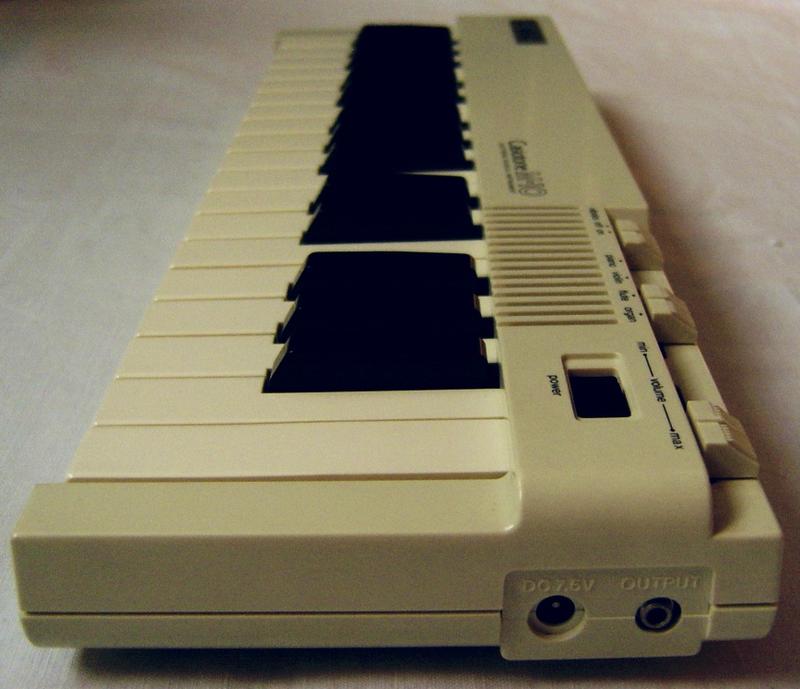 |
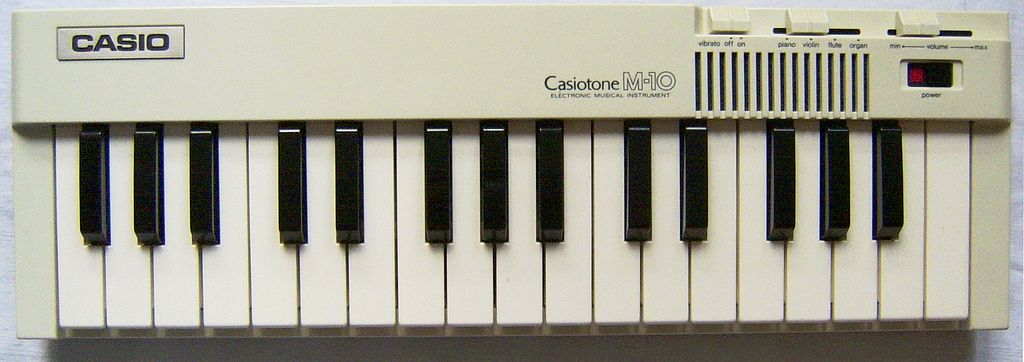
This keyboard from 1980 was one of the very first polyphonic midsize instruments made by Casio. It has only 4 preset sounds and a vibrato switch, but by an easy modification it can be upgraded to 23 preset sounds.
|
|
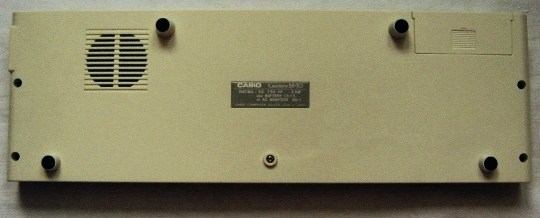
circuit bending detailsThe M-10 is the smallest polyphonic first generation Casio keyboard. Its NEC D773G CPU is an early member of the D77xG family and was also used in the serious fullsize Casiotone 401. Although the CPU outputs 14 bit audio, the DAC is a simple 12 bit construction to cut cost. The filter cutoff is controlled through CPU pin 46 to 750 Hz {piano, flute} or 820 Hz {violin, organ}.I even got the Casiotone M-10 service manual from 1980. Although it tells nothing new (and of course keeps silence about all those mythical hidden eastereggs), this ancient manual gives a nice introduction into the the general basics of sound synthesis. So there are diagrams of multipulse bit sequences for all active pins sent to the DAC during violin, flute and organ preset, which reveals a bit about the early Casio way of thinking. This text is only a brief overview and mainly meant for hardware comparison. The M-10 has been detailedly researched by Robin Whittle in his technical bulletin "Modifying the Casiotone Instruments" from 1981, which is very recommended to read if you want to upgrade this instrument. It e.g. explains mechanical details, how to upgrade the poor DAC and bankswitch to missing keys. keyboard matrixI haven't analyzed the M-10 by myself, but Robin Whittle explained it with many technical details including keyboard matrix. While the layout is generic for D77xG CPUs (see there for additional info), here are the D773G preset sound names for each key (based on Robin Whittle).
The keyboard matrix input lines are active-low, i.e. react on GND, thus
any functions are triggered by a switch in series to a diode from one "in"
to one "out" pin.
Matrix eastereggs are selected by each a locking switch in series to a diode at the following CPU pins:
CPU pin 16->30
CPU pin 17->30
CPU pin 17->27
CPU pin 16->26
CPU pin 17->26
CPU pin 17->31 You may connect a sustain pedal here. It holds all notes until pedal release (or running out of polyphony).
CPU pin 17->25
CPU pin 16->25
CPU pin 16->31 This makes a slightly different chromatic tone scale.
CPU pin 18->29, 18->30
Attention: I haven't tried out these eastereggs, thus I don't know if they are correct. |
The Casio M-10 was (as far I know) the only first generation Casio keyboard
with an "M-" name prefix. Only much later in early 1990th they released
their "Casio Club" keyboards M-100, M-200, M-300,
those were simply re-releases white versions of their sample based SA-5,SA-35
and SA-40.
| removal of these screws voids warranty... | ||
 |
 |
|
|
|