|
|
squarewave keyboard with strange accompaniment & analogue rhythm |
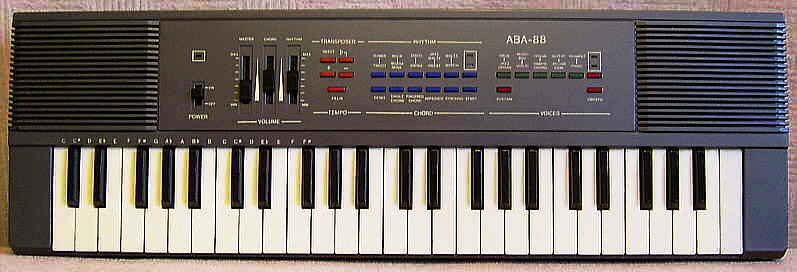
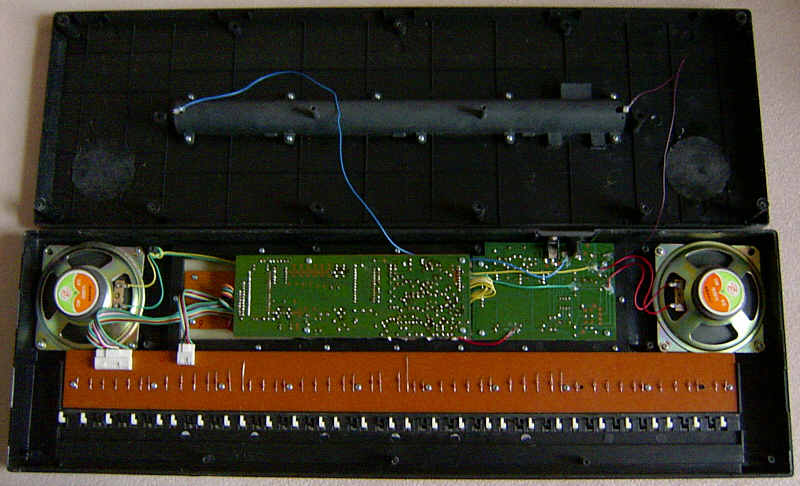
Like Testron, the ABA-88 is stereo with lovely warm timbres and has a bronze coloured case which is a little wider than the keyboard, but the functions resemble rather the Rhythmic 2, and also the case is flatter and less deep. Like both it employs a Yamaha 4-channel squarewave soundchip with some additional analogue percussion.
Bizarre is that model name "ABA-88" (including the winged horse logo) was apparently directly stolen from a wireless microphone with built-in FM radio transmitter, that was sold in Europe by company ABA in 1988. So this is really shanzhai in a bad way, much like the cigaret logo on the absurd Golden Camel-7A.
This keyboard was also released as Anitech KS-88 (seen on eBay).
| base & conga | = low & higher squarewave blips |
| snare (?) | = shift register noise |
| tambourin | = analogue transistor noise/ self-oscillation |
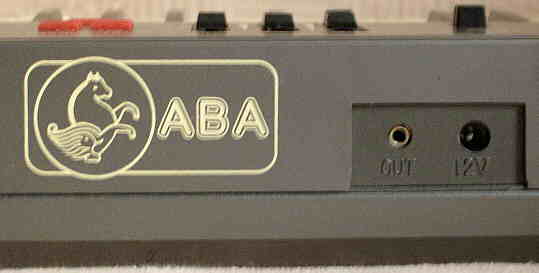 On
the back is a white "ABA" logo with the front half of a winged horse that
looks quite Arabian. Most case details resemble the
Testron. On
the back is a white "ABA" logo with the front half of a winged horse that
looks quite Arabian. Most case details resemble the
Testron. |
 |
 |
 |
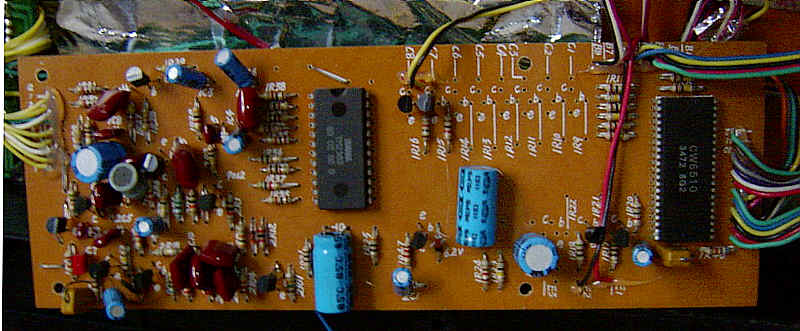
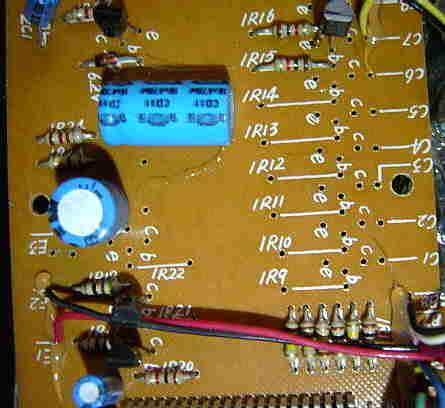
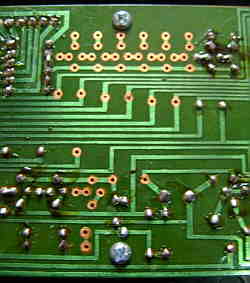
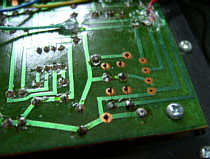
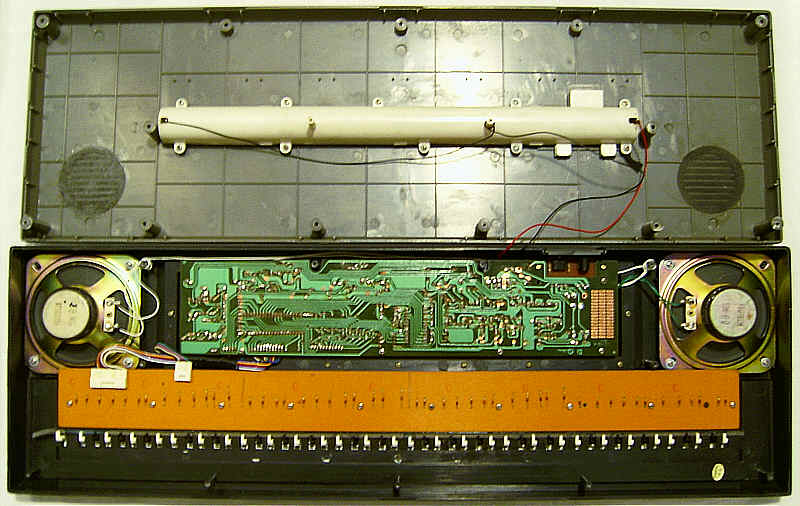
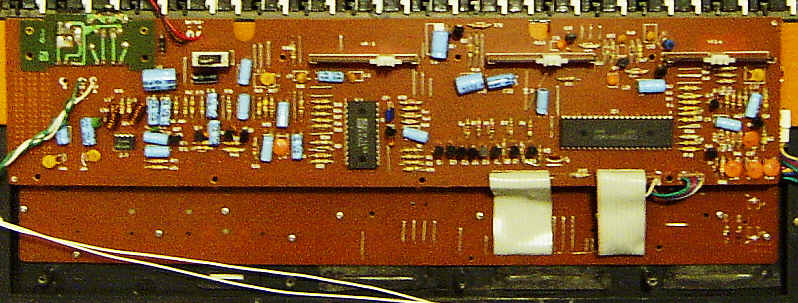
The PCB has plenty of unused empty solder holes. |
 |
 |
 |
 |
All non- percussion sounds are squarewave based (with different pulse widths and envelopes) and sound much like a C64. The soundchip (same like in Testron) apparently internally re-assigns the same tone generator channels to different outputs because in accompaniment mode only 1 voice remains at the right keyboard section for melody play.
Interesting for playing are the 5 semi- OBS sound buttons those can be also pressed while keys are held down without stopping their notes. By rhythmically pressing these buttons many arpeggiator- like timbre changes can be created, though this button pad can be regarded as a realtime sound control, although it responds a bit slow. The static voice assignment of the instrument is a little annoying, because in any chord modes only 1 polyphony channel remains for the user selected sound in the right keyboard section, no matter how many channels are really actually occupied by chords or accompaniment.
The automatic accompaniments insert a sort-of automatic fill-in every 4 measures, which can be a little confusing, but generally sounds nice. Unlike Testron and similar wonderful no-name instruments, the accompaniment of the ABA-88 works really lousy, because with rhythm there is no difference between "fingered" and "single finger" mode; both behave "fingered", which makes it (despite optional arpeggio) somewhat stubborn and boring; otherwise it even accepts non-chord key combinations, which allows to play disharmonic note clusters. Only with rhythm off there is a difference between both modes; "single finger" plays here chords like expected, while "fingered" behaves like a key split with 3 note polyphony (organ tones) to the left and 1 note to the right keyboard halve. Like with most late squarewave keyboards, the arpeggio button does rather a pattern variation (adds some higher octave notes) than enabling a separate arpeggio channel. The fill-in button inserts a fast percussion loop without accompaniment. The instrument makes no use of the digital metallic cymbal waveform of the YM2163 sound chip despite it would have sounded more natural than the employed transistor and shift register noise. Possibly this instrument was originally designed for a predecessor of the YM2163 that didn't feature these percussion sounds.
(note: In old versions of this page I described the accompaniment flaw wrongly, because the instrument was in another city (at my parents), so I couldn't verify.)
Like the Rhythmic 2 it features as well the demo melody "Blue Danube" (which is the demo of my HBATEC keyboard) as "For Elise" (which is the demo tune of the Testron), although all versions are arranged differently. The demo tunes of this instrument sound extremely off and weird; their accompaniment keeps playing with arpeggio in always the same key (i.e. no chord changes) and thus sound extremely disharmonic. I don't know whether this was intended as a bizarre sort of oriental free jazz medley, or if the programmer of this demo rather typed in the notes within few minutes without ever minding or verifying how it sounds. The oriental winged horse "ABA" logo suggests that it was possibly built by or for Arabian countries with their typical music style in mind.
Possibly this instrument hardware was a predecessor of the Rhythmic 2 and or even the Testron, despite the capabilities of its automatic accompaniments is so far away from the latter that I almost can't imagine this. The ABA-88 appears quite half-baked; possibly its CPU went into production with a severe software flaw that was discovered too late. Likely a close hardware successor was the similarly buggy Bestar MC 3300.
If there were no transistor tooters, this ultra-rare squarewave tablehooter could easily win the first prize in a contest for the world worst keyboard. While sound set and functions are basically identical with ABA-88, in this naughty twin the automatic accompaniments play horrible cacophonic note mess, that sounds like holding adjacent keys down in an uncrippled fingered chord mode of a normal keyboard. For obvious reasons ;-) there is no brand name on it, but the PCB is marked "TALU". Deichkind should play this! It may be good for e-punk or darkwave, but not much else.
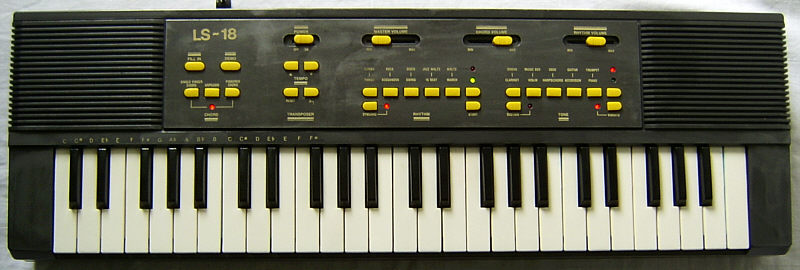
It is unbelievable that such a buggy CPU really went into production (or does only my specimen suffer of bitrot?). Possibly the programmer of ABA-88 tried to replace its fingered-only with a genuine single finger chord mode and messed up the algorithm or pitch lookup table. Even the demos (with anyway disharmonic accompaniment) are the same, so one CPU version may have been intended as a bugfix release of the other. The IC package here is wider (DIL instead of SDIL), so it may be older, and the sound IC is no original Yamaha part anymore. Due to different analogue filtering, the percussion sounds bassy and duller than in ABA-88; also the rest sounds a bit muffled and lacks warmth.
This keyboard was also released as Lonestar LS-18 (seen on webpage).
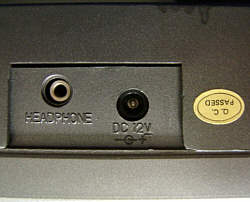
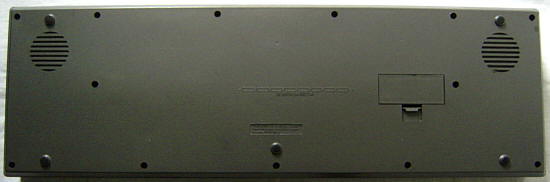
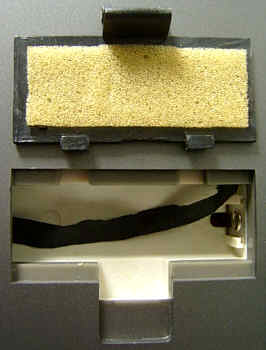
yellow plastic instead of rubber buttons preset sound button {oboe | jazz organ} renamed into {organ | clarinet} auto- accompaniment plays totally cacophonic. different CPU= "CW6510A-3937, 3937 8M2" (42 pin DIL, crystal clocked) + sound IC= "CW 3163, 8932A" (24 pin DIL | YM2163 clone by Jiahua)
 |
 |
 |
 |
 |
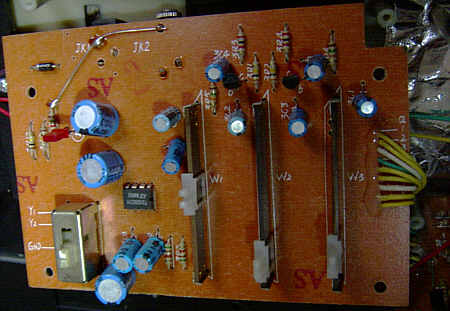
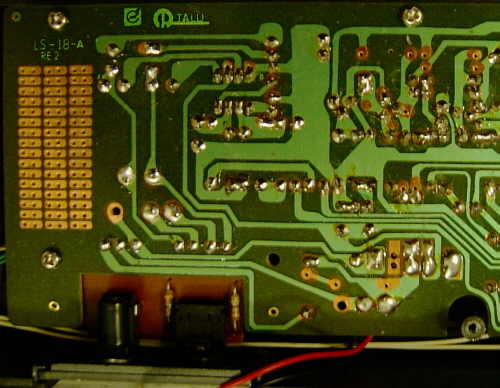 TALU, LS-18-A RE2
test solder area |
 |
| removal of these screws voids warranty... | ||
 |
 |
|
|
|