Casio
PT-82
PT-87
EP-20 |
small keyboard
with ROM-Pack, key lighting & blip rhythm |
|
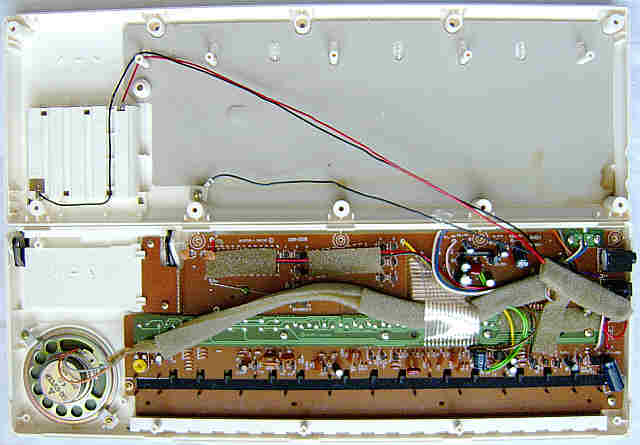
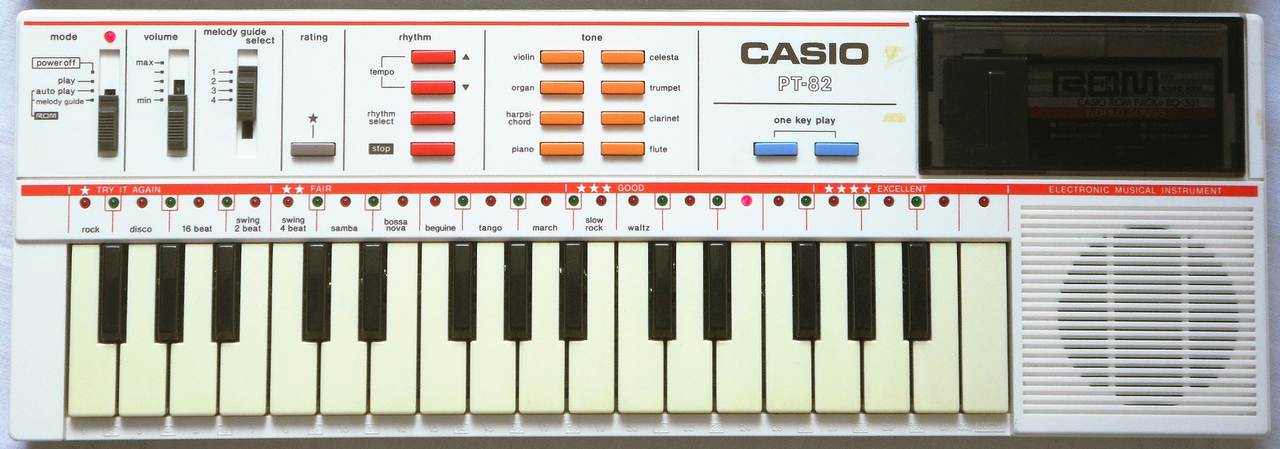
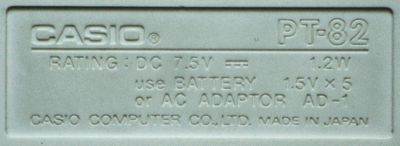
Casio PT-82
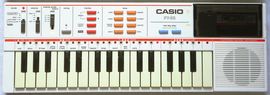
This keyboard from 1986 has many similarities with the Casio
VL-Tone
1 and PT-1, but includes a
"melody guide" key lighting feature for music teaching (not the
keys itself light up but a row of small LEDs above them) with ROM-Pack
music cartridge slot. Unfortunately it is very restricted and lacks the
built-in synthesizer, sequencer and 3 octave switch of the VL-Tone.
Although the automatic music playback from the ROM-Pack includes wonderful
polyphonic accompaniments, the player can play own musics only monophonic
with thin and dull sounding blip rhythms. A bit unusual is that this white
keyboard has brightly coloured orange and red buttons and red lines while
Casio normally preferred pastel colours. Also a red case version of the
PT-82 was made (which according to an e-mail lacks the headphone jack).
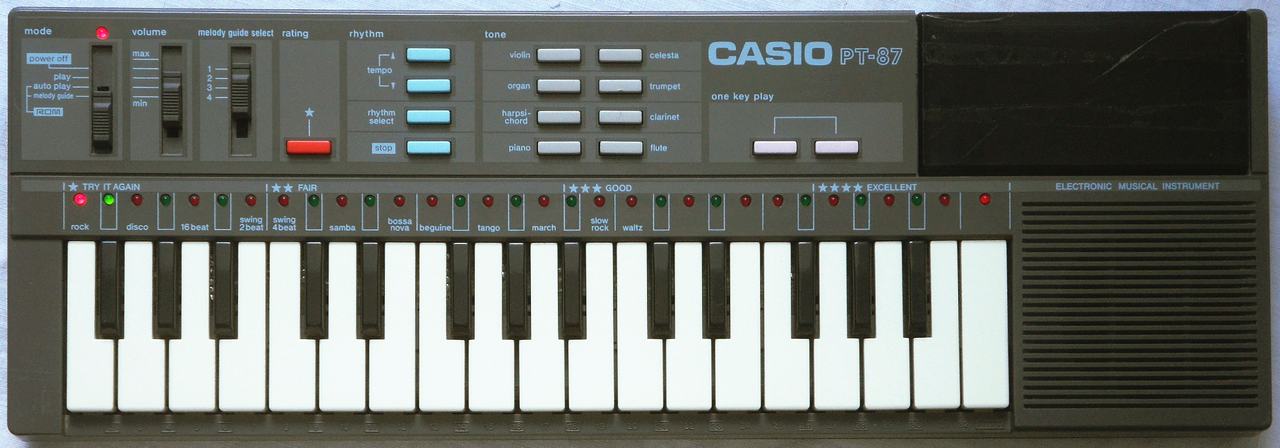
In 1987 it was re-released in grey as
Casio PT-87.
warning: IMO this is the perhaps most boring sounding Casio keyboard
with rhythm, so do not pay moon prices for this! - and no, it is not analogue.
Even circuit-bent the behaviour stays stubborn and you can not play chords
or accompaniment nor modify the digital sound synthesis (there are no eastereggs).
main features:
-
32 mini keys
-
built-in speaker (with unpleasant, loud mid-range resonance)
-
monophonic main voice
-
8 OBS preset sounds {violin, organ, harpsichord, piano, celesta, trumpet,
clarinet, flute}
-
12 preset rhythms {rock, disco, 16 beat, swing 2 beat, swing 4 beat, samba,
bossa nova, beguine, tango, march, slow rock, waltz}
-
volume switch (5 steps)
-
tempo +/- buttons (16 steps?)
-
ROM- Pack music cartridge slot for melody guide and "auto
play" (jukebox mode)
-
"melody guide" keyboard play training feature with key lighting (32 red
& green LEDs above the keys), 4 levels and automatic rating
-
2 "one key play" buttons (to step note by note through ROM musics)
-
multipulse squarewave sound generator similar like VL-1
(only monophonic keyboard play, but additional 4 note polyphonic accompaniment
during automatic ROM music play). The digital envelopes (with audible zipper
noise) are linear and thus sounds unrealistic because they fade silent
too soon.
-
rhythms consist of dull and distorted digital squarewave blips + simple
shift register noise {base, lo conga, hi conga, snare, cymbal, hihat}
-
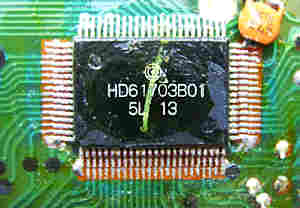
CPU= "Hitachi HD61703B01,
5L 13" (80 pin SMD)
-
tuning trimmer
-
headphone and power supply jack
modifications:
-
Power supply jack polarity changed and protection diode added (in PT-82
and PT-87).
notes:
The PT-82 was likely intended as a technically simplified successor
of the Casio PT-80. The speaker has
an unpleasant, loud mid- range resonance. The main voice sounds are the
same like with the PT-80, but tend to sound a little thinner and harsher.
These sounds resemble much a Casio VL-Tone 1;
unfortunately they don't include the famous "fantasy" sound of the latter.
Although the musics from ROM- Packs play with nicely orchestrated
accompaniment, the player can play own musics only monophonic with a simple
rhythm and no accompaniment at all. The distorted percussion sounds a bit
harsh, very colourless, and really thin and boring (like when blip drums
from a PT-30 keyboard would have been resampled at an extremely low resolution
and sample rate which removes all dynamics). The rhythm patterns resemble
PT-80, but are not identical (e.g. blip instead of popping base drum).
Much like with VL-Tone 1, the harpsichord sound suffers from a too
slow attack rate, which makes it unrealistic. In the plastic case of my
PT-82 was an embossed mark that seems to be the manufacturing date 86-02-08.
When the instrument is switched on, it plays a tone scale (8 notes)
while a light runs from left to right on the LED chain. The instrument
was sold with the Casio ROM- Pack RO-551.
The ROM- Pack cartridge employs the same conductive carbonized silicone
rubber connector that is used in many LCD watch displays. (I had to clean
mine and the contact row on the PCB with isopropanol to make it function
reliable.)
More interesting is that the musics from it can be used with "melody
guide" training feature, in which a flashing LED (next key) and a lit
LED (current key) in the LED chain above the keys teach monophonic keyboard
play. It has 4 training levels {1= with light, waits for correct key, 2=
with light, no waiting, 3= without light, waits for correct key, 4= without
light, no waiting}. After finishing a piece of music, the player can press
the "rating" button to see how good he has played. To show this, a sort-of
"wheel of fortune" noise effect is played while a light runs multiple times
from left to right above the keys. The light turns slower and then stops
at a certain key. The better the player has played (less wrong noted and
timing flaws), the further right it stops with a short jingle that depending
on how good the player was {"* TRY AGAIN"= falling notes, "** FAIR"= very
disharmonic clip of "Unterlanders Heimweh", "*** GOOD"= fanfare, "****
EXCELLENT"= different fanfare}. As a sound effect, the rating jingles can
be also started by pressing the "rating" button while the mode switch is
set to "play" instead of "melody guide". In this case the melody guide
level select switch selects which of the 4 jingles is played.
hardware details
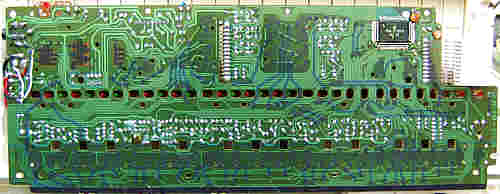
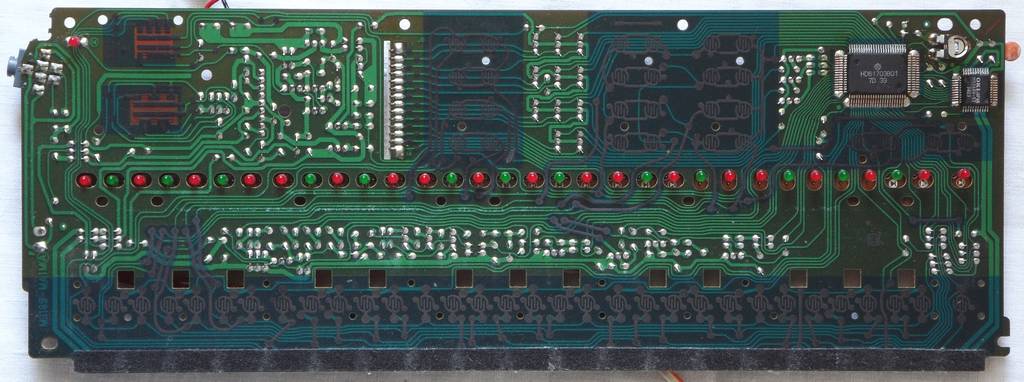
The Casio PT-82 is based on the single-chip CPU "Hitachi HD61703B01".
The PT-82 was the cheapest and most primitive keyboard with ROM-Pack
port. Its hardware is much simpler than PT-80
and contains far less analogue components. The CPU name strongly suggests
that it is based on Casio MT-18
(i.e. late PT-80 hardware) with only changed software. The PT-82 instrument
concept with rating algorithm is described in the US patent 4694723.
In my 1st PT-82 one of the red key lighting LEDs was faulty and had
to be replaced.
multipulse squarewave & timbre filter
The digital part of the sound generator is almost identical with Casio
PT-80 (see there), but the analogue part was strongly simplified
and hence sounds poor. The envelope height differs among sounds to match
the volume (and shorten certain sounds?). They have maximum 12 steps (only
8 in 'violin'?) and thus plenty of zipper noise (unlike VL-1
without smoothening circuit). The main voice is routed through a fixed
timbre filter, which is controlled by 2 CPU outputs 67 O5 (highpass) and
68 O4, those however stay always the inverted of each other (likely to
save cost of an external inverter), so it has only 2 settings.
|
preset sound:
|
multipulse pattern |
filter O4
|
filter O5
|
| piano |
1111100000000000 |
H
|
|
| harpsichord |
= piano |
|
H
|
| organ |
1110101011001010 |
H
|
|
| violin |
11111110 |
|
H
|
| flute |
11110000 |
H
|
|
| clarinet |
1111011100001000 |
H
|
|
| trumpet |
1000000000000000 |
H
|
|
| celesta |
= flute |
|
H
|
The accompaniment bass voice is plain 1:1 squarewave that is alternatingly
output with the chord and muffled by a capacitor.
The percussion has grainy digital envelopes (likely 3-bit) and thus
is typical blip percussion. The snare looks like plain squarewave modulated
(logic AND) with shift register noise. Unlike earlier models, this percussion
is not routed through an external analogue smoothening circuit (nor there
are trigger pulses to e.g. bypass the snare for this) but comes completely
premixed out of CPU pin 74.
keyboard matrix
See Casio EP-20. |
Casio PT-87
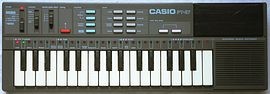
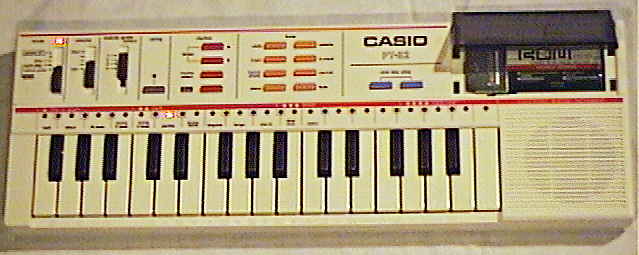
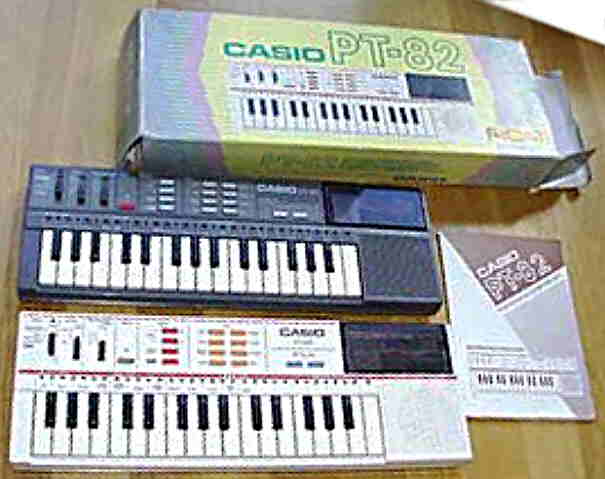
This grey cased instrument was a re- release of the PT-82 from 1987.
Inside the case embossed marks for 87 and {5, 6, 7, 8} make me conclude
that it was manufactured between may and august in 1987. Unlike the PT-82,
it has the classical pale coloured Casio buttons again.
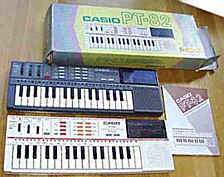 (old eBay photo of my PT-87 & PT-82)
 |
 |
 |
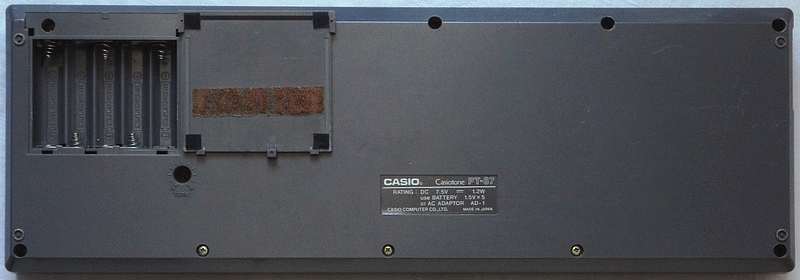
The PCB of this specimen contains less discrete components, the shielding
aluminium cardboard inlay is gone and the PT-87 has also no headphone jack
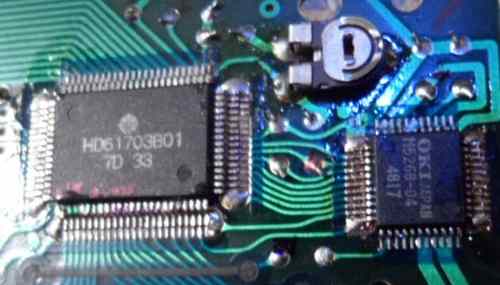
anymore. The CPU is "HD61703B01, 7D 33". My specimen has a strange defect;
when operated with batteries, it sounds distorted and howls, while with
a power supply it sounds perfect. Apparently the battery voltage (5 batteries
= 7.5V) is too low to operate the circuit properly - possibly a defective
voltage regulator drops too much voltage.
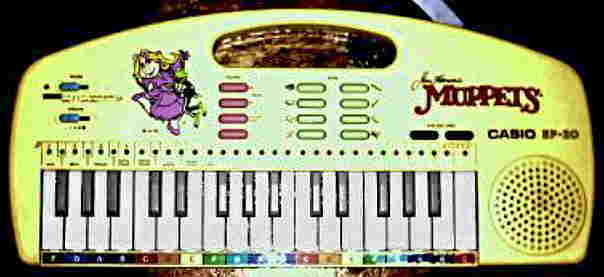
Casio EP-20 'Muppets'
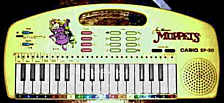
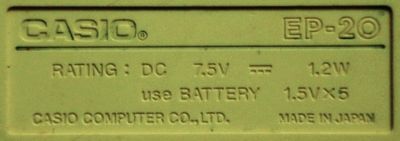
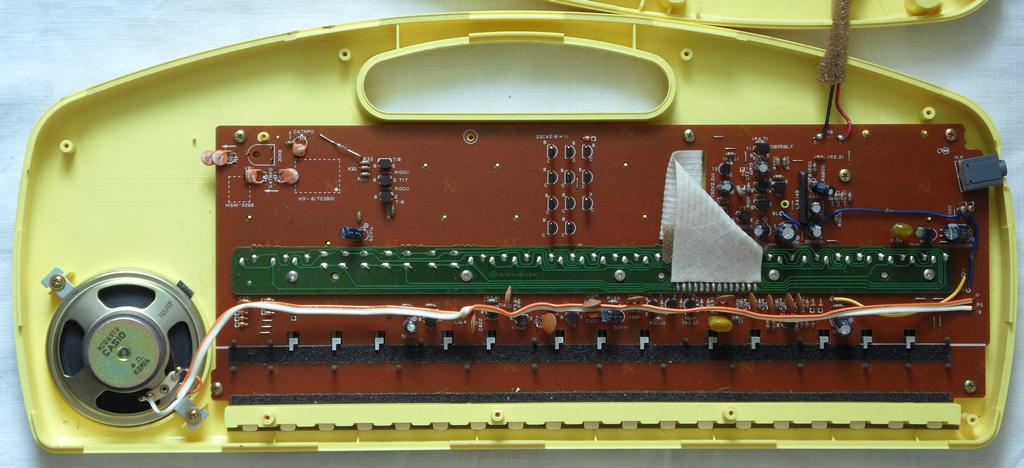
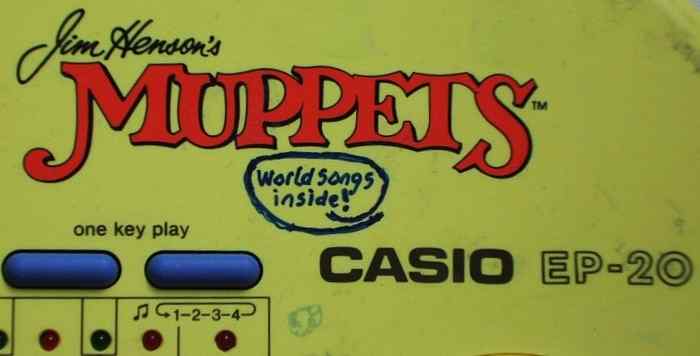
Also this yellow toy keyboard from 1987 (embossed case date and "©
ha! 1987" under Muppets "Ms. Piggy" picture) is a mutilated Casio
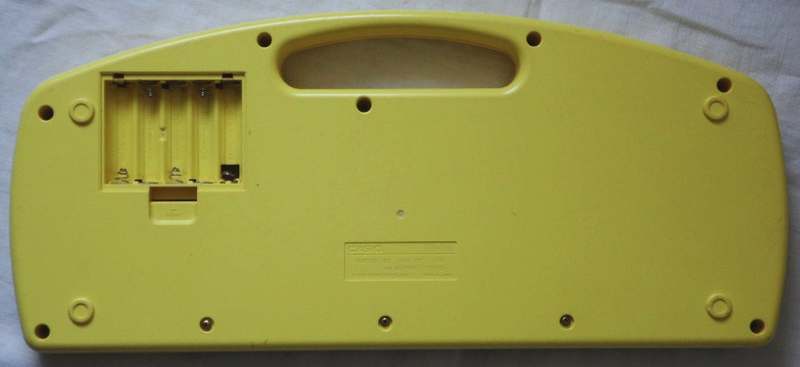
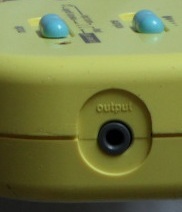
PT-82. The power supply jack, tuning knob, "rating" button and
"melody guide" level switch are omitted (level stays always 1). Also the
ROM cartridge slot is gone, instead it has only a fixed soldered ROM chip
"OKI MS268V-57, 7405" which contains 4 nicely orchestrated musics from
the "Muppets" TV series. The CPU is "HD61703B01, 7D 33".
eastereggs:
-
'melody guide' level selector & 'rating' button addable (exists in
PT-82).
-
ROM-Pack slot addable
modifications:
-
in 2nd specimen: music ROM soldered into ROM-Pack (a RO-551
'World Songs') and vice versa.
notes:
I initially had analyzed this (rather boring sounding) hardware in the
hope to find out more about the much more delicate and complicated
PT-30
and PT-50 (same hardware family,
flimsy foil cables) those are very unpleasant and risky to work with. But
later I analyzed them too.
circuit bending details
The Casio EP-20 (Muppets keyboard) is a variant
of PT-82/87. But instead of its ROM-Pack
port, in EP-20 the CPU is wired to a ROM chip "OKI MS268V-57, 7405"
(44 pin square SMD) that is nothing else than an internal ROM-Pack with
'Muppets' songs. An interesting technical detail is that it apparently
technically contains 7 pieces of music, but the musics 2, 4 and 6 are empty
files to make the ROM use only the white keys for song selection.
At the CPU the unused upper pin row is unsoldered to save space for making
traces run underneath. There are 2 adjacent unused solder pads to CPU pin
9 and 21 those look like a jumper or omitted capacitor. But bridging them
only makes the CPU keep resetting (power led flashes) or (with capacitor)
not start at all. Because similar PT-series keyboards (e.g. PT-30
or PT-80) have a set of additional buttons to the left of the keyboard
to play chords, I searched for such keyboard matrix eastereggs but found
none; even the matrix layout has nothing common with PT-80, thus I think
they use totally different software. Likely Casio had to rewrite everything
to make the melody guide "rating" algorithm fit.
keyboard matrix
The keyboard matrix is grouped by 6 and relatively clean. That is to say,
unlike e.g. PT-80 there is no chord button
section supported by this CPU, so pins KO8 and KO9 stay simply unused.
And like with other software numbers of this CPU, the matrix layout is
unique and not just a variant of others with some places left blank. I
analyzed the matrix by myself and later got a PT-82 service manual (that
differed in octave numbering) to confirm.
Useful eastereggs in EP-20 are only those of PT-82.
|
2 KI1
|
3 KI2
|
4 KI3
|
5 KI4
|
6 KI5
|
7 KI6
|
8 KI7
|
9 KI8
|
|
CPU pin
|
|
in 1
|
in 2
|
in 3
|
in 4
|
in 5
|
in 6
|
in 7
|
in 8
|
in / out
|
|
o
F#3
|
o
C4
|
o
F#4
|
o
C5
|
o
F#5
|
o
C6
|
O.
piano
|
O.
flute
|
out 1
|
10 KO1
|
o
G3
|
o
C#4
|
o
G4
|
o
C#5
|
o
G5
|
o
F3
|
O.
harpsichord
|
O.
clarinet
|
out 2
|
11 KO2
|
o
G#3
|
o
D4
|
o
G#4
|
o
D5
|
o
G#5
|
rating
|
O.
organ
|
O.
trumpet
|
out 3
|
12 KO3
|
o
A3
|
o
D#4
|
o
A4
|
o
D#5
|
o
A5
|
rhythm
select
|
O.
violin
|
O.
celesta
|
out 4
|
13 KO4
|
o
A#3
|
o
E4
|
o
A#4
|
o
E5
|
o
A#5
|
-
(?)
|
tempo
-
|
tempo
+
|
out 5
|
14 KO5
|
o
B3
|
o
F4
|
o
B4
|
o
F5
|
o
B5
|
one key
1
|
one key
2
|
stop
|
out 6
|
16 KO6
|
-
(?)
|
o
F#4
|
-
(?)
|
o
F#5
|
-
|
one key
1
|
one key
2
|
stop
|
out 7
|
15 KO7
|
|
-
|
-
|
-
|
-
|
G.
1
|
G.
2
|
G.
3
|
G.
4
|
out 8
|
19 KO10
|
|
-
|
-
|
-
|
-
|
M.
play
|
M.
auto play
|
M.
guide (halt)
|
M.
guide
|
out 9
|
20 KO11
|
The input lines are active-high, i.e. react on +Vs. Any functions can
be triggered by a non- locking switch in series to a diode from one "out"
to one "in" pin. The key leds are multiplexed from the matrix output pins
{10..20} to pin {69..71} through 11 transistors.
legend:
|
|
|
"o"
|
= keyboard key |
|
O.
|
= preset sound ('orchestra') |
|
M.
|
= 'mode' switch |
|
G.
|
= 'guide' switch |
orange
background |
= easteregg (unconnected feature) |
grey
background |
= unconnected doublet |
Solder a button with diode in series from CPU pin 12 to pin 7 to enable
rating.
In the lower left(?) PCB corner (component side view, speaker facing
left) between leds PCB and keys are 2 groups of 3 diodes followed by 1
diode. This fixed matrix diode CPU pin 19 -> pin 6 simulates a 'guide'
switch set to "1". Desolder this diode at pin 6 (stripe end). Instead connect
either its now open end through a 4 step switch to CPU pins {6..9}, or
connect 4 button switches through each a diode from pin 19 to pins {6..9}.
With the fixed diode removed (and all switches open), the guide mode
defaults to 3, melody waits in a loop but leds stay dark and only light
up when you missed a note for some seconds.
Among the 'mode' switch matrix places is a 'guide' doublet (diode
at CPU pin 20->8) that behaves like the regular one but makes the CPU halt
(key led 1 stays lit, sounding tones except percussion hang with stopped
envelope) so long the contact stays closed. This may be a test feature
to stop the program. Connecting a diode at 14-> 7 prevents panel buttons
from working and does nothing else. A diode at 15->2 or 15->4 behaves like
a mute note key, i.e. it does not sound but truncates any held note; like
with regular keys, pressing a 2nd key will sound as usual.
ROM-Pack hack
In my 2nd EP-20 specimen I removed the music rom with an SMD hot air soldering
station to transplant the 'World Songs' rom from a RO-551
and vice versa and though play the Muppets music on other keyboards. Important
is to use a ROM-Pack with square 44 pin IC "OKI MS5268". I used a
RO-551 with JASRAC label and rough flat back (Japanese version?, apparently
came with my PT-80). Other RO-551 (no JASRAC, shiny back with 3 holes)
contain a rectangular 22 pin IC "Matsushita MN6404xxxx" that won't fit.
Theoretically to the EP-20 also a ROM-Pack slot can be added, but this
would be mechanically very difficult and not worth the effort. |
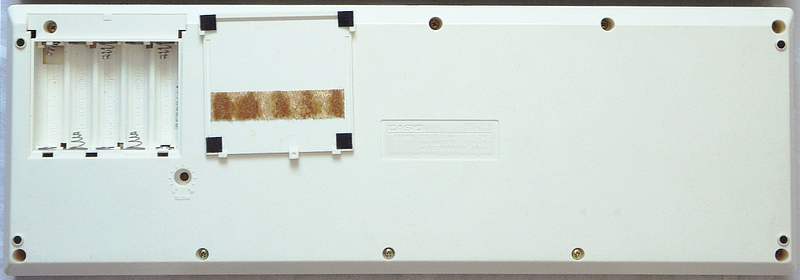
| removal
of these screws voids warranty... |
|
|
 |

|
|
| |
back
|
|
 (old eBay photo of my PT-87 & PT-82)