 |
 |
|
|
 |
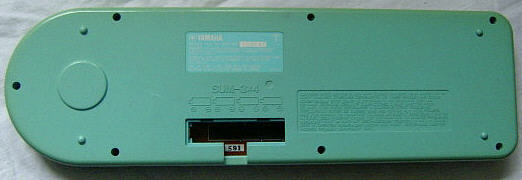 |
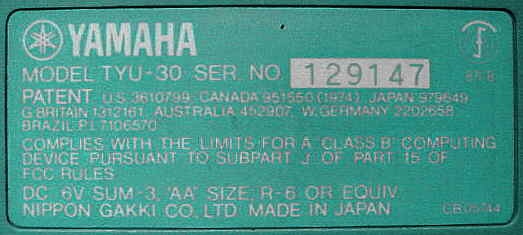 |
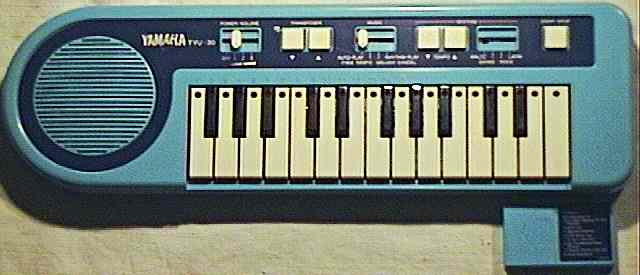
To play keyboard, select the "rhythm play" mode with the "music" switch. The preset sound is always a simple squarewave piano. You can choose one of 4 rhythms (without any accompaniment); the very electronic percussion sounds like an MC-3. The tempo can be adjusted between very low and fairly high, but starting a rhythm always switches it back to default. The transpose +/- buttons have no wraparound and also affect held notes, which can be used as a sound effect.
The others modes are for the built-in musics and key lighting. Unlike with Casio ROM-Pack keyboards, here only 1 LED lights up to show the key to be pressed, but no 2nd flashing LED indicates which note comes next. In "free tempo" mode the instrument waits until the correct note is played, while in "melody cancel" mode the accompaniment of the song simply continues, while you can play any notes to it (monophonic) on the keyboard. The accompaniments of the songs contain additional simple preset sounds made from multipulse squarewave with different volume envelopes; there is an e-bass (for bass), musicbox (for arpeggio chords) and violin (for obligato/ 2nd voice). They contain neither vibrato nor tremolo and resemble MC-3 preset sounds. The 'musicbox' has an unusual glassy timbre. Unfortunately none of them can be used for manual play.
It took me quite long to understand why the thing often had refused to start melodies and other times didn't, until I read in the manual that to get the musics to play, you must first press the key with the melody number and while still holding that key press and release the "start/ stop" button. (Sorry, previously even me explained this wrongly.) This reminds me much of my Atari 8 bit homecomputer reset button sequence for cassette loading, but for operating a children toy this is really a little hard and rather resembles the procedure for unlocking the child lock function of a badly designed VCR. When you select "*" instead of a number, the instrument plays all songs from the cartridge in a sequence.
cartridge A (CB-05739)
|
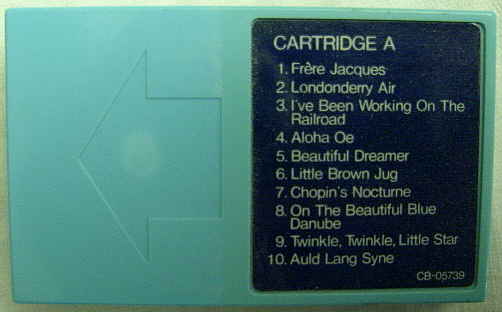
ROM="Y2165 3, 55255A" (8 pin DIL) |
cartridge B (CB-05740)
|
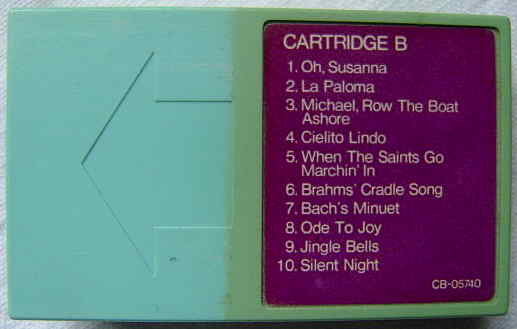 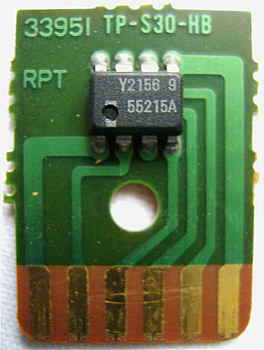
ROM="Y2156 9, 55215A" (8 pin DIL) |
question: Does anybody know if other
cartridges beside the above A and B were released for Yamaha TYU-30? The
numbers above the left keys count from 1 to 15, which lets me conclude
that cartridges with up to 15 melodies were at least planned for it. But
the downloaded manual does not tell anything beside that the instrument
was shipped with 2 cartridges.
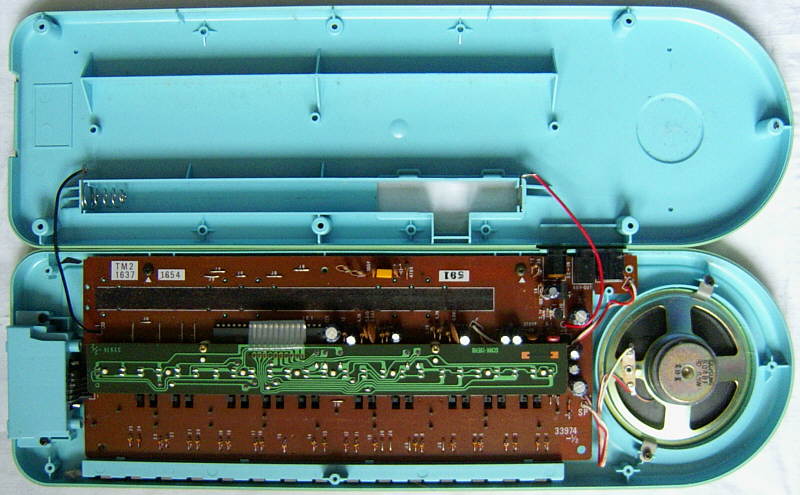
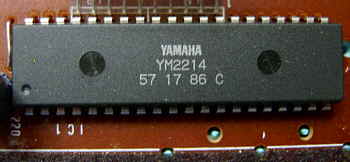
circuit bending detailsThe Yamaha TYU-30 is based on the single-chip CPU "YM2214" (crystal clocked @ 514kHz). The power amp IC is "LA4142 5F2" (9 pin SIL).
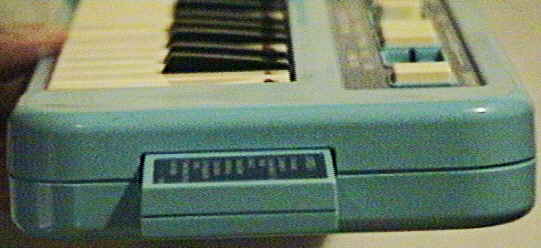
TYU Music Cartridge pinoutThe TYU Music Cartridge was Yamaha's apparently first shortlived attempt of replacing their somewhat flimsy PlayCards to compete with Casio ROM-Packs in toy grade mini keyboards. But by lack of success it disappeared so quickly that no additional cartridges are known.The cartridges of Yamaha TYU-30 contain a special ROM (8 pin DIL) with
4 pin bus for a kind of serial interface. Known are only the ROMs "Y2165
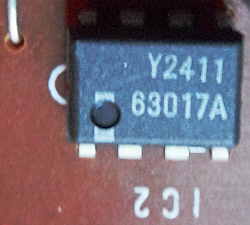
3" (Cartridge A), "Y2156 9" (Cartridge B) and "Y2411"
(internal ROM of Yamaha TYU-40). This
cartridge pinout (pins counting from left to right) was concluded from
TYU-30 PCB photos and the YM2214 pinout.
The YM2214 cartridge port signals look very crude, so I suspect a rather primitive protocol, taylored to match the internal structure of the LSI. ROM pin 8 (CK) receives a buffered version of the main clock. Pins 2, 5, 7 stay high for most of the time and there are only very short lo pulses at the start of each note or beat during song playback. The count of pulses (up to 8?) varies, but there are no gaps in between, which hints to unary coding (like a clock strike or mechanical phone dial) instead of normal binary data. Shorting pins during song playback sounds some wrong notes like with mandolin ring. keyboard matrixThe matrix layout of this keyboard is a mess; particularly the only 25 keys are in almost random order grouped 5x5. Because the CPU seems to be a simple LSI, possibly this was done as a lookup table for simplifying chord generation in the demo songs. Fortunately I had a schematics photo fragment of TYU-40 to see the key order, which else would have been very hard to figure out by hand. The control panel has independent matrix pins, although some outputs can theoretically also be used for keys, but 2 glitches are different and pin 17 behaves like a mixture of pin 23 and 27 when used as key output. Instead of diodes there are only 100 Ohm resistors used for the panel. Empty places do nothing. As eastereggs I found a matrix place muting the main voice and one turning it into a loud distorted buzzy organ-like tone, and closing multiple contacts selects additional rhythms.This keyboard matrix is based on my own examination, the key order on photo fragments of Yamaha TYU-40 schematics.
The input lines are active-low, i.e. react on GND. Any functions can
be triggered by a non- locking switch in series to a diode from one "in"
to one "out" pin. The 25 key lighting leds employ a separate matrix of
in and out pins named like their corresponding key pins, each wired from
an LB to LN pin (see pinout YM2214).
Unfortunately this is the only main voice change I could find. Apparently it is impossible to assign a different preset sound (e.g. from the sound palette of songbank accompaniments) to the main voice. Even in songs it always stays 'piano'. pinout YM2214 (GHS-6)The Yamaha YM2214 (40 pin DIL) is the CPU of the toy keyboards Yamaha TYU-30 and TYU-40. Its internal squarewave sound and percussion generator superficially resembles the DSG YM2163; so it has a time slice DAC and is 4 note polyphonic, but there seems to be no waveform DAC inside, so instead of sawtooth it can only output various multipulse squarewaves with simple volume envelopes. The employed multipulses look symmetic, so their bit loop may be generated by counting the same bit sequence alternatingly forward and backward. The IC has a 4 pin bus to read external music ROMs and outputs for key lighting LEDs. But the 5x5 key matrix supports only 25 keys in a very messy order. The control panel matrix is separate. Stubborn behaviour during shitshot tests hint that it is an LSI made from gate logics with very little software control.This pinout is based on partial photos of Yamaha TYU-40 schematics
and my own examination of the TYU-40.
I measured at the clock pin on oscilloscope 2.3 us (would be roughly 435 kHz). The crystal is labelled "CSB 514P2, (M) F", which according to other Yamaha schematics likely means 514 kHz. During shitshot on clock or ROM pins the YM2214 only makes the polyphony channels of the demo songs run out of sync or with wrong preset sound, rhythm, transpose or tempo, but it has no complex behaviour during crash. Particularly it is impossible to assign the main voice to anything else than the hardwired 'piano' sound, which hints that the YM2214 is an LSI made from gate logics with only very little software control. |
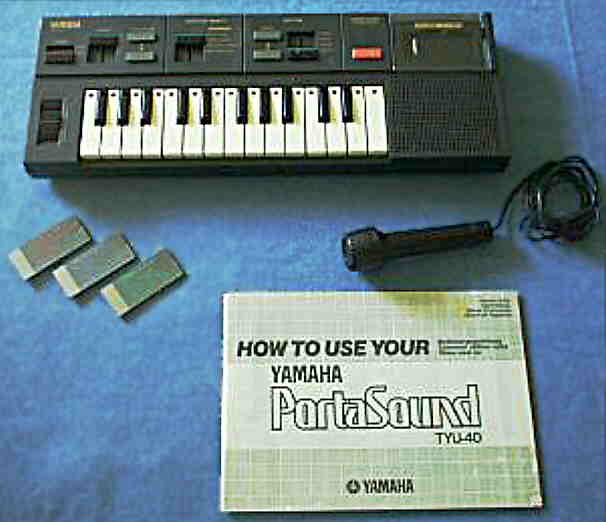 (Old eBay photo; my specimen lacks all the shown accessories.)
 |
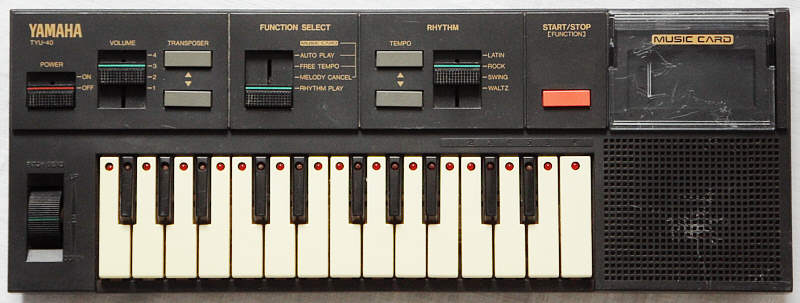
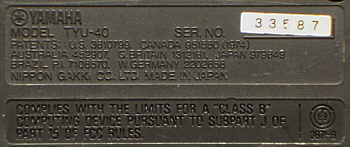
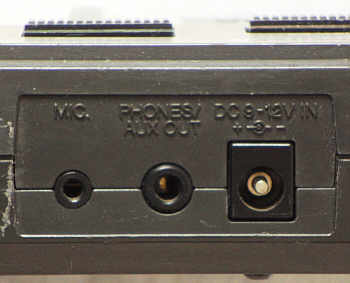
Unlike the TYU-30, the TYU-40 is black and exactly rectangular (nothing has rounded corners); also the sliders are vertical and it generally resembles closer the style of PortaSound non-toy keyboards. The placement and design of the acryl covered card slot is a naughty imitation of the ROM- Pack slot of Casio PT-82.
Due to strong similarities with TYU-30 I only explain here the differences.
 |
 |
 |
 |
 I
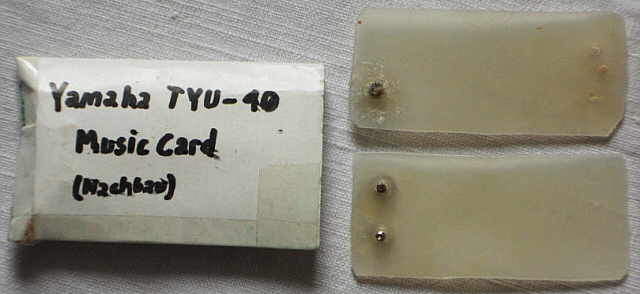
bought this keyboard with the Music Cards missing, but since they
were dummies, I simply made my own ones from 2 pieces of sheet plastic,
some screws (for the pins) and hotglue. Also the battery spring was rusted
off by leaked battery remains, and the analogue pitchbend potentiometer
suffers from dirt and the inaccuracy of its mechanical centring spring,
thus the pitch tends to vary after releasing the pitchbend wheel.
I
bought this keyboard with the Music Cards missing, but since they
were dummies, I simply made my own ones from 2 pieces of sheet plastic,
some screws (for the pins) and hotglue. Also the battery spring was rusted
off by leaked battery remains, and the analogue pitchbend potentiometer
suffers from dirt and the inaccuracy of its mechanical centring spring,
thus the pitch tends to vary after releasing the pitchbend wheel.
There exist exactly 3 cards with the following melodies:
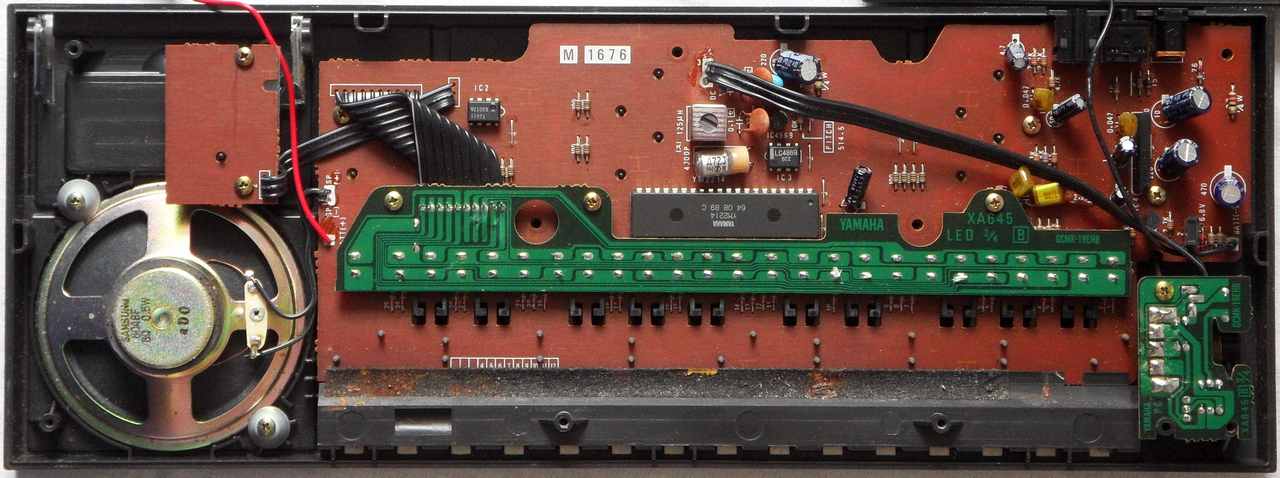
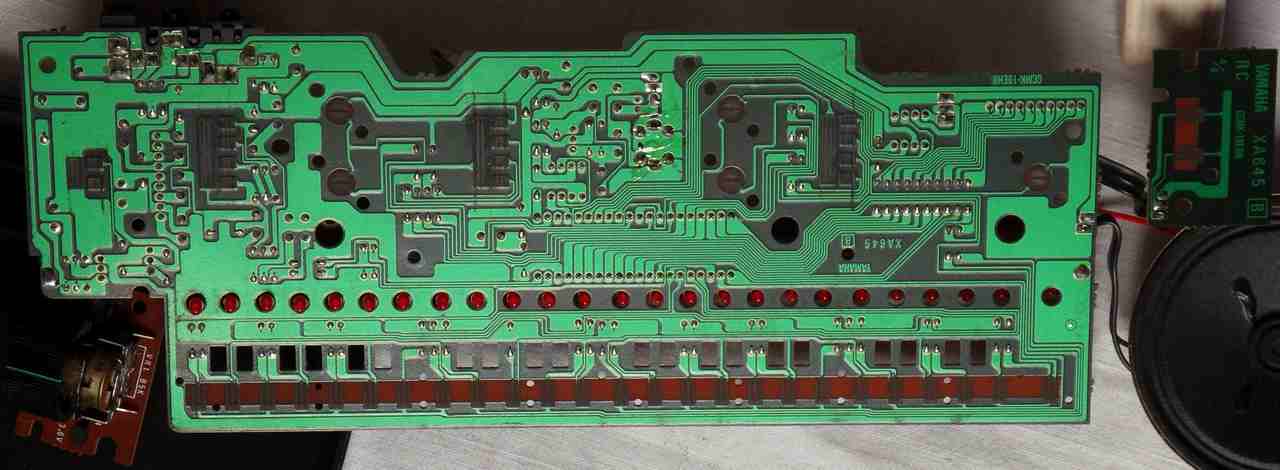
hardware detailsThe Yamaha TYU-40 hardware is basically identical with Yamaha TYU-30 (analysis see here) but instead of the cartridge slot it has (much like Casio EP-20) only one built-in music ROM "Y2411". The pitchbend is implemented by controlling the clock rate of an LC oscillator (IC "LC4969"). The power amp IC is "NJM 386S, JRC 6002" (9 pin SIL).
Pin 3 and 4 are pulled lo by 2 buttons in the fake Music Card slot to switch between 3 songbanks (both hi = off). In opposite to the 15 left keys in TYU-30, the songs of TYU-40 are selected through the 6 rightmost keys (key 25 stays "*" to play all), which hints that the protocol was designed to polls every key for theoretically up to 24 songs per cartridge. |
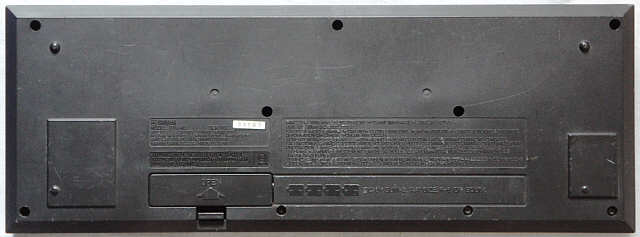
| removal of these screws voids warranty... | ||
 |
 |
|
|
|