|
sinewave keyboard with key lighting, barcode reader & analogue rhythm |
|
This keyboard of 1982(?) was Casio's first instrument with key
lighting feature ("melody guide") and was likely intended as competitor
to the Yamaha PC-100.
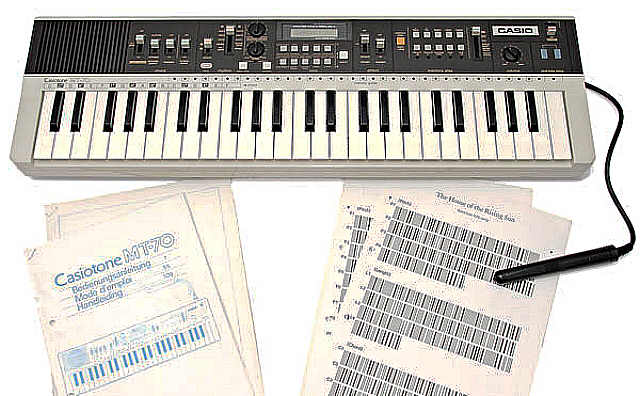
(old eBay photo of my specimen)
|
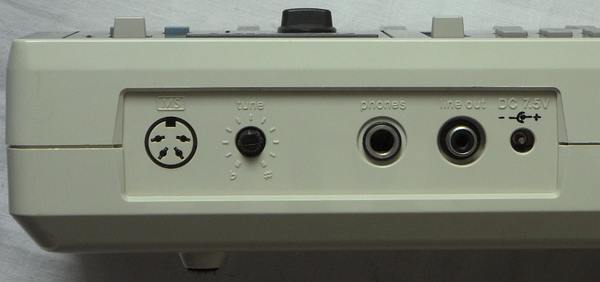
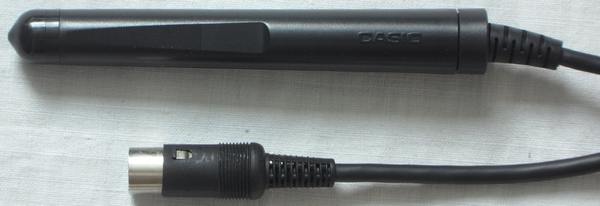
Unlike with modern such keyboards, not the keys itself but a row of tiny LEDs above the keys flash up to teach keyboard play. But while the PC-100 had its songs stored on so-called PlayCards with magnetic tape strips, Casio MT-70 employed an optical barcode reader pen (Casio MS-1) to scan in the songs from special barcode song books into the internal sequencer memory. But although the barcode for one song can take 2 pages, the complexity of the barcode musics is quite limited, because unlike the complex multi- track arrangements on Yamaha's PlayCards or on Casio's later ROM-Pack cartridge keyboards (see MT-800, PT-50), the sequencer memory of the MT-70 can only store one monophonic main voice track together with the default accompaniment made up from only 7 standard chords.
The sequencer can be also programmed by live play and then stepwise edited by hand (forward and backward), but it is not possible to store any instrumentation or rhythm changes, nor to playback plain "organ" chords without rhythm from it; besides notes and chords the sequences can only store 2 loop points for refrains and their repeat points - that's all. Entering sequences with chords is very awkward, because chords are entered and edited only stepwise in a different mode, in which the main voice stays mute and only the current note number is displayed on the LCD. I read that some people found also the barcode pen very awkward and difficult to use, but I had no problems with it; with some training it is easy to scan in an entire page within 10s. When a line is scanned wrongly, a drum sound indicates this, and on the LCD you can read which line needs to be re- scanned. Important is only to hold the pen a little tilted, and because it contains no own light source, it may need proper ambient light to work.
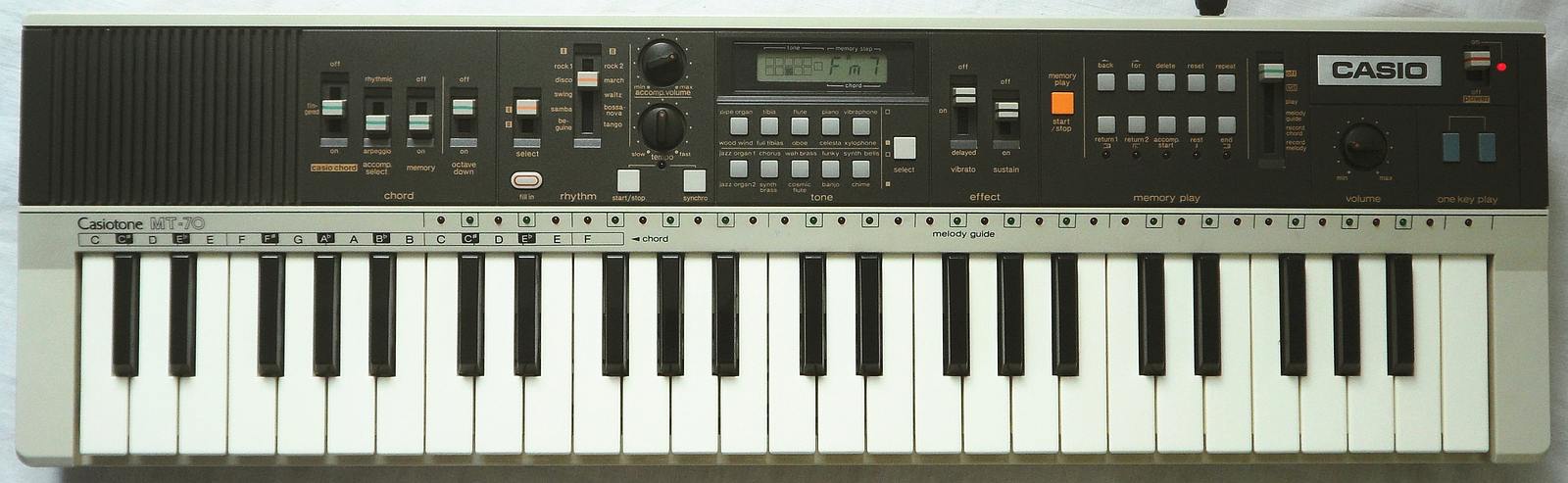
All main voice sounds consist each of mixed digital waveforms (made from sine wave combinations) with different volume envelopes. This sound generator was apparently optimized to simulate organ and flute tones, because everything else sounds very unnatural on it; the timbres are quite hollow, a bit harsh and bass notes tend to turn very dull. Likely it was intended as a direct competitor to the digital waveforms of the Yamaha PC-100 and should proudly demonstrate the end of the squarewave era, but since it sounds quite thin (very dull bass), it was no great success and thus later Casio keyboards (e.g. the great CT-410V) returned to stair- and squarewave based timbres. The MT-70 has only one fixed organ timbre for chords and also its analogue percussion sounds rather thin, thus all together the MT-70 sounds quite plain home- organ- like, and this not necessarily in a positive way. But at least it features an unusual arpeggio and some unusual main voice sounds those do not exist in any other Casio midsize keyboard.
The original German retail price of Casio MT-70 was 899DM and in a German Conrad catalogue from 1986 799DM (about 400€). A wooden fullsize key version of this instrument was released as Casiotone 501.
 |
 |
 |
 |
 |
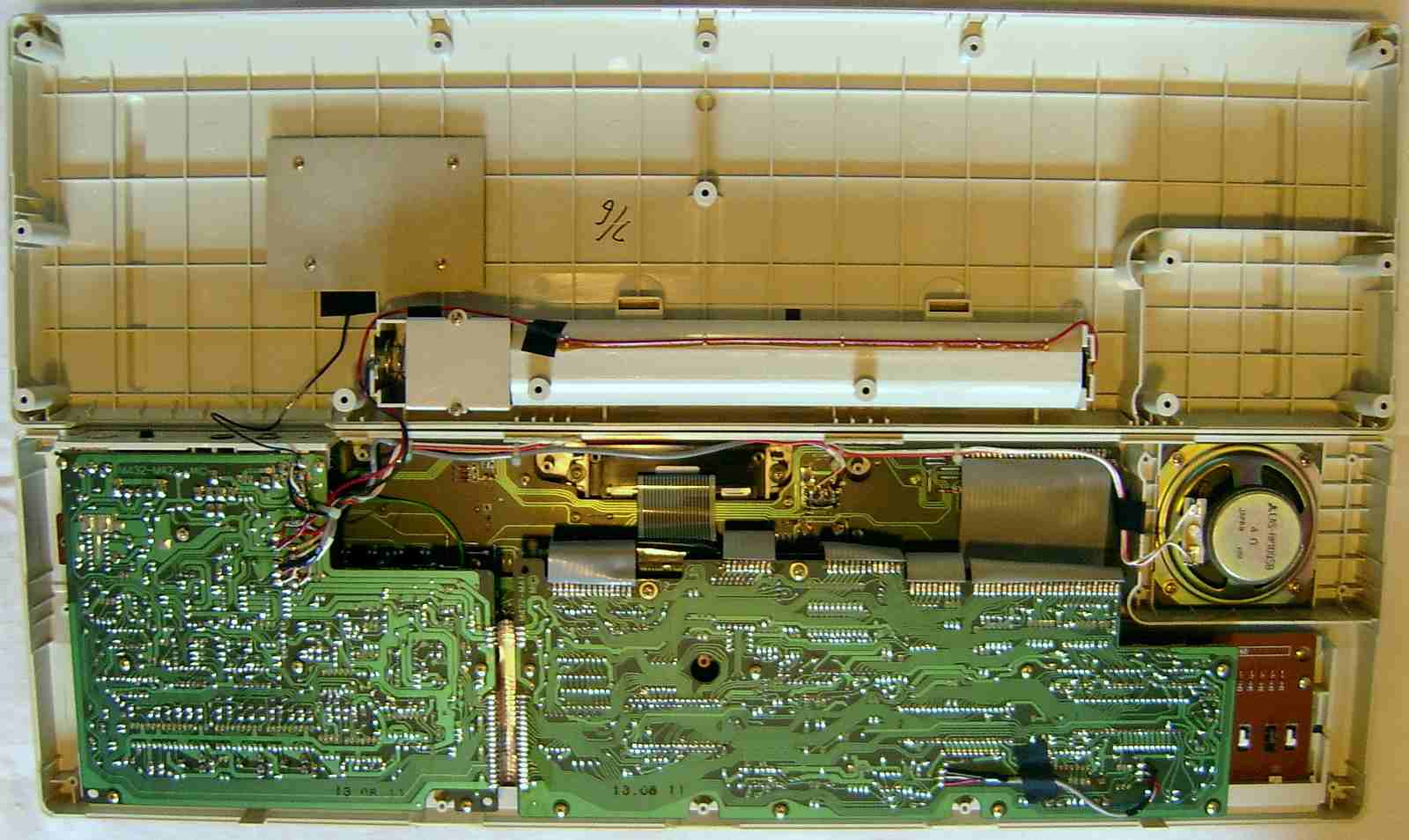
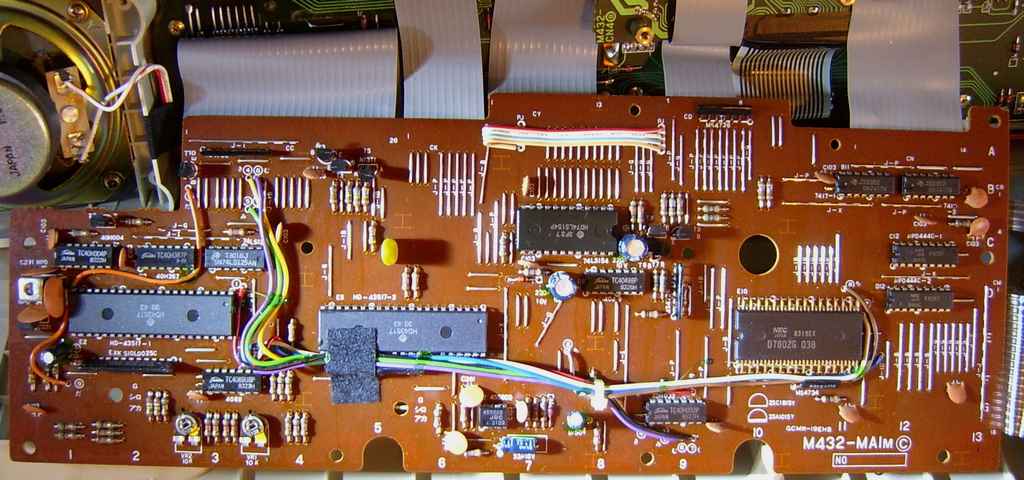
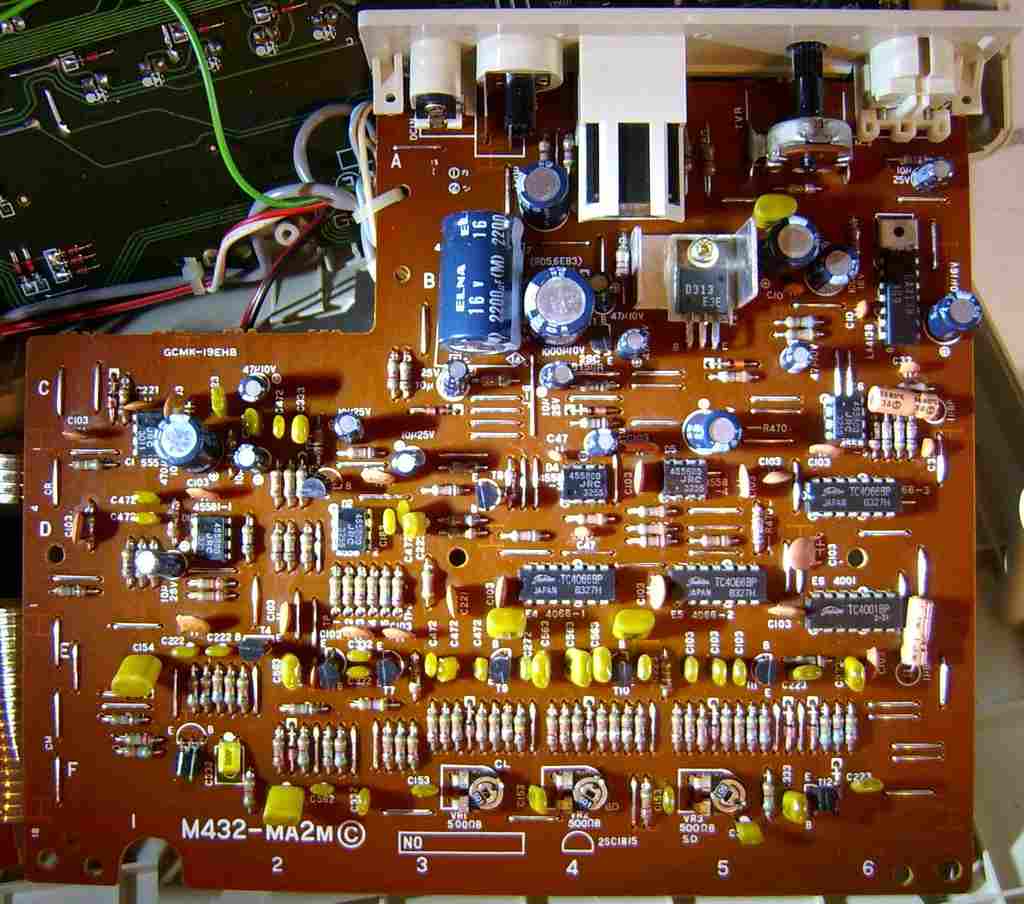
The quite complex partially analogue hardware of this instrument visually resembles the Casio MT-60 and also somewhat the Casio CT-410V, but unlike these, in MT-70 the timbres are not squarewave based but sound rather like slightly rough digital sinewaves, and also the CPU outputs no sounds by itself but delegates this task to 2 identical sound ICs for chord and main voice. Annoying is that each sound IC has only 4 polyphony channels; in chord mode this reduces the main voice polyphony from 8 to 4 notes.
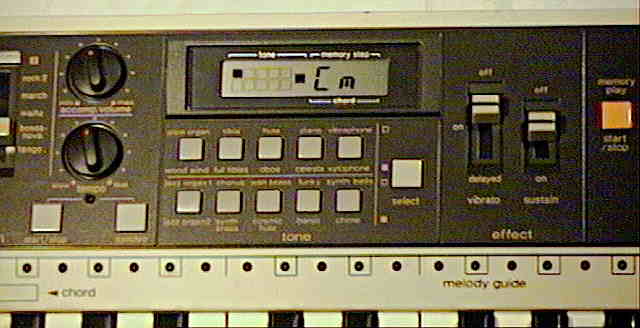 Interesting
for playing is that the 10 semi- OBS sound preset buttons can be also rapidly
pressed while keys are held down, which switches the sound or retriggers
the envelope of the already selected sound without any noticeable delay,
thus by rhythmically pressing these buttons many arpeggiator- like timbre
changes can be created, though this button field can be regarded as a realtime
sound control. (OBS sound buttons on most other Casio keyboards respond
rather slow.) The left half of the LCD always shows a picture of the sound
preset button layout; a black square in it indicates the currently selected
button + "select" button status. (Apparently
Casio intended here
to simulate the intuitive visibility of locking switches with non- locking
ones, but in reality theses tiny black squares far away from the corresponding
buttons are rather confusing; a set of LEDs directly at these buttons (like
done with the sequencer controls) would have been more instructive. Later
Casio (e.g. with CT-410V ) even returned to locking push buttons.)
Interesting
for playing is that the 10 semi- OBS sound preset buttons can be also rapidly
pressed while keys are held down, which switches the sound or retriggers
the envelope of the already selected sound without any noticeable delay,
thus by rhythmically pressing these buttons many arpeggiator- like timbre
changes can be created, though this button field can be regarded as a realtime
sound control. (OBS sound buttons on most other Casio keyboards respond
rather slow.) The left half of the LCD always shows a picture of the sound
preset button layout; a black square in it indicates the currently selected
button + "select" button status. (Apparently
Casio intended here
to simulate the intuitive visibility of locking switches with non- locking
ones, but in reality theses tiny black squares far away from the corresponding
buttons are rather confusing; a set of LEDs directly at these buttons (like
done with the sequencer controls) would have been more instructive. Later
Casio (e.g. with CT-410V ) even returned to locking push buttons.)
On MT-70 only flute and organ presets sound fairly realistic, and even these resembles rather undistorted Hammond organ timbres. The "piano" consists of something like a plain sine wave with decay envelope, thus it features the likely dullest bass range ever heard on a so-called piano; possibly it should imitate an e-piano, but it resembles rather a dull Hammond organ bass with envelope, thus it is no wonder that after power- on the MT-70 selects the "pipe organ" as default sound instead. The "tibia" and "full tibias" are also organ (pipe?) timbres. The "celesta" resembles a music box, and its bass range rather a steel drum. Both "jazz organ" sounds are the same dull Hammond timbres, while the 2nd one begins with a more percussive key click. Also the "wood wind" sound resembles a Hammond timbre with a dull percussive click. The "chorus" is also just a plain pipe organ timbre, which perhaps may resemble a "vox humana" pipe organ rank, but has only very vague similarity with a human chorus. Otherwise the "synth brass" on the same button indeed sounds quite much like a synthesized human "wah" voice (although particularly the bass range is extremely hollow and resonant). The "wah brass" instead is no human voice nor anything brass- like, but yet another Hammond organ timbre; unfortunately it starts with a dull percussive click that sounds wrong particularly during polyphonic play. Likely Casio confused some sound names here when they designed the front panel. The "cosmic flute" is an electronic organ tone that starts with a percussive click (like a xylophone) and crossfades from a high to a medium octave sine wave. The "funky" sound resembles very much a steel drum and consists of a medium octave note rapidly followed by a high octave note with each a decay envelope. (You get almost the same sound by selecting the "piano" and then playing a 1 octave higher note rapidly followed by a 2 octave higher one. Interesting is that this sound has (by my knowledge) absolutely no relation to funk music, and that on other (later?) (e.g. CT-410V or MT-60) Casio keyboards instead different sounds with the names "funny" and "funny fuzz" were released, those all may have been the result of a successles attempts to program a "funky" e-bass sound, although none of these sounds like one. The "banjo" sounds rather hollow and resonant; the "xylophone" is a much duller version of it and sounds unnatural. The "vibraphone" is otherwise one of the more realistic timbres. The "synth bells" plays within 0.5s 3 notes (octave 0, octave +2, octave +1) on a sine wave timbre with decay envelope, thus it resembles a short arpeggio fragment. The "chime" is a brightly clanging metallic sound; high notes resemble a triangle, but the bass range sounds rather like telephone touch tones. This sound consists of 2 partial tones with 5 notes distance those have the same percussive decay envelope, and like "synth bells" it is great for new age music. When sustain is switched off, all sounds stop almost immediately after releasing the key, and the sound presets itself also contain neither vibrato nor tremolo.
The accompaniment is similar flexible playable like the Testron one, and thus also accepts any disharmonic note combinations and not just those few ones that establishment has defined as "chords". But unlike later Casio keyboards (e.g. CT-410V or MT-60), the MT-70 features only a single fixed timbre (an organ tone with some sustain) for chords and accompaniment, thus also when played without rhythm, the rhythm switch can not be used here to select the chord section timbre. The arpeggio of the MT-70 behaves quite unusual, because when in fingered chord mode only one key is pressed in the chord section, the instrument plays the arpeggio pattern not continuously like other keyboards, but fades it in and out and thus chops the chinking arpeggio note stream into separate bursts of notes (like if someone would slowly turn an imaginary arpeggio volume knob up and down again, synchronized with the rhythm bar speed). Only when more than 1 key is held down, the arpeggio plays continuously. The only other keyboard I know with this behaviour is my Casiotone 1000P, on which the arpeggio pattern can be even programmed by hand. With the MT-70 I also miss independent volume control knobs for the individual accompaniment voices.
My MT-70 came with a musical lesson book containing a stack of barcode
score sheets for these
14 songs. In the ancient home computer magazine "Your Spectrum"
(Issue 4, June 1984) was an article about connecting a Sinclair ZX Spectrum
home computer with the barcode reader input of a Casio
VL-5. This article contains a BASIC program and many technical
details about the data format of the Casio barcode song books, and it says
that the same program works also with the MT-70. The article can
be found here.
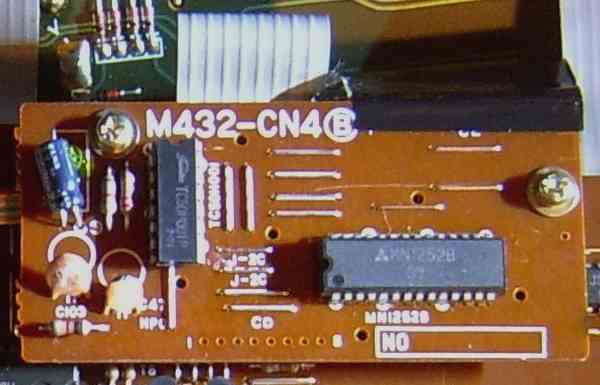
hardware detailsThe quite complex analogue hardware of this instrument visually resembles Casio MT-60 and also somewhat CT-410V, but unlike these, the timbres are not stairwave based but a mix of slightly rough digital sinewaves. The CPU "NEC D7802G 038" outputs no sounds by itself but delegates this task to 2 identical sound ICs Hitachi HD43517, those drive each a 12 bit resistor ladder DAC.
Each sound IC has only 4 polyphony channels; one sound IC outputs the main voice, the 2nd the chords. With chords turned off, the chord sound IC mutes its DAC and instead re-routes its 4 channels as digital data into the 1st sound IC to produce 8 main voice notes (though wasting 1 DAC bit). The MT-70 was derived from the fullsize Casiotone 701, which has a 3rd HD43517 sound IC to support 8 note polyphonic play in chord mode, and a 3 digit 7 segment LED display instead of LCD. The general hardware architecture seems to be in US patent 4534257 (describing a CPU controlled keyboard that strongly resembles the 701, priority date 1981). The Casio barcode data format is described in the US patents 4422361 (general) and 4437378 (with key lighting). According to US patent 4464966 Casio also planned barcode programmable rhythm, which AFAIK was never released. The sound IC is more detailedly explained in my Casiotone 1000P hardware description (see there). The sequencer is in US patent 4876938 (autoplay) which also mentions this sound IC. US patent 4622879 reveals the sequencer edit algorithm. On my Casiotone 1000P synth (same sound ICs, I read the service manual) each of its preset timbres consists of up to 5 fixed harmonics (layered sine waves). While its preset volume "envelopes" affect all of them equally, a 2nd kind of preset envelope named "modulation" changes the volume envelopes of (apparently up to 3) harmonics individually, e.g. to imitate a short filter sweep (wah effect) or increase bass or treble amount along the keyboard to approximate lowpass or highpass filtering. But no matter how exciting this additive synthesis thing looks in theory, in real life it sounds just like a sterile drawbar organ that lacks any grit and distortion because fake filters add no overtones. This sound engine is the absolute antithesis of POKEY - smooth and shiny and free of any rough intentional noise. I also suspect that the harmonics have not independent envelopes but that every preset sound has only one envelope with few steps between those it crossfades the vector of harmonics (i.e. waveform), i.e. all overtones change in the same time slots which limits expressivity. |
If you enjoy the main voice sound engine of the MT-70, watch out for the rare Casiotone 1000P, which was Casio's first fullsize digital (sort-of) synthesizer that permits far more sound variations with complex programmable arpeggio. The envelope and 2 timbre components for the individual sounds can be selected from each 10 variations (i.e. 1000 sound variations) those all sound fairly tame (resembling Casio SK-1 additive synth/ drawbar organ mode) and are best suited for new-age music or soft and bassy organ tones. Unfortunately this strange special purpose synth has no rhythm at all.
The technically closest relative of the MT-70 seems to be the Casiotone 701, because this large wooden instrument from 1982 with 61 fullsize keys had the same melody guide key lighting feature with barcode pen and sequencer (I saw this on an old Casio advertisement flyer). Someone e-mailed me that it is indeed based on the same CPU and sound chip type (with 3 instead of 2 ICs to permit always 8 note polyphony). This is quite unusual because the Casiotone 701 had instead of the LCD a red 3 digit "memory step" LED display and a different set of 20 preset sounds and 16 preset rhythms those were both selected through a set of locking push buttons and a bank select switch (8+1 for rhythm, 10+1 for sounds); also the 2 rhythm names those share each button switch are different from those on each slide switch position of the MT-70. (He told me that 2 DAC ICs "AM6012PC" (12bit, 22 pins) had died in his specimen. I don't know if these often fail by ageing or wear, but another e-mail confirmed that they tend to die; the modern replacement type is "Analog Devices DAC312". ) A funny feature are 2 "electronic sound effect" pad buttons those play each a laser zap/ synth tom sound {'piu!', 'pow!'}. A crippled 701 without barcode and sequencer section was released as Casiotone 601 and (with "fill-in" instead of "electronic sound effect" buttons) Casiotone 602 (both are very rare; likely the sequencer exists as matrix easteregg but may need to install SRAM ICs to make it work).
The only other Casio midsize instrument with sinewave sound was the
ultra rare oriental keyboard Casio AT-40.
Another instrument with LCD and sequencer was the Casiotone
7000, which had a large wood and metal case with 61 fullsize keys,
12 rhythms (6+1 locking buttons) and programmable stereo chorus effects.
Like MT-70 it had an LCD display and 20 semi- OBS sounds selected through
non- locking buttons, but it had no key lighting and employed a complex
sequencer that could save its data on audio cassettes. But sound and rhythm
engine is based on MT-65 hardware
family.
| removal of these screws voids warranty... | ||
 |
 |
|
|
|