circuit bending details
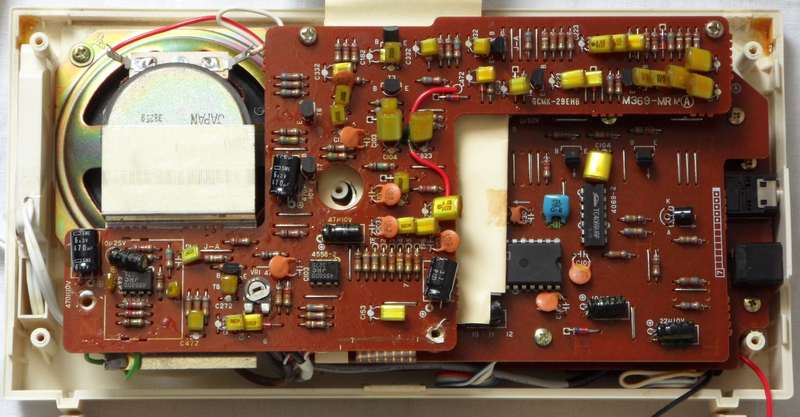
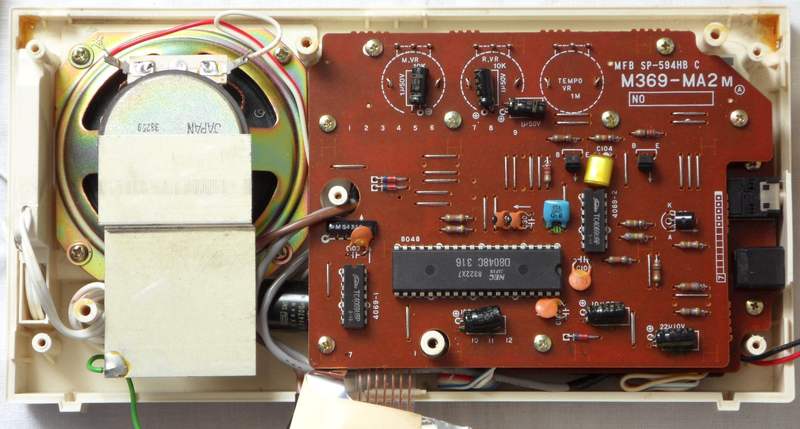
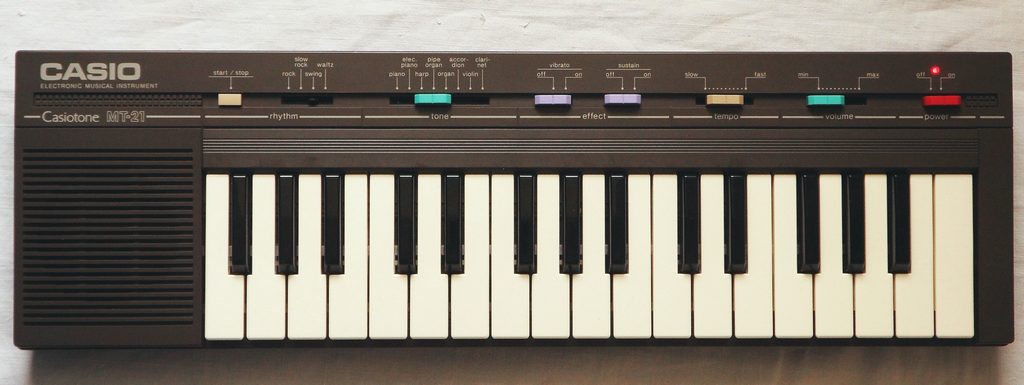
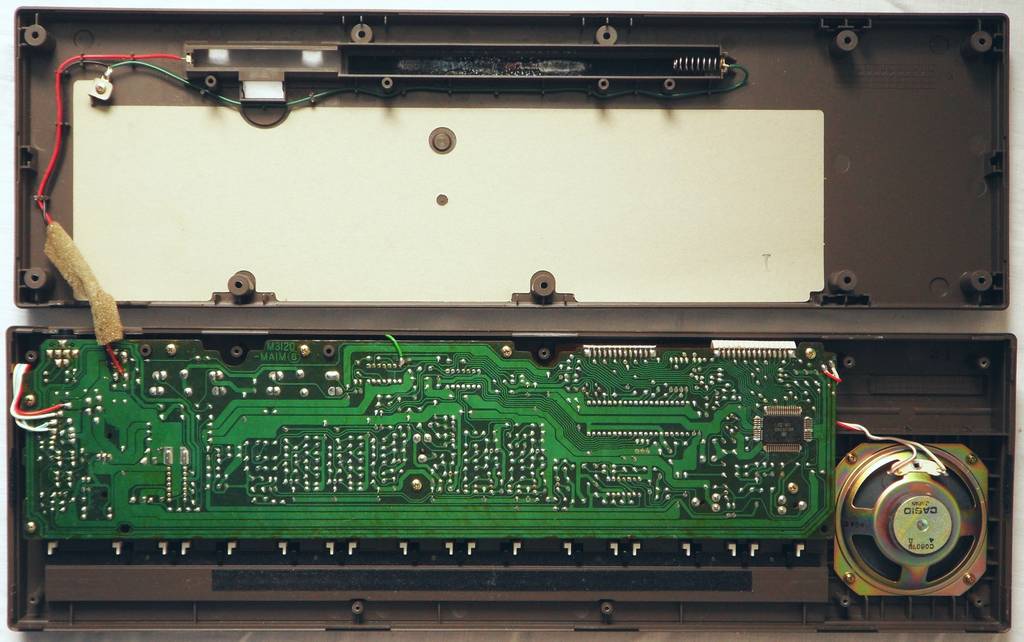
The Casio MT-21 is built around the main voice CPU HD44140
and uses all its features (no matrix eastereggs). The rhythm is controlled
by the unique accompaniment CPU "Toshiba TMP8048P
1104" (Intel MCS-48, variant of "NEC D8048C-316").
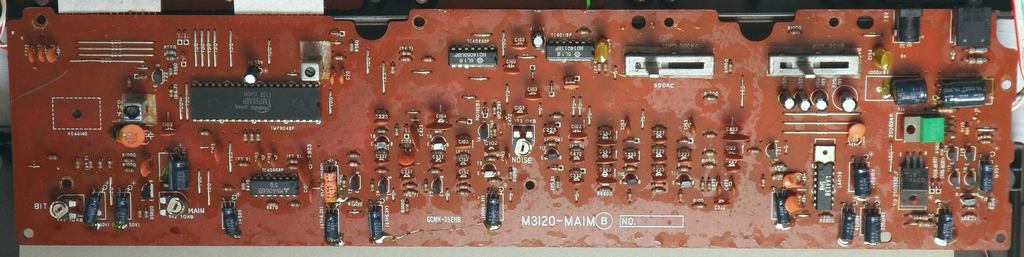
The analogue percussion section uses fairly much discrete components despite
(by omitted "samba" rhythm) it lacks the 'clave' circuit. On the PCB are
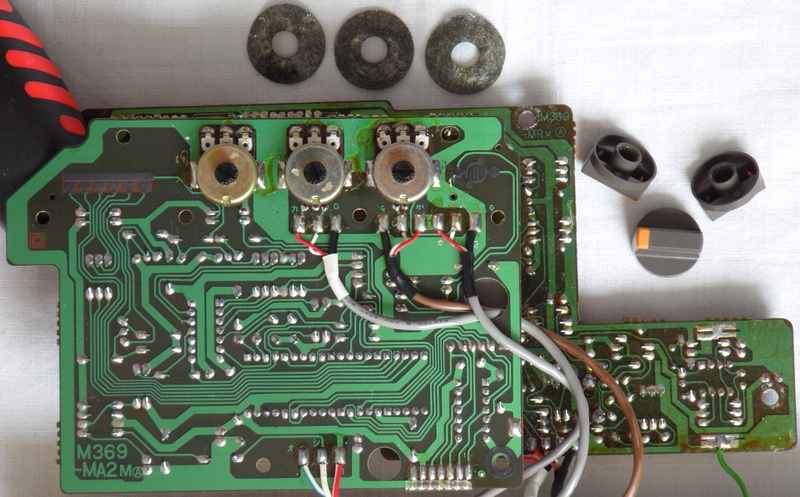
trimmers for main voice bit compensation (tweak low DAC bits), "main" and
"noise".
Most unusual is that the rhythm uses the accompaniment CPU of Casio
MT-40, so its entire bass accompaniment (including the famous Sleng
Teng riddim pattern) is included, but unleashing it would need additional
analogue circuits and buttons.
main voice keyboard matrix
The main voice is produced by the self-contained sound CPU HD44140,
which has only few functions and supports no accompaniment. Very unusual
for Casio is its keyboard matrix layout with 16 output and only 3 input
lines. There are no eastereggs.
|
6 KC1
|
7 KC2
|
8 KC3
|
9 KC4
|
10 KC5
|
11 KC6
|
12 KC7
|
14 KC8
|
15 KC9
|
16 KC10
|
17 KC11
|
18 KC12
|
19 KC13
|
20 KC14
|
22 KC15
|
23 KC16
|
|
CPU pin
|
|
out 1
|
out 2
|
out 3
|
out 4
|
out 5
|
out 6
|
out 7
|
out 8
|
out 9
|
out 10
|
out 11
|
out 12
|
out 13
|
out 14
|
out 15
|
out 16
|
out / in
|
|
O.
clarinet
|
O.
organ
|
O.
harp
|
o
F#0
|
o
A0
|
o
C1
|
o
D#1
|
o
F#1
|
o
A1
|
o
C2
|
o
D#2
|
o
F#2
|
o
A2
|
o
C3
|
o
D#3
|
sustain
|
in 1
|
3 KI1
|
O.
violin
|
O.
pipe organ
|
O.
piano
|
o
G0
|
o
A#0
|
o
C#1
|
o
E1
|
o
G1
|
o
A#1
|
o
C#2
|
o
E2
|
o
G2
|
o
A#2
|
o
C#3
|
o
E3
|
vibrato
|
in 2
|
4 KI2
|
O.
accordion
|
O.
elec. piano
|
o
F0
|
o
G#0
|
o
B0
|
o
D1
|
o
F1
|
o
G#1
|
o
B1
|
o
D2
|
o
F2
|
o
G#2
|
o
B2
|
o
D3
|
o
F3
|
APO disable
|
in 3
|
5 KI3
|
The input lines are active-low, i.e. react on GND. Any functions can
be triggered by a non- locking switch in series to a diode from one "in"
to one "out" pin.
legend:
|
|
|
"o"
|
= keyboard key |
|
underlined
|
= function needs locking switch (i.e. stays active only so long the
switch is closed) |
|
O.
|
= preset sound ('orchestra') |
orange
background |
= easteregg (unconnected feature) |
Connecting a diode at pins 5->23 prevents auto-power-off (seen in Casio
MT-45, thanks Traktor for info).
rhythm key matrix
The rhythm controls and bass key buttons are handled by the accompaniment
CPU TMP8048P-1104. The matrix input
lines are routed through the inverter TC4069BP ("Hitachi HD14969UBP", 14
pin DIL) next to it, so its input pins need to be used.
|
5 /P15
|
none /P16
|
none /P17
|
<- inverter pin
|
accomp. CPU pin
|
|
in 1
|
in 2
|
in 3
|
in / out
|
|
R.
start/stop
|
C.
C1
|
C.
G#1
|
out 0
|
12 DB0
|
R.
synchro/ fill-in
|
C.
C#1
|
C.
A1
|
out 1
|
13 DB1
|
R.
waltz
|
C.
D1
|
C.
A#1
|
out 2
|
14 DB2
|
R.
samba
|
C.
D#1
|
C.
B1
|
out 3
|
15 DB3
|
R.
swing
|
C.
E1
|
C.
C2
|
out 4
|
16 DB4
|
R.
slow rock
|
C.
F1
|
C.
C#2
|
out 5
|
17 DB5
|
R.
pops
|
C.
F#1
|
C.
D2
|
out 6
|
18 DB6
|
R.
rock
|
G1
|
C.
D#2
|
out 7
|
19 DB7
|
The input lines are active-high, i.e. react on +Vs. Any functions can
be triggered by a non- locking switch in series to a diode from one "out"
to one "in" pin.
legend:
|
|
|
R.
|
= preset rhythm |
|
C.
|
= chord |
orange
background |
= easteregg (unconnected feature) |
-
2 additional rhythms & fill-in
The rhythms "samba", "pops" and a fill-in button can be added by wiring
button switches through diodes from TC4069BP pin 5 to pin 15, 18 and 13
of the TMP8048P. Note that by the lack of a 'clave' circuit samba will
play mutilated.
-
bass keypad & accompaniment
Theoretically likely the whole bass accompaniment section of Casio
MT-40 can be added, although it would be a lot of work.
pinout HD44140
The LSI "Hitachi HD44140" (54 pin SMD, pins count anticlockwise from below
the left stub pin) was Casio's most simple polyphonic single chip main
voice hardware of early 1980th keyboards (likely used first in MT-11 of
1982). Compared with the very versatile first generation predecessor
D77xG,
it was cut down to have as few functions as barely needed for a short beginners
keyboard. So despite 8 note polyphony the keyboard matrix supports only
37 keys and 8 preset sounds with 1 sustain and 1 vibrato switch. Unlike
D77xG the chip produces no feelable heat, so the transistor count was likely
minimized for long battery life (possibly created for the mythical solar
cell powered mouth organ that became the
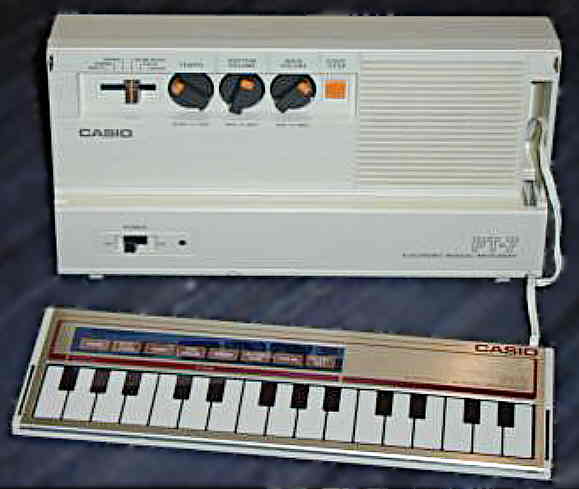
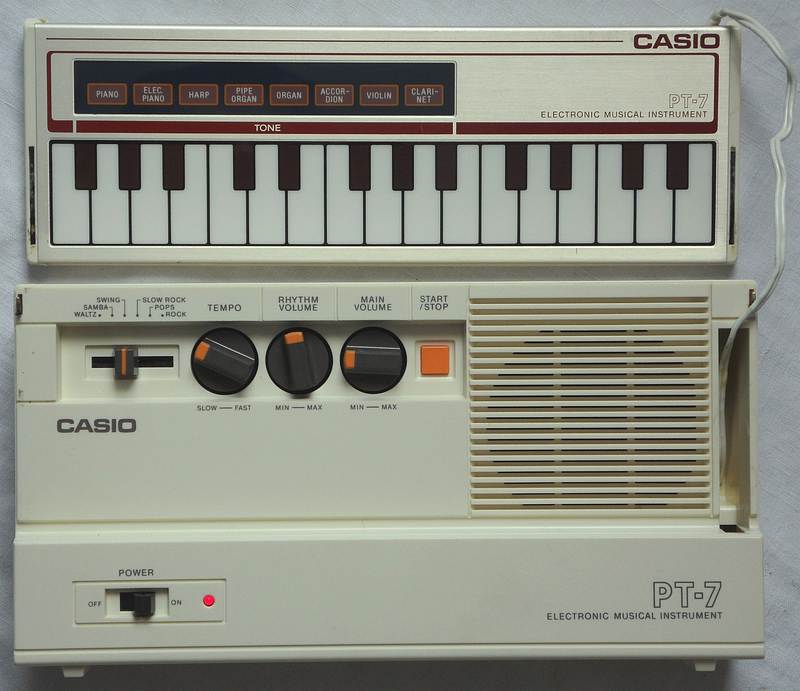
PT-7).
A bit strange is the integrated DAC that outputs its lower bits (at increased
level) only on a separate pin; also the highest bit is separately output
in normal and inverted. All these have to be combined through an external
voltage divider (small resistor network with ratio 1:64), which was likely
done to reduce noise. The only 11 DAC bits also have separate output pins
(not used in any instruments I know).
The sound generator is a very simplified variant of Consonant-Vowel
synthesis. Each preset sound is made from 2 layered multipulse squarewaves
(8 steps long?) crossfading by simple volume envelopes those do not change
with note pitch. Each step can have only the height {-1, 0, +1}, i.e. protrude
fully up, fully down or be zero. (I.e. unlike D77xG there are neither ramp
nor curve sections.) The linear envelope and low bit resolution make it
sound rather artificial, but the unusual sonorous waveforms are unique
and the high internal clock rate (1.425 MHz?) prevents cold aliasing noise.
The preset sounds 'clarinet' and 'piano' set the external fixed lowpass
filter to 750Hz, else it stays 1.1kHz (seen in MT-11 service manual). Unlike
D77xG there is no spread scale, i.e. holding the same notes in different
octave causes no phasing (but phase changes among multiple key presses,
thus there are no octave dividers involved).
caution: The pin numbering of this IC package is very bizarre.
I expected it to start in the slanted lower left corner (text readable),
but numbers on MT-45 and particularly MT-200 PCB (different IC in same
package) indicate that it starts from below the stub pin to the left and
the missing pin is skipped, i.e. this IC has only 54 (or 55??) instead
of 56 pins. I first made this pinout from my own observation, but later
got the MT-11 service manual for pin names.
caution: The MT-11 service manual indicates that this CPU uses
"negative logic", i.e. technically +5V is its GND while 0V is its -5V supply
voltage. So the voltages are not was the pin names suggest. I use
the positive voltage naming convention (from 0V to +5V, not -5V to 0V).
Apparently all "O#" pins are outputs, "I#" are inputs and "IO#" can be
both.
| pin |
name |
purpose |
| 1 |
NC |
|
| 2 |
VDD1 |
ground 0V |
| 3 |
KI1 |
key matrix in |
| 4 |
KI2 |
key matrix in |
| 5 |
KI3 |
key matrix in |
| 6 |
KC1 |
key matrix out |
| 7 |
KC2 |
key matrix out |
| 8 |
KC3 |
key matrix out |
| 9 |
KC4 |
key matrix out |
| 10 |
KC5 |
key matrix out |
| 11 |
KC6 |
key matrix out |
| 12 |
KC7 |
key matrix out |
| 13 |
NC |
|
| 14 |
KC8 |
key matrix out |
| 15 |
KC9 |
key matrix out |
| 16 |
KC10 |
key matrix out |
| 17 |
KC11 |
key matrix out |
| 18 |
KC12 |
key matrix out |
| 19 |
KC13 |
key matrix out |
| 20 |
KC14 |
key matrix out |
| 21 |
NC |
|
| 22 |
KC15 |
key matrix out |
| 23 |
KC16 |
key matrix out |
| 24 |
NC |
|
| 25 |
TEST |
(wired to supply voltage GND) |
| 26 |
NC |
|
| 27 |
GND |
supply voltage +5V |
| - |
(no pin) |
|
|
|
| pin |
name |
purpose |
| 28 |
PG1 |
clock in (5.752 MHz?) |
| 29 |
PG2 |
clock out (inverted PG1) |
| 30 |
MS |
(wired to supply voltage GND) |
| 31 |
PGTO |
clock/4 out |
| 32 |
PGTI |
clock/4 inverted? out |
| 33 |
O1 |
audio out (upper bits) |
| 34 |
O2 |
audio out (lower bits, weighted 1/64) |
| 35 |
VDD4 |
ground 0V |
| 36 |
IO12 |
dac bit out (LSB) |
| 37 |
IO11 |
dac bit out |
| 38 |
IO10 |
dac bit out |
| 39 |
IO9 |
dac bit out |
| 40 |
IO8 |
dac bit out |
| 41 |
IO7 |
dac bit out |
| 42 |
NC |
|
| 43 |
IO6 |
dac bit out |
| 44 |
IO5 |
dac bit out |
| 45 |
IO4 |
dac bit out |
| 46 |
IO3 |
dac bit out |
| 47 |
IO2 |
dac bit out (MSB) |
| 48 |
NC |
|
| 49 |
IO1 |
bit compensation (inverted highest bit) |
| 50 |
O3 |
bit compensation (highest bit, like pin 47) |
| 51 |
VDD3 |
ground 0V |
| 52 |
O5 |
/APO auto-power-off out (not used) |
| 53 |
O4 |
filter control out (lo=duller) |
| 54 |
VDD2 |
ground 0V |
| - |
(stub) |
(internally wired to supply voltage GND) |
|
At the left side of the package is an unused short pin stub that is
internally connected with +Vs (positive supply voltage) and apparently
not counted as a pin. At the opposite side is no pin at all. The "NC" pins
are unconnected, behave like inputs (high resistance) and have lo level.
Pulling these to +Vs through 1K resistor seems to do nothing. It is unknown
if some of the many pins wired to GND or +Vs are genuinely inputs or test
pins.
I see no complex signals for communication with a host CPU; likely the
HD44140 is too dumb for this or interesting pins are just grounded. When
shitshot (touching clock pins) it does nothing spectacular (sometimes stuck
notes or silence or plain notes decaying naturally, but no new timbres),
which hints that is a rather banal LSI circuit of hardwired logic gates
and counters (even simpler than D77xG) with next to no software inside.
Also the strange keyboard matrix layout (16 x 3) was likely done to simplify
internal wiring.
The PT-7 powers on with 'harp' preset sound, but MT-21 (slide switch
in intermediate position) defaults to 'piano', thus I guess that in PT-7
external components (a capacitor?) set it to 'harp'.
An obviously related real sound IC by Casio (controlled by a CPU, with
percussion generator and chord+bass channel support) is HD43720.
pinout TMP8048P-1104
The "Toshiba TMP8048P 1104" (40 pin DIL) is the rhythm CPU of Casio
MT-21. This IC is almost identical with "NEC D8048C-316"
(see there).
I first thought the rhythm patterns were more complex (automatic fill-ins),
but apparently this was an illusion by different analogue percussion circuitry
inside MT-21. The pinout and behaviour are identical; even the bass accompaniment
is fully functional (verified by inserting into Casio
MT-40 and vice versa) despite no instrument is known to make use of
it.
Technically the "TMP8048P xxx" is a generic microcontroller of the well
documented Intel MCS-48 family. Dumping its ROM with the eprommer Willem
Pro4 isp however gave some strange results. When read as P8050AH, the
4KB output has 512 bytes followed by 14 repeats of the first 256 bytes.
When read as other MCS-48 variants, the output repeats already after the
first 256 bytes, so it is unknown whether the code is longer than the dumped
512 bytes. The trailing 287 bytes exactly match those of the 1KB ROM dump
from "D8048C-316", which makes me expect that also the TMP8048P ROM is
genuinely 1KB with the rear 512 bytes unreadable. It might even be that
the software is identical with D8048C-316 but gets scrambled by some kind
of copy protection circuit. |