Casio HZ-600
 |
SD synth with analogue filter & realtime programmable accompaniment |  |
|
 |
 |
Unfortunately the thing is far less exciting than the feature list suggest, since for a serious synth the entire instrument sounds disappointingly cold, thin and digitallic; it resembles rather a Bontempi GT-759 than the much warmer sound of Casio's earlier "consonant vowel" keyboards. The problem may be that the HT-700 keeps its digitally controlled VCF always in the signal path (even when not in use), while older keyboards either lacked them or could completely bypass them through a mechanical switch. (Late 1980th ghettoblasters often had similar sound problems with their fancy looking and cheaply designed equalizer or reverb units.) But this gives the sounds also a cheesy lo-fi appeal that reminds to typical C64 sounds, and the thing can do a lot of wonderful multipulse squarewave organ timbres those remind to classic Atari POKEY sounds (but without the complex noise effects and special tone scale), and some waveforms even include that small dose of distortion that is necessary to make polyphonic squarewave musics sound really good.
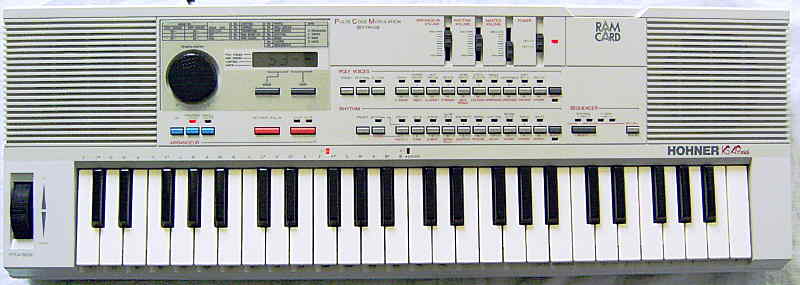
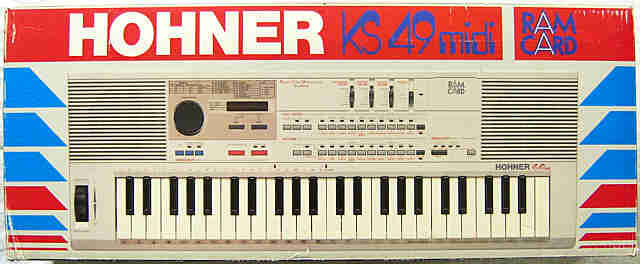
There are 40 preset sounds, of those 20 can be overwritten by the user. The preset sound and rhythm set differs between Casio HT-700 and Hohner KS 49 midi; at least with my KS 49 most preset sounds are quite unrealistic, but realistic timbres are anyway no great talent of this hardware. A special RAM Card (Casio RA-100, now hard to find) can be inserted to store 20 additional user presets and user rhythms etc., but there is no MIDI sysex feature to backup data elsewhere. The percussion is made from medium resolution samples; they resemble the Casio MT-520 drum section but sound thinner, brighter and knock less woody. The bongos e.g. sound here more like drumming with fingers on the floppy aluminium foil lid of a yoghurt cup. The preset accompaniments of the KS 49 sound quite cheesy and many are over- orchestrated; their chord timbres overuse filter wahwah effects, which makes them rather resemble cheap no-name FM tablehooter accompaniments than realistic instrument timbres. Fortunately the fingered accompaniment at least accepts also non- standard key combinations beyond establishment chords, and the rhythm programming mode can be abused as a tekkno drum computer (although the percussion sounds rather boring for this and can not be routed through the VCF).
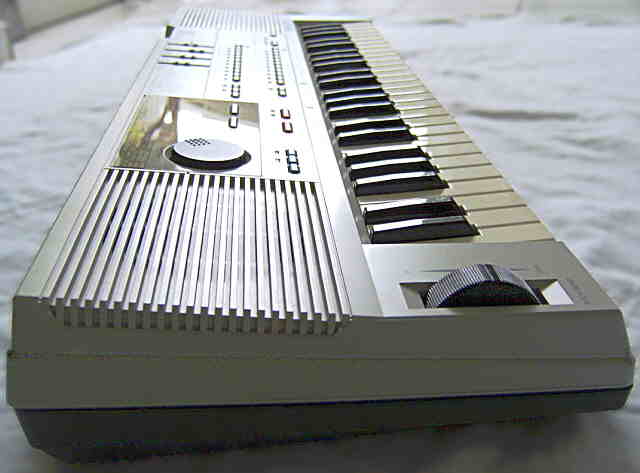
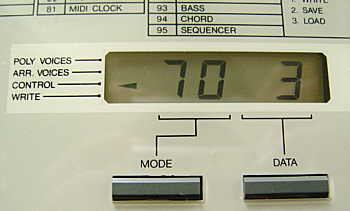
There is only a single common VCF used for all main voice polyphony channels, but a 2nd VCF exists for the also editable accompaniment voice on the left keyboard half. All synth parameters and tempo are selected and set through 2 buttons and a dial knob. Unlike the endless rotary encoder of other digital synths, the dial here turns a normal potentiometer, thus the value jumps to the current pot position when touched, and you have to turn it all way back and tweak the previous value when you only want to change a parameter a little; a normal number keypad would have been far less awkward here. Also the LCD only shows parameter numbers (0..95) instead of names. At least you can nicely abuse this dial as a realtime sound control for a previously selected parameter (e.g. filter cutoff), which often makes grainy zipper noise and can be also used for granular timbre change effects. But it takes many seconds to assign a different parameter to it, which disturbs live play. There is also a pitchbend-, but no modulation wheel, and synth parameters can not be accessed through MIDI.
 |
 |
 |
 |
 |
 |
polarity protection diode added, power supply jack polarity corrected.
All SD synthesizers are based on the the sound IC "NEC D935G" with analogue 4-pole VCF "JRC 2090D" controlled by a "NEC D78C10G" CPU with external RAM and ROM. While regular versions employ only 1 sound IC and 2 VCF (1 for chord and melody section), the high-end model Casio HT-6000 contains even 4 sound ICs with 8 VCF (1 per polyphony channel) and additionally an MCS-48 CPU for velocity(?) and 2 gate array SMD ICs for bus handling. I expect that the D935G gets all waveform data from the CPU, since it has no software number and the count of available waveforms differs between HT-6000 and other models, but it may be that HT-6000 only layers the same standard waveforms of multiple ICs.
The sound engine of the HT-700 was far inferior to the CZ synths; e.g. while the CZ synths can do a lot of different hiss timbres by "noise modulation", the noise generator of the HT can not change its fixed hiss timbres (except through the monophonic VCF), and its noise pattern has always a tremolo with about 6Hz in it, which is likely caused by a too short shift register loop pattern (like with certain Atari POKEY noises). The main voice oscillator of the HT-700 can generate 32 different basic "DCO" waveforms, those all sound like based on filtered multipulse squarewave. Any of the 32 basic waveforms seems to be made from 2 layered suboscillators those each generate a stair shaped(?) waveform with independent envelope, but the internal parameters of these suboscillators can not be set directly, but only the 32 resulting basic waveforms. While most of these are simply static squarewave tones with different multipulses run through different filter capacitors, there are also special ones. E.g. number 6 is pure noise, some others mix that noise with a squarewave tone and 23 even automatically slowly grows brighter by crossfading between 2 suboscillators in the classic "consonant vowel" manner. Also some others contain quick timbre changes during their attack phase to approximate mallet, flute or picked string instruments, but they always keep their multipulse squarewave appeal. Just disable the VCF (set cutoff=31, resonance=0), set chorus to 0 or 1, select a squarewave with simple envelope and voila - you get the nicest historical videogame music timbre; in some waveforms even the typical mild distortion is there, that gives polyphonic squarewave music the classic Atari VCS2600 appeal. The programmability of the accompaniment voice (left keyboard section) is far more restricted than the main voice (only 16 basic waveforms, less parameters), and annoying is also that the octave range of the oscillators can not be changed, because their pitch is too high to create really low bass sounds. The bass voice of the accompaniment can not be edited at all.
Like with CT-410V, the sound generator itself is mono and only post- processed by the stereo chorus, which adds to the main and accompaniment voice a cold sounding detuned chorus that reminds to My Music Center timbres; unlike the stepless slider of the CT-410V it can be set only to 3 panning/ vibrato speeds or turned off (but apparently always stays in the signal path), and the chorus setting is here part of each preset sound. Strange is that my Casio MT-800 and MT-520 sound much warmer despite active stereo chorus, thus possibly it is only the VCF or even a poorly designed power amplifier that ruins the sound of my KS 49. Despite the data entry dial also the resolution of some other parameters is quite coarse, which appears especially unnecessary with the rhythm tempo setting. Instead of the awkward tempo/ entry dial, Casio should have better used the semi- OBS buttons as a keypad to type in parameters. Likely at least the analogue filter and chorus section of the the HT-700/ KS 49 can be easily upgraded with external potentiometers for better realtime controls, and I expect that like with my CT-410V there are many other things changeable through circuit bending. (I haven't analyzed the hardware closer yet.) Very unusual for Casio hardware is that the buttons of my KS 49 employ instead of rubber contacts metal cap switches, despite these tend to be less reliable (well known from the infamous original Atari VCS2600 or Spectravideo Quickshot I joysticks, those contacts often cracked apart or slid away under their adhesive film cover on the PCB). A bit confusing is also that the accompaniment control buttons {single finger, fingered, off} don't work so long any keys are held (likely a bug related to semaphores because a double press on "fingered" or "single finger" toggles the key split point).
On the internet is a lot of info available about the Casio HT-700, thus I won't describe its operation and features in detail here.
While most preset sound names on Casio HT-700 correspond to many of the Casio CZ-230S presets, on the Hohner KS 49 midi several sounds are different; some of them differ even so much (e.g. "plunk extend" vs. "psycho", "pearl drop" vs. "harmonium") that it is unlikely that only the control panel names were changed, although some of them may be only in different order. With Casio HT-700 the presets are:
Generally the preset sounds are not really realistic; in the bass range many sounds turn into a more or less buzzy, sonorous purring drone, which is a characteristic style element of squarewave based instruments. When a key is trilled with sustaining sounds, each new note occupies a new sound channel, which produces a great phasing sound and volume increase effect although this eats up polyphony. The semi- OBS preset sound buttons have each a LED and respond nicely fast; pressing them retriggers the notes of held keys with the selected preset sound, which can be used for live play tricks. The "piano" has to much presence with a thin bass and slightly dull treble range. The "harpsichord" is a multipulse timbre with a nicely sonorous (although unrealistic) bass range; "clavinet" (Hohner invented that thing) is the same without sonorous multipulse. The "jazz organ" (resembles Bontempi GT-770 "circus organ") has a percussive attack and strong fast 6Hz square vibrato and chorus vibrato, but it fades thinner and generally sounds ridiculously thin and creaky despite sonorous multipulse bass range. The "brass" is a cold tooting electronic chorus tone with semi- percussive attack, which resembles the famous Casio SA-series "brass ens". "strings" employs the same timbre with slow attack, long sustain and 4Hz tremolo; unlike the latter it sounds astonishingly realistic. "wow brass" is a "brass" variant with filter meow effect and -tremolo; it turns bright and dull again and reminds to typical cheap FM synth brass sounds. "synth celesta" is bright squarewave musicbox timbre with nicely sonorous multipulse bass range and 4Hz tremolo. "celesta" sounds more massive and resembles more an unfiltered squarewave pseudo- piano. "magic flute" is a dull flute (or wooden organ pipe) with a small dose of chorus; the dull bass range resembles a grainy very low resolution sine wave sample. "harmonium" has an additional 2 octave higher overtone and thus sounds brighter. "harmonica" is a sonorous reed organ timbre (resembling sawtooth wave) that fades slightly thinner. "vibes" is a bright vibraphone timbre with long sustain made from filtered multipulse squarewave; "soft bells" sounds slightly brighter and shorter. "e-piano" is a duller "vibraphone" variant with only short sustain. "wah-brass" is a quickly dull fading dry filter sweep timbre with fast 6Hz tremolo; it resembles much rather a funky e-bass than a brass timbre. "crescendo" resembles a harp or dull xylophone layered with a louder and brighter fading synth strings timbre with fast 6Hz tremolo and some sustain (nice pad sound). "fantasy" has here nothing to do with any Casio sounds of that name, but sounds like a water drop in a cave layered with a short dull flute or xylophone tone (multipulse timbre) with sustain (that is slightly shorter with held notes). "psycho" is a sort of upward howling and brighter growing US police car siren, that with held key stops after 4 howls (about 3s), but slowly fades duller and fades away (while it keeps howling) when the key is released earlier. "storm" is an eerie wind noise that hisses brighter until key release (or 2s) and then duller using a filter sweep while it fades away with very long 10s sustain. There is also some chorus and a continuous 4Hz tremolo in it (caused by the poor shift register noise generator), which sounds very much like a typical classic analogue 1960th or 70th SF movie sound effect. Its fixed pitch unfortunately ignores the played note, but pressing multiple keys causes a dramatic volume increase and opens the (monophonic) VCF again each time.
Additionally there are 20 overwriteable default user preset sounds, those original names I don't know because I only have the downloaded Casio HT-700 version of the manual. Thus the following names were chosen by me where the Casio names don't match. "piano 2" is a bit brighter than 1. "marimba" is a bit too dull. "pipe organ" is the well known multipulse timbre that simulates a metal pipe organ rank; this one has long sustain and sounds a bit thin. "strings 2" has a faster attack and more mids than 1. "wow brass 2" resembles 1 but grows only dull. "harp" sounds ok with some chorus. "koto" is a bright picked string that fades duller during attack (like intended) with some sustain/ chorus. "double reed" is a dull rather thin reed organ timbre with some chorus. The "clarinet" is ok with some chorus. "fantasy 2" sounds like a thin harp layered with a howling flute that slowly fades silent and has short sustain. "honkytonk piano" sounds like "piano 2" with howling detuned chorus vibrato. "vibraphone 2" sounds duller than 1. "violin" sounds fairly realistic with some chorus. "synth-strings" sounds like "strings" with a small dose of detuned chorus vibrato. "synth trumpet" is a buzzy squarewave trumpet timbre with percussive attack and sustain. "mandolin" doesn't ring and has a percussive metallic treble range like a toy piano; the mids rather resemble a mandolin or small harp. "sitar" is a bright picked string with chorus and sustain; the buzzy mids are rather a decaying synth brass timbre (made from sawtooth waves?). "slash reed" is a thin and squawky reed organ(?) timbre, which scratchy attack phase somewhat resembles a saxophone. "synth-guitar" is a thin picked string timbre, which fades duller by a filter sweep (like an e-guitar wahwah effect); it has no sustain and immediately stops by key release. "storm 2" resembles 1 but starts bright instead of dull and sounds thinner and less spectacular.
The preset accompaniments of the KS 49 sound quite cheesy and
many are over- orchestrated; especially their chord timbres overuse filter
wahwah effects, those resemble 1970th funk "wokachika" sounds. The accompaniments
and rhythms are programmable and there is an additional bass track with
a fixed monophonic e-bass sound. Nice is that the rhythm programming mode
can be also abused as a tekkno drum computer, although the percussion sounds
boring. Like with a Yamaha "custom drummer" mode, a template pattern
repeats in a loop and you can add individual percussion in realtime through
keyboard keys (press simultaneously leftmost ">" key for loud accent notes).
Holding the "record/ delete" button simultaneously with a particular percussion
key deletes the corresponding percussion track from the user pattern only
for that duration the key is pressed, which nicely permits small changes
in the running pattern. Pressing "record/ delete" with stopped pattern
clears the entire pattern. Unfortunately the thin drums can not be routed
through the VCF (the old Casio CT-410V
still could do this). The accompaniment sound depends on the currently
selected preset rhythm (also with rhythm off). Annoying is that despite
in fingered chord mode the left keyboard section can be expanded to the
entire keyboard half, it can not be used as a real 2nd main voice, because
it transposes any played notes into a single octave and always attempts
to hold chords so long any key in that section stays pressed. Also the
maximum chord volume is a bit too low as 2nd main voice. Running rhythm
always starts the automatic accompaniment and can not be combined with
manual chord mode (e.g. as a 2nd main voice) - outsider keyboards like
Antonelli
2495 were much more versatile here. The programmable accompaniment
also only accepts 8 standard chords, those are entered in a strange way
through the rightmost 8 white keys.
hardware detailsThe Hohner KS 49 midi is a rebranded variant of Casio HT-700, that is member of the HT-3000 hardware family. The complex multi-chip hardware is built around the CPU NEC D78C10G that controls the SD sound IC NEC D935G and 2 percussion ICs OKI M6294-03 and -04. The melody and chord voice is routed from the sound IC through each a VCF JRC 2090D, followed by the stereo chorus. The sound ic also controls the LCD.This text is based on the service manuals of Casio HT-3000, HT-700,
HZ-600,
MT-600 and CT-630.
Exciting is that beside MT-600 the wiring of all instruments is very similar and the CPU is controlled by only one external rom; custom chips (beside percussion ICs) have no software numbers, which makes the system open for experiments with rom swaps or even custom software by replacing the rom with a socketed 32KB eprom (27C256) to change preset sounds or (more interesting) implement proper midi sysex dump support to get rid of the rare ram cards and define synth parameters through midi. There is plenty of address decoding going on. The CPU e.g. selects ram,
sound IC, percussion IC 1 & 2 and LED controller 1 & 2 through
the binary number on address lines A14, A13, A12 while A15=hi. A15=lo selects
ROM. Lower Address bits A0..A7 are latched from data bus during a pulse
on ALE. If I understand the address decoder tables correctly, this is the
memory map.
The RAM Card RA-100 is not in address space but accessed through I/O pins C0..C7. Lower address is latched during a pulse on C11. Then upper address is latched during a pulse on C12. /CE is generated by C5=lo during rising edge of C12. RAM Card insertion is detected when C15=lo. The sound IC D935G generates melody and chord channel. CPU pin 21 (N) switches the routing, to send 4 of the polyphony channels through a different VCF when in chord or keysplit mode. The VCF IC JRC 2090D contains a 4-stage low-pass filter. It is voltage controlled by the sound IC. The melody voice VCF cutoff is pins AO5 (increases from 2.5V to 0.8V), envelope is AO4 (0.5V to 3.5V) , resonance is AO6. The chord voice VCF cutoff is pins AO2, envelope AO0, resonance AO2. The VCF adjustment is complicated because the original text is useless without schematics, so I try to summarize it naming the IC pins. For VCF cutoff adjustment, ground the VCF IC (JRC 2090D) pins 3 and 9. Connect a signal generator through a capacitor to pin 18 and inject 0.8V Vrms +/-1% 590Hz +/-1% signal. Check with a level meter at pin 12 is 0.8V +/-2%. Apply 2.0V +/-1% to pin 3 (of course after removing your grounding test lead). Adjust the trimmer until the voltage at pin 12 is 0.2 Vrms +/-5%. Reduce the signal generator output to 0 Vrms. Now the pin 12 voltage has to be between 1.8 and 2.3V. This procedure needs to be performed for both VCF. The trimmer for Melody VCF is VR2, for Chord VCF is VR4. For VCF bias adjustment, set on the keyboard the entry dial in mode = 10 (Melody VCF Cutoff Frequency), data = 0. Connect a voltmeter to pin 3 of the IC and adjust trimmer VR5 until the voltage is 2.5V +/-20mV. Set the entry dial in mode = 10, data = 31. Verify that the voltmeter shows 0.8V +/-20mV. The mute circuit is in a strange way resusing the BAS (bass squarewave
tone) pin of the sound IC in what looks like a kind of handshake.
The stereo chorus is a phase shifting delay circuit with plenty of analogue stuff, using a 1024 steps BBD IC MN3207 clocked by IC MN3202. It stays off when both CPU pins 19 (CH0) and 20 (CH1) = lo, shallow when CH0 = hi and deep with both hi. keyboard matrixThe matrix outputs KC1..KC11 are inverted from pins C0..C10 of the CPU. The keyboard inputs KI1..KI6 are latched inverted to the data bus during the inverted pulse at 1Y0 from the LED controller. The same happens with panel inputs SI1..SI6 and pulse at 1Y1.I haven't analyzed this matrix by myself. This is based on the Casio
HT-3000 and HT-700 service manuals. Matrix places those are not used in
HT-700 I have marked as eastereggs. So the HT-3000 has an own group
of preset sound buttons for lower (chord section) keys and a longer keyboard.
Some preset sounds of Hohner KS 49 midi differ from HT-700
due to different rom.
The input lines are active-low, i.e. react on GND. Any functions can
be triggered by a non- locking switch in series to a diode from one "in"
to one "out" pin.
The pitch wheel is at CPU pin 34 (AN0). The additional modulation wheel of HT-3000 is wired to CPU pin 35 (AN1). (Adding it will likely need an additional "Modulation on/ off" button at SI5->KC7.) Theoretically it might be possible to upgrade non-synth models also with synth buttons and data entry dial (CPU pin 35 (AN1)), but without LCD (and RAM card slot) it would be pointless. The CT-630 matrix in service manual has same layout but different preset sounds and lacks synth features. It is unknown how much of it may be reviveable as matrix eastereggs, since the hardware lacks the 2 upper address latch ICs (TC74HC374P and TC74HC174P) and the rom has a different software number 023. The MT-600 is even more crippled. In its service manual it has only 1 percussion IC M6294-06 and 2 additional gate arrays UPD65005GF-151 (for panel matrix and LEDs) and -152 (for keyboard matrix) containing latches, buffers and decoder. It is hard to understand why; apparently they translate the matrix layout for a case with wrong control panel that was not designed for it (using 10 buttons to select 40 preset sounds and 10 buttons for 20 rhythms), so I doubt that it has eastereggs common. The rom is software number 065. The HZ-600 matrix layout otherwise is clearly related to HT-3000. In service manual it lacks all parts related to chord and rhythm (it only has keysplit), and some preset sounds differ. Interesting is that at matrix place SI6->KC6 it has a "sustain" button. pinout JRC 2090DThe "JRC 2090D" (18 pin DIL, in schematics named "NJM2090") is a voltage controlled filter (VCF) used in Casio keyboards. It contains a 4-stage low-pass filter. Cutoff frequency reduces when pin 7 voltage (0.8 .. 2.5V) increases. Resonance is proportional to voltage of pin 9 (0.5 .. 2.2V).
pinout D78C10GThe CPU "NEC D78C10G" (64 pin zigzag DIL) was used in Casio SD synthesizers. It is a documented romless 8-bit microcontroller, which behaviour depends on software in external rom. It has 256 byte internal RAM.This is the pin meaning when used in instruments of the Casio HT-3000
hardware family, that includes almost all Spectrum Dynamics instruments
like HT-700 (with variant Hohner KS 49 midi), HT-3000,
HZ-600,
but also MT-600 and CT-630. Surprisingly they use their CPU
in a very similar way despite changes in rom contents. Regard that the
pinout in the much more complex Casio HT-6000
strongly differs.
Like pitch and modulation wheel, the data entry dial is simply a potentiometer with 0..5V output to an ADC. Because in some modes it directly changes sound, an analogue modulation or envelope circuit may be wired to its input. pinout D935GThe Music LSI "NEC D935G" (80 pin SMD) is the Spectrum Dynamics sound IC of Casio HT/HZ series keyboards. It is 8 note polyphonic with digital envelope and can route 4 polyphony channels to a separate output to play melody and chord (or keysplit) voice. Additionally it has a squarewave bass tone & envelope output, and control voltage outputs for 2 VCF (each cutoff, resonance, envelope). In total it contains 12 DACs. Those for melody & chord are each 7-bit using separate DAC outputs for upper and lower bits those need to be combined through an external voltage divider (820+130 ohm resistor for ratio 1:158, add MSB (highest bit) inverted or uninverted with trimmer from 2 separate pins). So the resolution is likely 15-bit. The DCO waveforms include white and metallic digital noise. The DCA envelopes have ADSR parameters and can crossfade between waveforms. The LFO has waveform, depth, delay and speed settings. The VCF port supports cutoff and resonance and has ADSR envelope with depth too. In HT-6000 it can do ring modulation. Many parameters have 5-bit (32 steps) resolution; possibly they got artificially limited only by the ADC resolution of the data entry knob. It is hard to identify how much of all this is software defined or hardcoded inside the chip. As a real sound IC the D935G is controlled by an external CPU.The D935G was basically the last and most sophisticated version of Casio's
classic Consonant-Vowel-Synthesis engine. As successor of the D931C
it handles 2 VCF instead of switching between fixed filters and was likely
more optimized for use in synthesizers. And like the old D77xG
it even has an LCD port.
Pin 77 (BAS) in HT-700 and HT-3000 service manual is described as "bass pitch signal", which looks confusing; the attached line is named "MUT2" and in schematics connected to CPU pin 23 (chord voice mute request). In keyboards without this bass it is indeed described as a melody mute control pin. The HT-700 block diagram text tells that BAS is the "pitch" (apparently squarewave), the bass envelope output from A06 gets mixed in a transistor, and while the sound IC generates no sound, it pulls P3 lo to eliminate noise. This makes no sense, unless it does something complicated like automatically muting the chord voice during bass or such things, or the CPU simply ignores pin 23 when it wants bass with chord. Pin 30 is clock out at half frequency if I3 is wired lo (done here), but becomes clock in if I3 is wired hi. The undocumented pin 62 is wired to 61, which looks like a secret model select feature. But I saw this in service manuals of HT-700, HT-3000, CT-630, MT-600, HZ-600 and eventually even on photos from inside my HT-6000, so it can't be a mode that was actually used. The Casio HT-6000 is much more complex and uses 4 of these sound ICs (each driving 2 VCA). It assigns them differently and so names the combined chord & melody outputs "melody A" and the "melody" outputs "melody B". It does not use the dedicated bass channel, because it layers the outputs from each 2 sound ICs for upper and lower (chord) keyboard section and so uses one of the melody channels as bass. In HT-6000 the LCD has 8 digits and is operated by sound IC 1(all pins) and 2 (omitting pins 26..28). |
A HT-700 variant without editable parameters was released as Casio MT-600 (similar case without LCD and entry dial). Casio also released an 61 fullsize keys variant of their HT-700 as Casio HT-3000, which had an additional modulation wheel (that may be addable to the HT-700 and KS 49 as a hardware easteregg); a light grey version came out as Hohner KS 61. A HT-3000 variant without editable parameters was the Casio CT-630 (same case, different button layout, no pitch/ modulation wheels). A speakerless HT-3000 without accompaniment was the Casio HZ-600. Another (much simpler) midsize keys synth with halfway similar digital ice-age sound is the Elta KE-491.

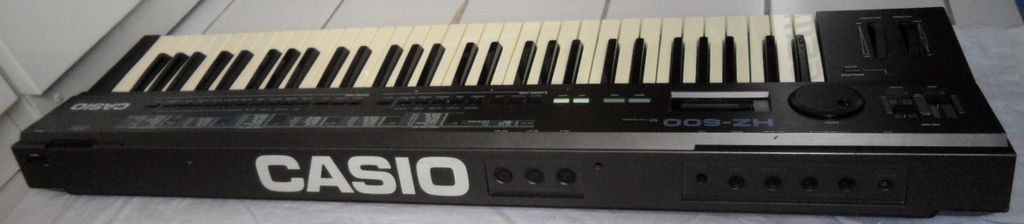
Technically it is a Casio HT-3000 without accompaniment (nor rhythm, only keysplit), no sequencer and no speakers. The main voice engine is the same like Hohner KS 49 midi with additional modulation wheel.
 |
 |
 |
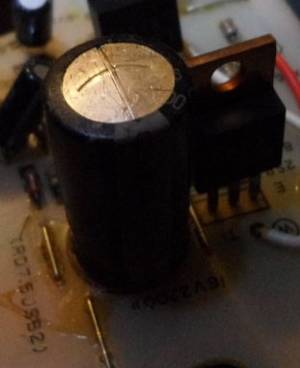
polarity protection diode added, power supply jack polarity corrected.
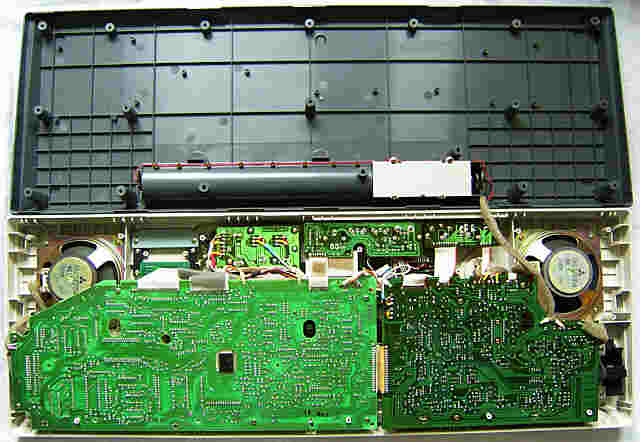
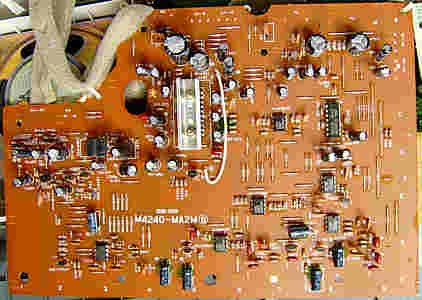
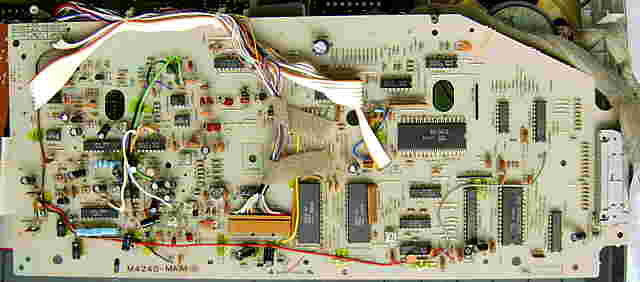
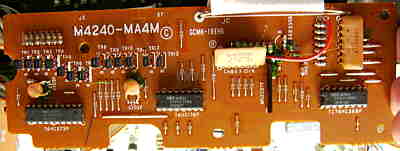
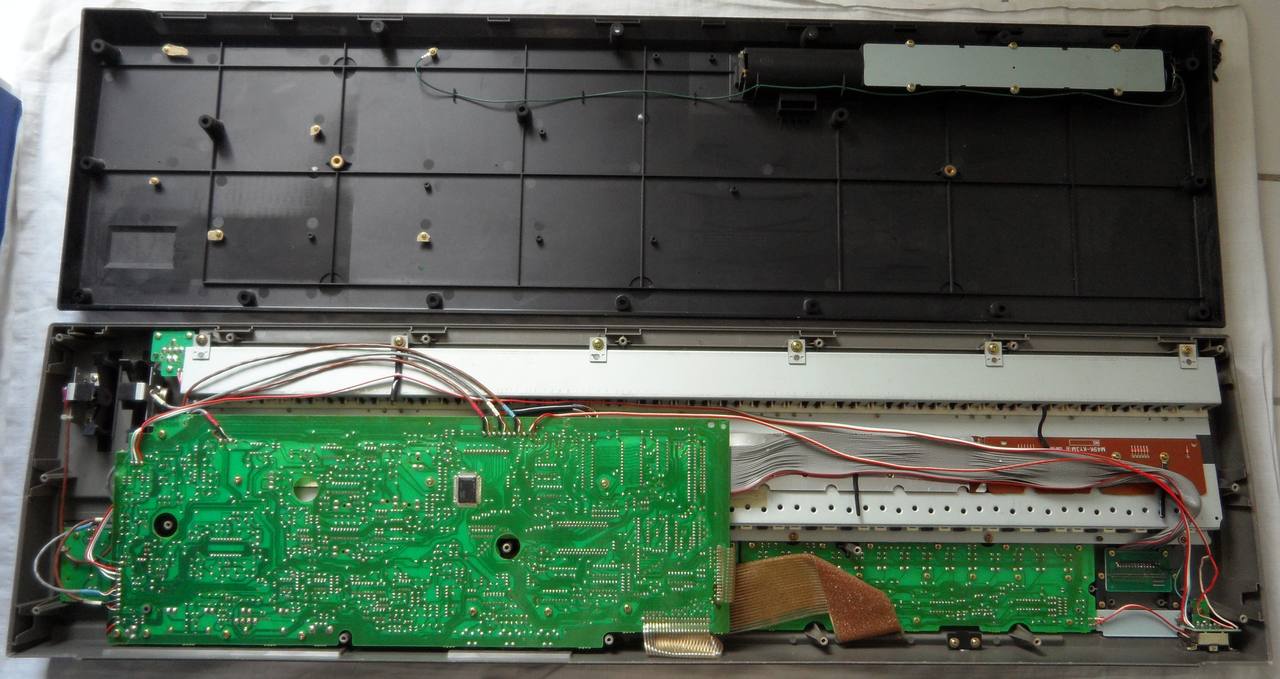
hardware detailsThe Casio HZ-600 is the most basic synth of the HT-3000 hardware family. The complex multi-chip hardware is built around the CPU NEC D78C10G that controls the SD sound IC NEC D935G but there is neither chord nor percussion, but only keysplit. The melody voice of upper and lower keys is routed from the sound IC through each a VCF JRC 2090D, followed by the stereo chorus. The sound ic also controls the LCD.
keyboard matrixThe matrix has the same layout like HT-3000, but lacks all rhythm and accompaniment related features. They are unlikely to exist as eastereggs because the ROM contents is much smaller. Also some preset sounds differ.I haven't analyzed this matrix by myself. This is based on the Casio
HZ-600 service manual.
The input lines are active-low, i.e. react on GND. Any functions can
be triggered by a non- locking switch in series to a diode from one "in"
to one "out" pin.
|
The flagship of the HT-series was the Casio
HT-6000 (61 fullsize keys, aka Hohner KS 610/TR as a light
grey variant), which had a more versatile synthesis engine (64 waveforms,
4 detuneable suboscillators per sound, different velocity curves, ring
modulator, separate VCA per channel etc.), which is a quite serious synth
and does not sound squarewave-like.
| removal of these screws voids warranty... | ||
 |
 |
|
|
|